Learn · Boilermaking
Repair vs Alteration Under the NBIC
Part of Boilermaker and the Code · step 17 of 22 · next: Who Signs Off Your Work
In learning paths: Boilermaker and the Code
Assumes you know: The NBIC and the R Certificate of Authorization
The NBIC names two distinct activities, repair and alteration, and the word that gets attached to your job decides the engineering, the documentation and the inspection it carries. Same crew, same welding, same vessel: one word, and the weight of paperwork behind the job changes completely.
*Learn the Trades is a free study resource. We are not a licensing body, an authorized training provider, or an exam administrator. Reading this page does not award any card, license, or certification. Always verify requirements with the issuing authority linked in the sources.*Why it matters on the job
At apprentice level this is background. At foreman level it is your problem, because you are the one being asked how long the job will take and what it needs, and those answers change depending on which activity it is. Calling an alteration a repair is the classic way for a repair organization to lose its certificate, and it usually happens through optimism rather than dishonesty: someone wanted the job to be simpler than it was.
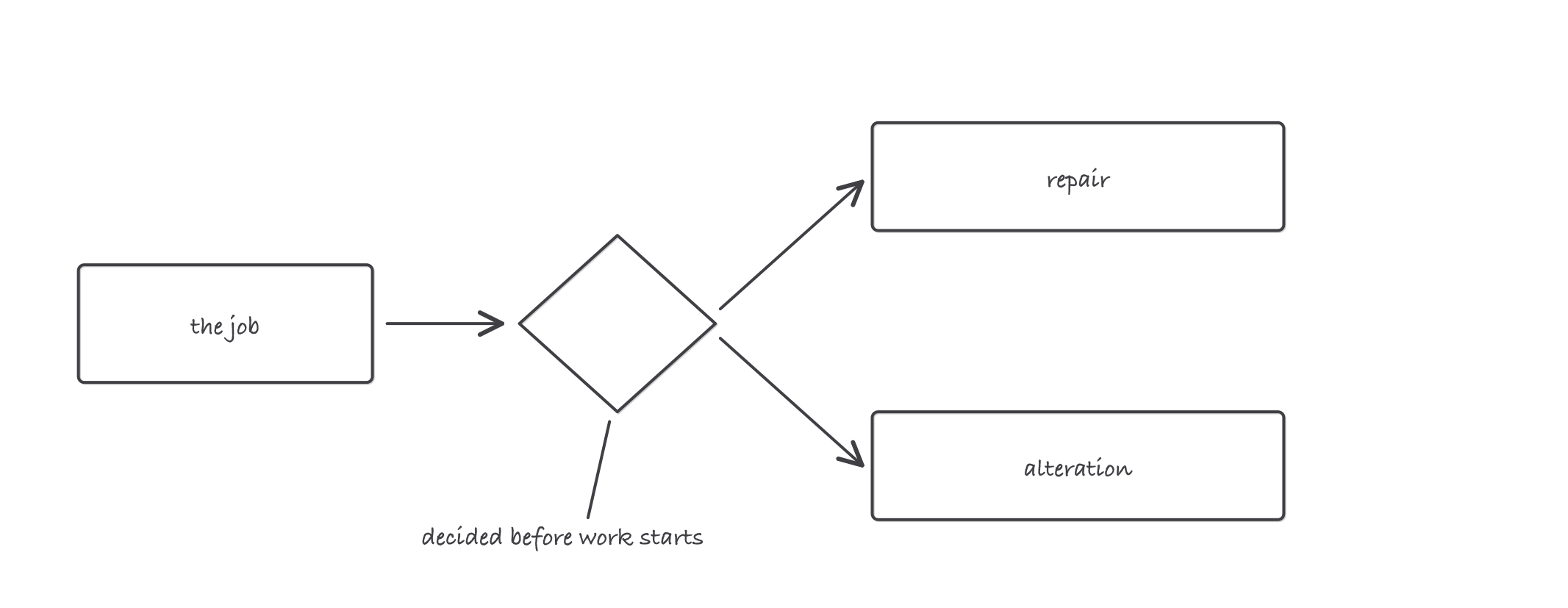
The classification happens at the front of the job, and it sends the work down one route or the other
Where the definitions live
The controlling definitions of repair and alteration are stated in NBIC Part 3, Repairs and Alterations. Part 3 is a purchased document, and this page does not paraphrase it.
The line between the two activities is the exact thing people get wrong, and a plausible-sounding summary passed along by a coworker is how the wrong classification enters a job. The classification always matters, and the answer comes from the code text and from the people whose job is to apply it.
Who actually decides, and when
The classification is settled at the front of the job, not discovered halfway through it. Two parties settle it together:
- The certificate holder’s quality system. A repair organization’s written quality system sets out how work is evaluated, planned and documented before it starts, and classification is part of that evaluation.
- The Authorized Inspector. The organization holds an inspection agreement with an Authorized Inspection Agency precisely so an inspector independent of the shop is involved, and their acceptance is part of the process rather than a formality at the end.
Nobody on the tools makes this call, and nobody makes it mid-shift because the job turned out bigger than the scope said. When a job grows past its scope, the correct move is to stop and get it reclassified.
One certificate, two routes
The R Certificate of Authorization covers the repair and alteration of pressure-retaining items. The distinction is not about whether the shop is allowed to do the work.
What differs is what the work requires. The two activities carry different engineering, documentation and inspection requirements, and which requirements attach to which activity is set out in Part 3. So a shop that misclassifies a job is not doing work it lacks authority for. It is doing authorized work through the wrong process, generating the wrong records, and involving the inspector at the wrong points. That is a quality system failure, and the quality system is the thing the certificate is issued against.
Where it bites
- Reclassifying mid-job is a real outcome, not a defeat. Scope grows on outage work constantly. Stopping to reclassify costs a day; finishing an alteration on repair paperwork can cost the certificate.
- “It’s only a tube” is not a classification. The size of the physical job and its classification under Part 3 are different questions with different answers, and the small one is not automatically the simple one.
- The original construction code does not settle it either. Whether the boiler was built to Section I or the vessel to Section VIII tells you nothing about how in-service work on it is classified. That question belongs entirely to the NBIC.
- Watch for definitions quoted without a source. Trade forums are full of confident one-line definitions of alteration. Part 3 is where the definition lives. It is worth what it costs, and every shop doing this work has a copy.
Verified requirements
| Where | Expires | Renewal | Continuing education |
|---|---|---|---|
| United States (federal) | Yes | 3 years | Confirm with issuer |
Information comes from issuing-authority sources. Confirm current rules, fees and eligibility with the authority before acting.