Learn · Boilermaking
The ASME BPVC Sections
Part of Boilermaker and the Code · step 12 of 22 · next: Section I: Power Boilers
In learning paths: Boilermaker and the Code
Assumes you know: Boilers and Pressure Vessels
The ASME Boiler and Pressure Vessel Code is not one book. It is a shelf of numbered sections, and the section that governs your work is decided by the equipment in front of you, not by your job title and not by who employs you. Learn the map first and every drawing, procedure and inspection record you are handed for the rest of your career will tell you where it sits.
Why it matters on the job
You will hear the sections used as shorthand from your first week: “that’s a Section I job,” “that vessel is a U,” “he’s qualified under Nine.” The drawings reference a section, the welding procedure references a section, and the inspector’s paperwork references a section. Reach for the wrong one and you are reading rules written for different equipment.
Four sections cover most boilermaking work
Section I carries the official title Rules for Construction of Power Boilers. This is the section most boilermakers spend a career under: the drums, headers, tubes and piping of steam plant.
Section IV covers heating boilers, the lower-duty equipment that heats buildings rather than driving turbines.
Section VIII covers pressure vessels, and it is subdivided into Divisions 1, 2 and 3.
Section IX carries the official title Welding, Brazing, and Fusing Qualifications. It sits on a different axis from the other three. Section IX does not govern a class of equipment at all; it governs how welding gets qualified for the equipment the other sections cover.
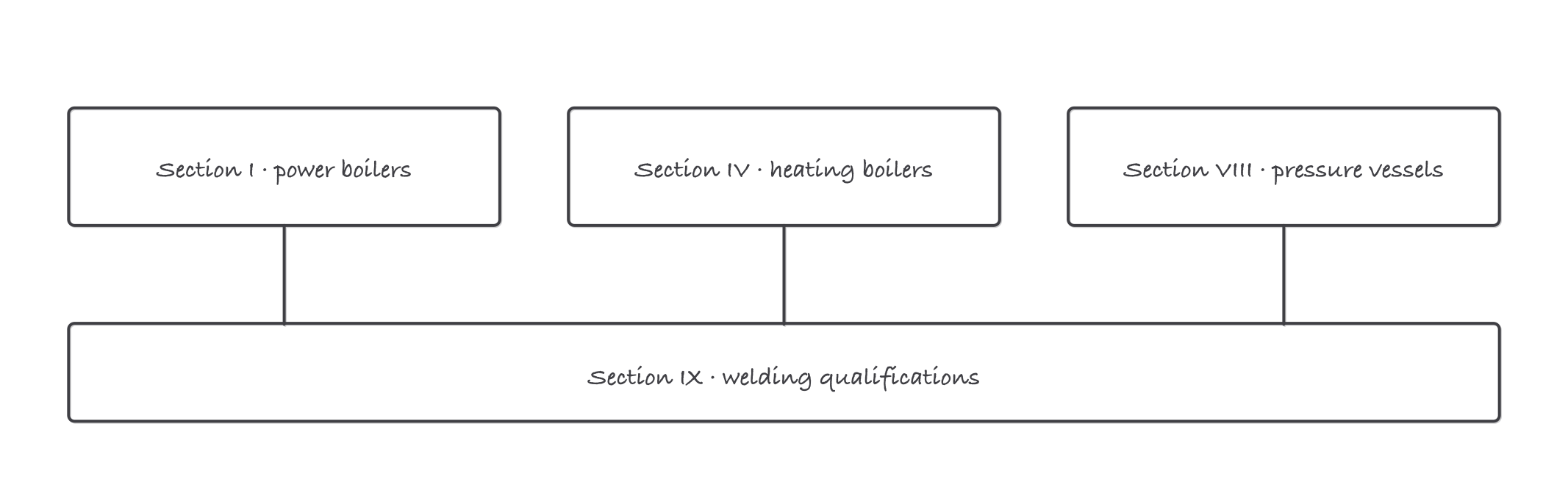
Three sections divide the equipment; Section IX runs underneath all of them
The designator letters are the free map
ASME’s boiler and pressure vessel certification pages publish a table of designator letters, and that table shows how the sections divide up. Each letter marks a scope of certified work tied to a section:
- S, A, E, M and PP sit under Section I power boiler work.
- H and HLW sit under Section IV heating boilers.
- U, UM, U2 and U3 sit under Section VIII pressure vessels.
- V, HV, UV and UD cover pressure relief devices.
What each individual letter scopes is set out in that table, and that is where to check. The pattern worth carrying is that a letter tells you what a shop is certified to build, not how good it is.
Construction code, then in-service code
The BPVC governs construction. It tells you how equipment is built in the first place. Once that equipment is installed and running, a different document takes over: the National Board Inspection Code (NBIC) governs installation, inspection, repair and alteration for equipment already in service.
That handover explains a sentence that confuses new hands. A code repair on a twenty-year-old boiler is not “built to Section I again.” It is performed under the NBIC, by a shop certified for repair work, with the original construction code as background rather than as the governing rules.
Reading a shop’s scope
A fabrication shop holds certificates for S and U. Read that the way the table reads it: the shop is certified for Section I power boiler work and for Section VIII pressure vessel work. It carries nothing under Section IV, so heating boiler construction goes to a shop whose scope includes it. Nothing there is a comment on the welders. It is a statement about which rules the shop’s quality system has been reviewed against.
Where it bites
- The equipment picks the section, every time. A boilermaker doing an outage on a power boiler one month and a vessel the next has moved between sections without changing trades.
- Section IX is not a fifth kind of equipment. Treating it as one is how apprentices misread the shelf. It answers “is this welding qualified?” and never “what is this thing?”
- Letters are scope, not rank. A shop with a U and no S is differently scoped, not less capable. People see letters and imagine levels.
- The code itself is a purchased document. ASME’s free web pages carry section titles and the designator table, and very little else. Anyone quoting you a scope threshold, a thickness or a pressure limit from memory is reciting something they have not checked. The section text is the only place those numbers exist.