Learn · Boilermaking
Who Signs Off Your Work
Part of Boilermaker and the Code · step 18 of 22 · next: The Boilermaker Apprenticeship (BNAP)
In learning paths: Boilermaker and the Code
Assumes you know: The NBIC and the R Certificate of Authorization
The person who turns your finished welding into code work does not work for your employer, and that is the entire point of them. Pressure work is accepted by an inspector who is independent of the organization doing the job, and until that acceptance happens the weld is metal rather than code work.
*Learn the Trades is a free study resource. We are not a licensing body, an authorized training provider, or an exam administrator. Reading this page does not award any card, license, or certification. Always verify requirements with the issuing authority linked in the sources.*Why it matters on the job
You will spend more of your career waiting for an inspector than you expect, and the crews who handle that well are the ones who understand what the inspector is there to do. They know which stages need acceptance before they can be covered, they have the records ready, and they do not treat the visit as an interruption. The crews who handle it badly rework things.
One word, three credentials
“Inspector” gets used for at least three different people who hold three different credentials from two different bodies.
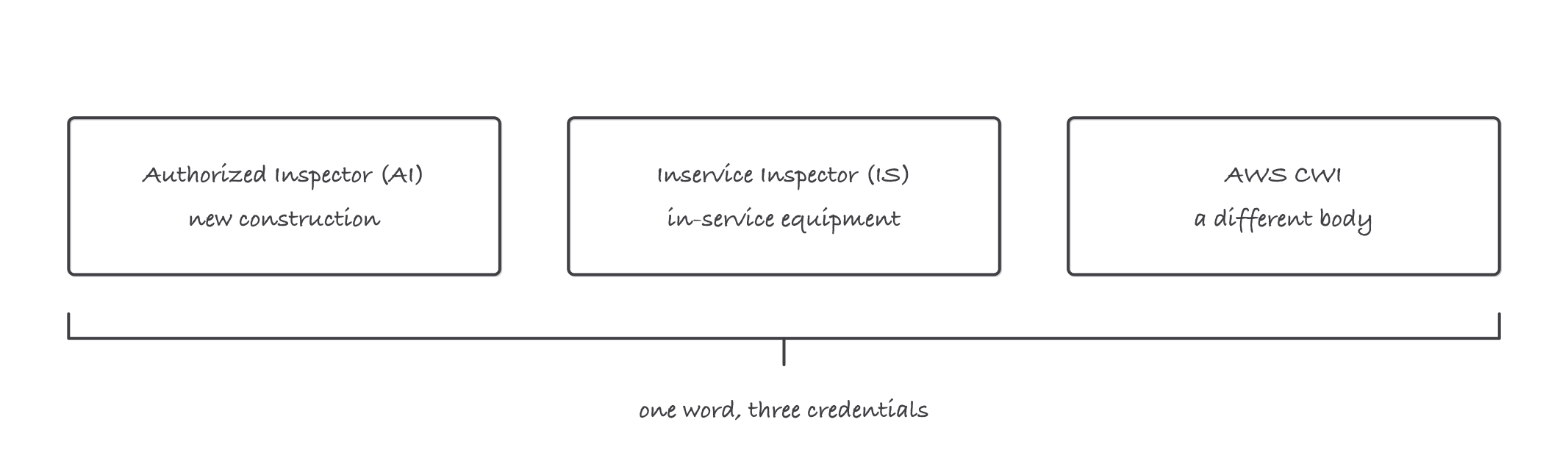
One word covering three credentials from two different bodies
Who employs them, and why it is not optional
A National Board commission is not a personal ticket someone carries between jobs. The holder must be employed as an inspector by one of a defined set of organizations:
- a jurisdiction, meaning the state or municipal authority that regulates boilers and vessels there
- an Authorized Inspection Agency
- an Owner-User Inspection Organization
- a Non-member Enforcement Agency
- a Federal Inspection Agency
- the National Board itself
The employment relationship is a precondition of holding the commission rather than a consequence of getting it. That structure is what makes the inspector independent of your shop: their pay, their instructions and their professional standing all come from somewhere else.
Where the AIA fits
ASME runs a separate accreditation program for Authorized Inspection Agencies, the organizations whose inspectors inspect ASME Certificate Holders. Accreditation covers the inspecting organization; certification covers the fabricating organization. They are deliberately different programs.
This is why the inspection agreement matters so much to a shop. A repair organization holds an agreement with an AIA, which is how a commissioned inspector is available to its work in the first place. The inspector who arrives on a code job is arriving under a standing relationship, not being summoned.
What acceptance actually covers
An inspector accepts work against records, not against impressions. What is in front of them, in some combination depending on the job, includes the welding procedure the work was done to, the qualification records for the people who did it, the material documentation, the results of any nondestructive examination, and the pressure test. The weld is one input among several.
Records are not administration wrapped around the real work; they are the form in which the real work becomes acceptable.
Where it bites
- The inspector does not work for you, and cannot be leaned on. Independence is the mechanism, so pressure applied to an inspector is a serious matter rather than a negotiation.
- AI and IS are not seniority levels. They are different scopes, one for new construction and one for in-service work, and a career can run through either or both.
- A CWI is not a substitute for a commissioned inspector on code work. Nor is a commissioned inspector a substitute for a CWI where a CWI is what the contract specifies.
- Cover nothing that has not been accepted. Insulation, cladding and refractory over unaccepted work turn a half-hour hold into a day of removal.
Verified requirements
| Where | Expires | Renewal | Continuing education |
|---|---|---|---|
| United States (federal) | Yes | Confirm with issuer | Confirm with issuer |
| United States (federal) | Yes | Confirm with issuer | Confirm with issuer |
| United States (federal) | Yes | Confirm with issuer | Confirm with issuer |
Information comes from issuing-authority sources. Confirm current rules, fees and eligibility with the authority before acting.