Learn · Boilermaking
WPS, PQR and WPQ
Part of Boilermaker and the Code · step 6 of 22 · next: Section IX vs AWS D1.1
In learning paths: Boilermaker and the Code
Assumes you know: ASME Welding Qualifications for Boiler Work
Three documents sit behind every code weld, and they answer three different questions. The WPS says what to do. The PQR says why we believe that works. The WPQ says who is allowed to do it. Learn which question each one answers and the confusion stops.
*Learn the Trades is a free study resource. We are not a licensing body, an authorized training provider, or an exam administrator. Reading this page does not award any card, license, or certification. Always verify requirements with the issuing authority linked in the sources.*Why it matters on the job
Every argument on a pressure job about whether a weld is acceptable ends up at one of these three pieces of paper. Being the person who can say “show me the WPS, and the PQR behind it” changes how a quality manager talks to you, and it is the difference between a journeyman who welds and a journeyman who can be handed a job packet.
WPS: the written instructions
A welding procedure specification is the instruction sheet for making a particular weld. It names the process, the material it applies to, the filler, the joint arrangement, the position, the electrical characteristics, the preheat and interpass handling, and the technique. It is written to be followed at the bench, by anyone qualified to it.
Treat it as a recipe. It does not prove anything on its own; it tells you what to do.
PQR: the evidence behind it
A procedure qualification record is the record of what actually happened when the employer welded a test assembly to that procedure and had it tested. It captures the values used during the test and the results of the mechanical testing that followed.
The PQR is history, not instruction. Nobody welds to a PQR. It exists so that the WPS is not an opinion, and a WPS with no PQR supporting it is a document with nothing underneath it.
WPQ: the person
A welder performance qualification record says that a named person welded a coupon in accordance with a qualified procedure and the coupon passed. It is about demonstrated ability, not about the design of the weld.
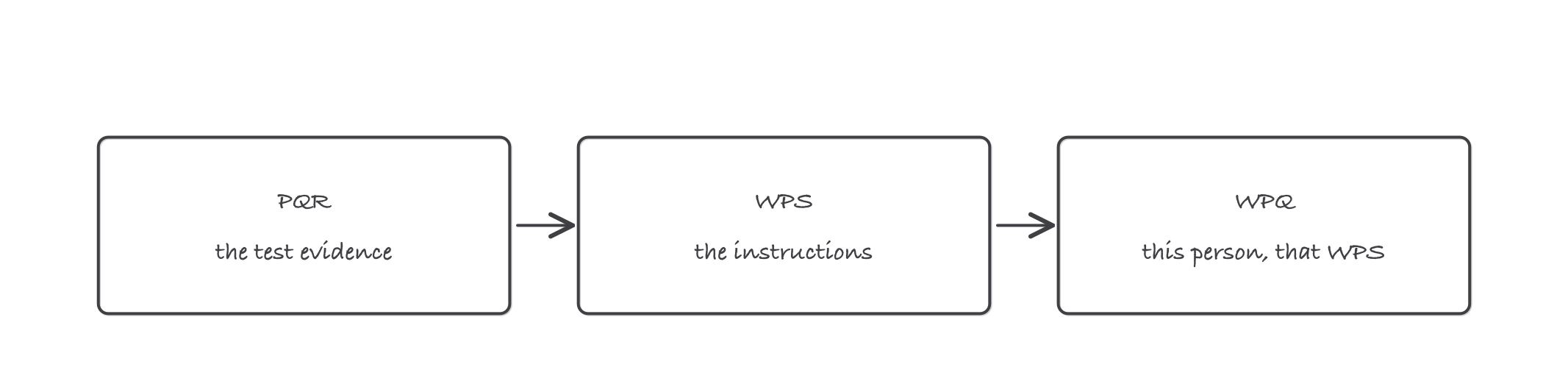
Evidence supports the procedure, the procedure defines the qualification, and the qualification names the person
The order they come into existence
The sequence surprises people, because the document you use every day is created in the middle.
- The employer drafts a WPS, a proposed way of making the weld.
- The employer welds and tests a qualification assembly to that draft.
- The results become the PQR.
- The WPS is issued in final form, supported by that PQR. Now it can be used on production work.
- Welders are tested to the issued WPS, and each result is recorded as a WPQ.
So the arrow of proof runs from the PQR up to the WPS, while the arrow of use runs from the WPS out to the welder.
Worked example: reading a job packet
You are handed a folder before a shutdown weld and asked to confirm you can do the work. Three checks, in this order.
- Find the WPS for the joint in front of you. Does it cover this base material, this thickness range, this process and this position? If the joint on the drawing is not inside what the WPS covers, the packet is wrong and no amount of skill fixes that.
- Find the PQR the WPS references. A WPS should point at the record that supports it. If nobody can produce the PQR, the WPS is unsupported and the question goes to the quality manager, not to you.
- Find your WPQ against that WPS. Your name, that procedure, still current. If your qualification is to a different procedure, you are not qualified for this joint, however similar the two look.
Three documents, three questions, five minutes. Doing this before the scaffold goes up is the habit that separates people who get called back for outage work from people who do not.
Where it bites
- “I’m qualified” is meaningless without naming a procedure. Qualification is always to something. The right sentence names the WPS.
- A revised WPS can invalidate what you were qualified on. Procedures get revised. When one changes, ask whether your qualification still covers the work rather than assuming it carries over.
- The PQR is not a template to weld from. Its values are what happened in one test, not the range you are allowed to work in. The WPS carries the range.
- None of the three travel with you. They belong to the employer’s quality system, which is why a new shop generally requalifies you even on identical work.
Exam relevance
For pressure work, the test that matters is a welded coupon judged against the code rather than a written paper. What examiners and quality managers do probe verbally is exactly the material above: which document says what, which one you weld to, and what you check before you start. Being able to say that the WPS instructs, the PQR supports and the WPQ names the person is a short answer that lands well and is genuinely useful the next morning.
Verified requirements
| Where | Expires | Renewal | Continuing education |
|---|---|---|---|
| United States (federal) | Yes | Confirm with issuer | Confirm with issuer |
Information comes from issuing-authority sources. Confirm current rules, fees and eligibility with the authority before acting.