Qualifications · Boilermaking
ASME Welding Qualifications for Boiler Work
Part of Boilermaker and the Code · step 3 of 22 · next: Code Repairs and R-Stamp Work
In learning paths: Boilermaker and the Code
Assumes you know: Boilers and Pressure Vessels
Welding qualification for pressure work is two separate events, and neither of them produces a card in your wallet. First an employer qualifies the welding procedure, proving that a particular combination of material, process, filler and technique makes a sound weld. Then the employer qualifies you against that procedure, proving you can execute it. Both records live in the employer’s quality system, and everything else follows from that.
*Learn the Trades is a free study resource. We are not a licensing body, an authorized training provider, or an exam administrator. Reading this page does not award any card, license, or certification. Always verify requirements with the issuing authority linked in the sources.*Why it matters on the job
On a code job, an unqualified weld in a pressure part is not a quality problem to be argued about later. It is scrap, or a cut-out and redo, with an inspector’s signature standing between the shop and the customer. Understanding whose paperwork you are welding under tells you which questions to ask on day one at a new shop, and stops you from claiming something in an interview that the shop’s quality manager will contradict in ten seconds.
Two events, in order
The procedure is qualified first. The employer writes down what it intends to do, welds a test assembly following it, and has that assembly destructively tested. The results are recorded as evidence. Until that evidence exists, there is nothing for a welder to be qualified to.
Then the person is qualified. You weld a test coupon in accordance with the qualified procedure, the coupon is tested, and the result is recorded against your name.
The order carries the meaning. A welder “qualified” with no procedure behind them is qualified to nothing, because there is no defined set of conditions their test result applies to.
Where the qualification lives
Section IX qualification is not portable the way a national certification is. The record belongs to the employer’s quality system, and moving to a new shop generally means qualifying again there, even on the same process and the same material.
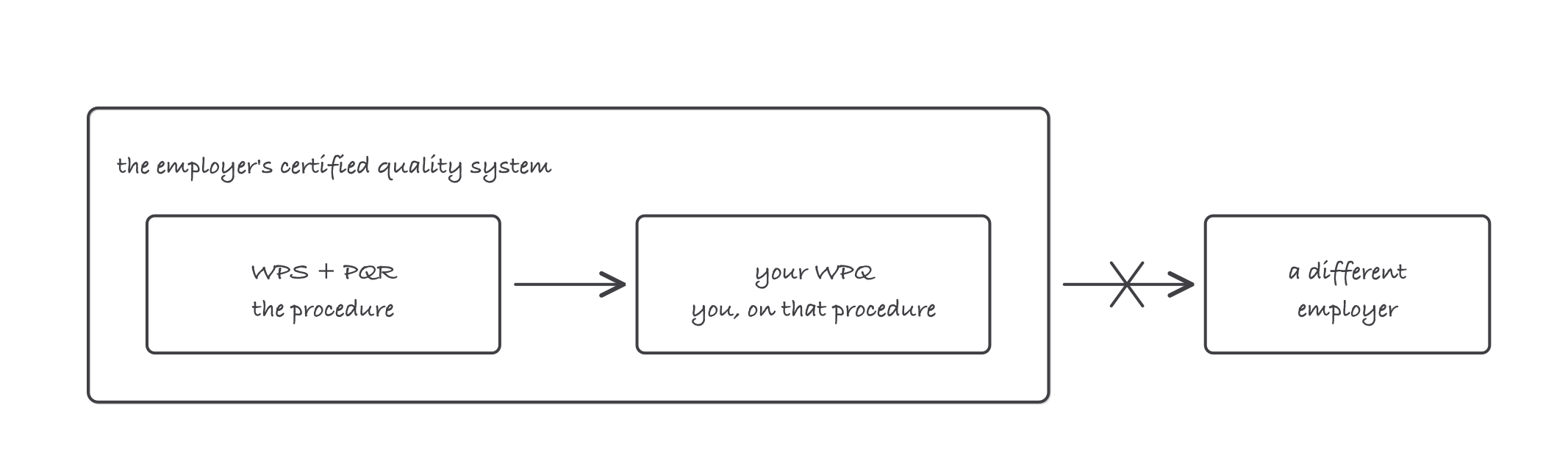
Both records live inside one employer’s system, which is why the qualification does not walk out the door with you
Welders arriving from structural work find this genuinely surprising, because AWS holds its Certified Welder records in a national registry precisely so that they do travel. Two different systems, built to answer two different questions.
What a qualification actually covers
A qualification is bounded. It says you can weld this process, on this kind of material, in this configuration, within limits, and the things that define those limits are called essential variables. Change one of them and the qualification no longer covers the work.
Which variables are essential, how wide each qualified range runs, and how long a qualification stays current without being used are all defined inside Section IX. Those numbers are in the purchased standard, and nobody should be carrying them around as trade folklore. When a range matters, the answer comes from the book and from your shop’s quality manager, in that order.
Worked example: a welder’s first month at a code shop
Follow the paperwork rather than the arc.
- The shop already holds its procedures. It has a set of welding procedure specifications, each supported by a procedure qualification record that shows the tested evidence. You do not write these and you do not own them.
- The quality manager picks the procedure you will be tested to, based on the work the shop actually has.
- You weld a test coupon in accordance with that procedure, under the shop’s control.
- The coupon is tested and the result is recorded as your welder performance qualification, filed in the shop’s records.
- You weld production within the range that record covers, and the shop tracks your continuity so the qualification stays current.
- You take a job at another shop. Your skill goes with you. The qualification generally does not, and the new employer runs step 3 again.
Where it bites
- The stamp is not the qualification. The certificate and the mark belong to the company; your Section IX record is the only part of this that is about you. Confusing the two in an interview marks you as someone who has not worked code.
- A structural qualification does not authorize pressure work. AWS D1.1 and ASME Section IX answer different questions under different codes, and the dedicated lesson in this trade works through why.
- “Certified welder” is loose talk in a pressure shop. Ask instead which procedures you are qualified to and who holds the records. That question identifies you as someone who has been around code work.
- Time away from a process can cost you the qualification. Nobody will tell you when it happens. Track your own dates rather than assuming the shop will.
Exam relevance
There is no written test to pass here in the sense that a licensing exam is written. Qualification is demonstrated by welding a test coupon under controlled conditions and having it examined, and the acceptance criteria come from Section IX rather than from an examiner’s judgment. What you can prepare is the part that fails people: consistent technique in the position you will be tested in, clean fit-up, and the discipline to follow the written procedure exactly rather than the way you have always done it.
Verified requirements
| Where | Expires | Renewal | Continuing education |
|---|---|---|---|
| United States (federal) | Yes | Confirm with issuer | Confirm with issuer |
Information comes from issuing-authority sources. Confirm current rules, fees and eligibility with the authority before acting.