Learn · Boilermaking
Watertube and Firetube Boilers
Part of Boilermaker and the Code · step 5 of 22 · next: WPS, PQR and WPQ
In learning paths: Boilermaker and the Code
Assumes you know: Boilers and Pressure Vessels
Every boiler you will ever work on belongs to one of two families, and the difference is a single question: is the water inside the tubes or outside them? In a firetube boiler the hot gas travels through the tubes and the water surrounds them. In a watertube boiler the water travels through the tubes and the fire surrounds them. Answer that question first and most of the rest of the machine follows.
Why it matters on the job
The family decides how you get at the work. On a firetube you open a head at one end and pull tubes out along the shell. On a watertube you go in through a drum manway and work down a bank from inside a confined space. It also decides how much water is sitting in front of you when something fails, which is the difference between a bad day and a fatal one.
Firetube: gas inside, water around
A firetube boiler is a cylindrical shell full of water with tubes running through it. Combustion happens in a large furnace tube low in the shell, and the flue gas is turned back through smaller tube banks (a pass) once, twice or three times before it reaches the stack. Heat crosses the tube wall into the water surrounding it.
The pressure boundary here is the shell itself, plus the tubesheets at each end and the tubes between them. Firetube units carry a large volume of water for their output, which makes them steady under swinging load and slow to come up to pressure. They generally sit at lower pressures and smaller outputs than watertube units, which is why you find them in laundries, hospitals, food plants and packaged boiler rooms rather than under a turbine.
Watertube: water inside, fire around
A watertube boiler turns the arrangement inside out. Water and steam circulate inside the tubes; the burner fires into a furnace box that the tube walls form the sides of. The classic layout has an upper steam drum and a lower mud drum joined by banks of tubes, with unheated downcomers carrying water down the cool side and heated risers carrying a steam and water mixture up the hot side.
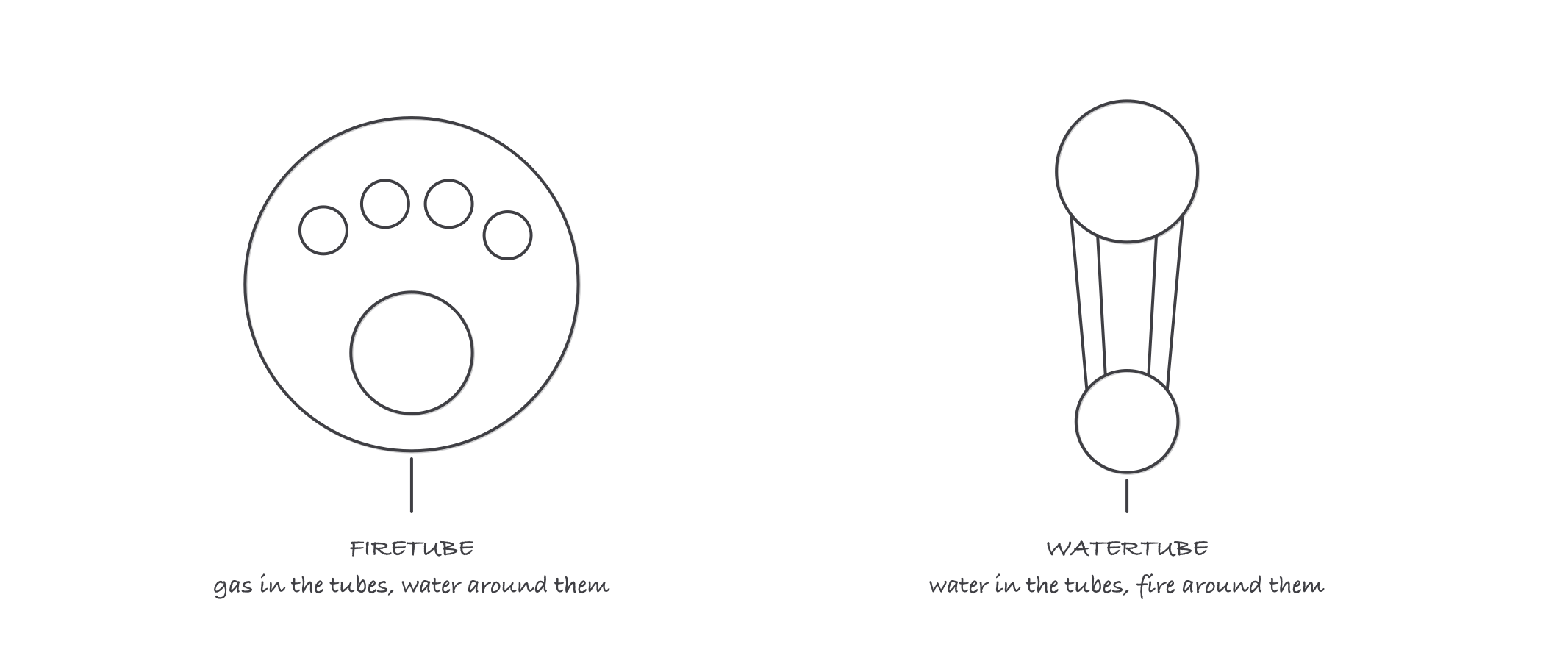
The same question answered two ways: gas in the tubes, or water in the tubes
Because the pressure is carried by many small-diameter tubes rather than one large shell, watertube designs go to far higher pressures and outputs. They hold less water for their capacity, so they raise steam quickly and respond fast, and they punish a loss of circulation as fast.
Drums, headers and what actually holds pressure
Three words show up on every watertube drawing:
- The steam drum is the upper vessel where steam separates from water. It is usually where you enter for tube work.
- The mud drum (also called the lower or water drum) sits at the bottom of the circuit and collects the solids that drop out of the water.
- A header is a length of heavy pipe or a box that many tubes land in, used where a full drum is not needed, typically at the ends of a waterwall.
All of those are pressure parts. The casing, the buckstays, the ductwork and the platform steel around them are not. That is the line to be sure of on a boiler job.
Worked example: follow one pound of water
Take a pound of water around a two-drum watertube boiler.
- It enters the steam drum through the feedwater line, mixing with the water already circulating.
- Gravity carries it down an unheated downcomer on the cool outside of the setting, because cold water is denser than the hot mixture on the other side.
- It turns into the mud drum at the bottom, then up into a heated riser tube facing the furnace.
- Heat boils part of it. Now the tube holds a steam and water mixture that is much lighter than the water in the downcomer, so it rises on its own. Nothing pumped it: the density difference did all the work, which is why this is called natural circulation.
- It arrives back in the steam drum, where the separators throw the water back down and let the dry steam leave through the outlet.
Now do the same trip on a firetube and notice how short it is. The water never goes anywhere. It sits in the shell and boils.
Where it bites
- The water volume is the hazard. A firetube’s large water inventory is stored energy at saturation temperature. Drop the pressure suddenly and that water flashes to steam. This is why firetube shell failures are historically so destructive, and why nobody hurries a cool-down.
- Pass count is not tube count. A “three-pass” firetube describes how many times the gas changes direction through the boiler, not how many tube banks you will be pulling. Read the drawing.
- Tube removal has a direction. Firetube tubes come out along the shell axis, so you need clear floor space the length of the boiler at one end. Watertube tubes usually come out through the drum. Plan the lay-down area before the outage, not on the morning of it.
- Waterwall tubes are the furnace wall. On a modern watertube unit the membrane wall is both the pressure boundary and the furnace enclosure. There is no separate firebox behind it to fall back on.