Learn · Boilermaking
Code Repairs and R-Stamp Work
Part of Boilermaker and the Code · step 4 of 22 · next: Watertube and Firetube Boilers
In learning paths: Boilermaker and the Code
Assumes you know: ASME Welding Qualifications for Boiler Work
The day a boiler goes into service, the code that governs it changes. It was built under the ASME Boiler and Pressure Vessel Code, which is a construction code. From the moment it is installed and operating, installation, inspection, repair and alteration run under the National Board Inspection Code (NBIC). A repair is not “built to Section I again,” and running a crew on a code repair means running it under a different book than the one the equipment was made to.
*Learn the Trades is a free study resource. We are not a licensing body, an authorized training provider, or an exam administrator. Reading this page does not award any card, license, or certification. Always verify requirements with the issuing authority linked in the sources.*Why it matters on the job
Foremen get caught by this line more than welders do. The crew can be flawless, the welds can be perfect, and the job can still be rejected because the work was scoped, documented or inspected as the wrong kind of activity. On in-service equipment the paperwork is part of the product, and the shop’s certificate is what makes the paperwork mean anything.
Two codes, one piece of equipment
ASME BPVC governs construction. It tells a manufacturer how to design, build, examine and test new equipment, and an ASME Certificate Holder applies the Certification Mark when it is done.
The NBIC governs everything after that. First published in 1946, it is adopted into law across most United States and Canadian jurisdictions, and it is issued in odd-year editions. It has four parts:
- Part 1, Installation
- Part 2, Inspection
- Part 3, Repairs and Alterations
- Part 4, Pressure Relief Devices
Part 3 is where a repair crew spends its time.
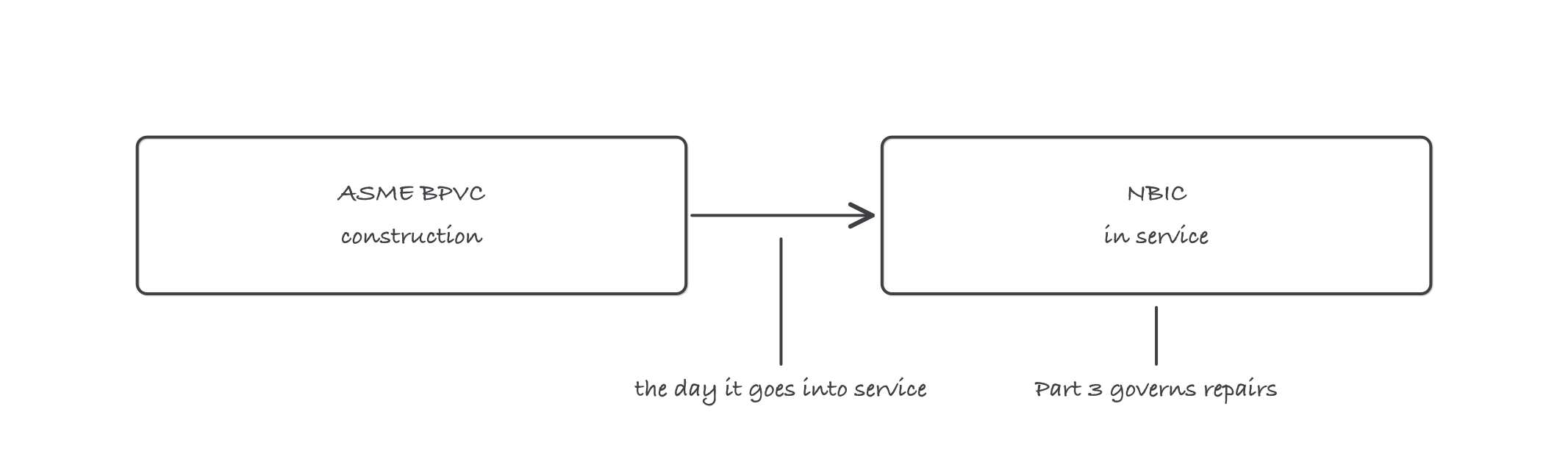
One vessel, two codes: construction hands over to the in-service code on the day it starts working
Repair is not the same word as alteration
Under the NBIC, a repair and an alteration are two named and distinct activities, and they carry different engineering, documentation and inspection consequences. The formal definitions live inside NBIC Part 3, a purchased document, so treat any secondhand definition with suspicion and read the book your shop holds.
What matters at crew level is the consequence. Misclassifying an alteration as a repair costs shops their certificates, because the work then bypasses the design review and the inspection steps the code attaches to an alteration. If the change touches the design, the rating, or anything that would have needed the original designer’s involvement, stop and get it classified before anybody strikes an arc. There is a dedicated lesson in this trade on the distinction.
What a code repair actually requires
Five things have to be true before the work is legitimate, and none of them are about welding skill:
- An organization with the right certificate holds the job. For repairs and alterations to pressure-retaining items, that is a National Board R Certificate.
- The organization’s written quality system covers this work. The certificate is issued against that system, and work outside it is not covered by it.
- There is an inspection agreement with an Authorized Inspection Agency, so an inspector is contractually in the loop before the job starts rather than after.
- The welding runs to a qualified procedure, welded by people the organization has qualified, exactly as on new construction.
- The work is documented and the report form is completed and handled the way the code and the jurisdiction require.
Take any one away and you do not have a code repair. You have a weld.
Worked example: a leaking waterwall panel
A utility unit comes down and a section of furnace waterwall is leaking at a tube. Walk the job as a foreman.
- Establish what the equipment is and what governs it. It is a power boiler built under Section I, now in service, so the repair runs under NBIC Part 3.
- Classify the work. Replacing a section of tube like for like, with the same material and the same design, is a repair. If the plant wants a different alloy, a different thickness or a modified arrangement, stop: that conversation is about an alteration and it goes to the engineering route before it goes to the crew.
- Confirm your shop’s certificate covers it, and that the inspector under the inspection agreement knows the job exists.
- Pull the right procedure. The welding procedure specification for that material and joint, with welders qualified to it on file.
- Agree the hold points with the inspector before the scaffold goes up, not after the fit-up is done. This is the step crews skip and the step that costs the most when skipped.
- Do the work, examine it as the procedure requires, and pressure test as required.
- Complete the documentation so the report reflects what was actually done, and hand it over.
Notice that steps 1 to 3 and 5 happen before anybody welds. On code repair work, most of a foreman’s value lands before the arc is struck.
Where it bites
- Nobody holds an R stamp personally. It is an organizational certificate with a written quality system and an inspection agreement behind it. Correcting the habit in yourself is worth more than it sounds.
- The certificate does not travel with the crew. Working under a shop’s R Certificate for ten years gives you experience and gives you nothing to take to a shop that does not hold one.
- Your jurisdiction pins the edition. The NBIC comes out in odd years, and the current book on the shelf is not always the enforceable one.
- “We always do it this way” is not a procedure. On in-service pressure work, the written procedure and the classification of the activity are the job. Everything else is execution.
Verified requirements
| Where | Expires | Renewal | Continuing education |
|---|---|---|---|
| United States (federal) | Yes | Confirm with issuer | Confirm with issuer |
| United States (federal) | Yes | 3 years | Confirm with issuer |
Information comes from issuing-authority sources. Confirm current rules, fees and eligibility with the authority before acting.