Learn · Boilermaking
Section VIII: Pressure Vessels
Part of Boilermaker and the Code · step 14 of 22 · next: The ASME Certification Mark and Its Designators
In learning paths: Boilermaker and the Code
Assumes you know: The ASME BPVC Sections
Section VIII of the ASME Boiler and Pressure Vessel Code governs pressure vessels, and it is split into three divisions. A boilermaker who has only worked power boilers meets Section VIII the first time a job takes them to a refinery, a chemical plant or a tank farm, and the paperwork looks familiar until the section number on the drawing changes.
*Learn the Trades is a free study resource. We are not a licensing body, an authorized training provider, or an exam administrator. Reading this page does not award any card, license, or certification. Always verify requirements with the issuing authority linked in the sources.*Why it matters on the job
The same skills build both. The same rigging, the same fit-up, often the same welders. What changes is the body of rules the work is measured against, and therefore which procedure is valid, which certificate the shop needs, and what the inspector is looking for. Turning up to a Section VIII job with a Section I mental model will not make you wrong about the metal. It will make you wrong about the paperwork.
Where vessels part company from boilers
Section I is titled for power boilers; Section VIII is titled for pressure vessels. In practice, steam-raising plant sits under Section I and equipment whose job is to contain pressure sits under Section VIII. Section IV, meanwhile, takes the heating boilers.
Where exactly the line falls for an awkward piece of equipment is settled in the code text and confirmed by the Authorized Inspector on the job. It is not settled on the shop floor by argument, and it is not settled by what the item looks like. The point to carry is the one that runs through the whole code: the equipment decides which section governs, not your trade and not your employer.
Three divisions, one class of equipment
Section VIII contains Divisions 1, 2 and 3. Three divisions means three alternative sets of construction rules covering pressure vessels, not three grades of quality and not three levels of difficulty.
Which division a given vessel is built to is an engineering decision, and it is made before anyone cuts plate. What reaches the shop floor is the answer rather than the reasoning: the drawings, the material list and the welding procedure all arrive already committed to a division, and your job is to work to what they say.
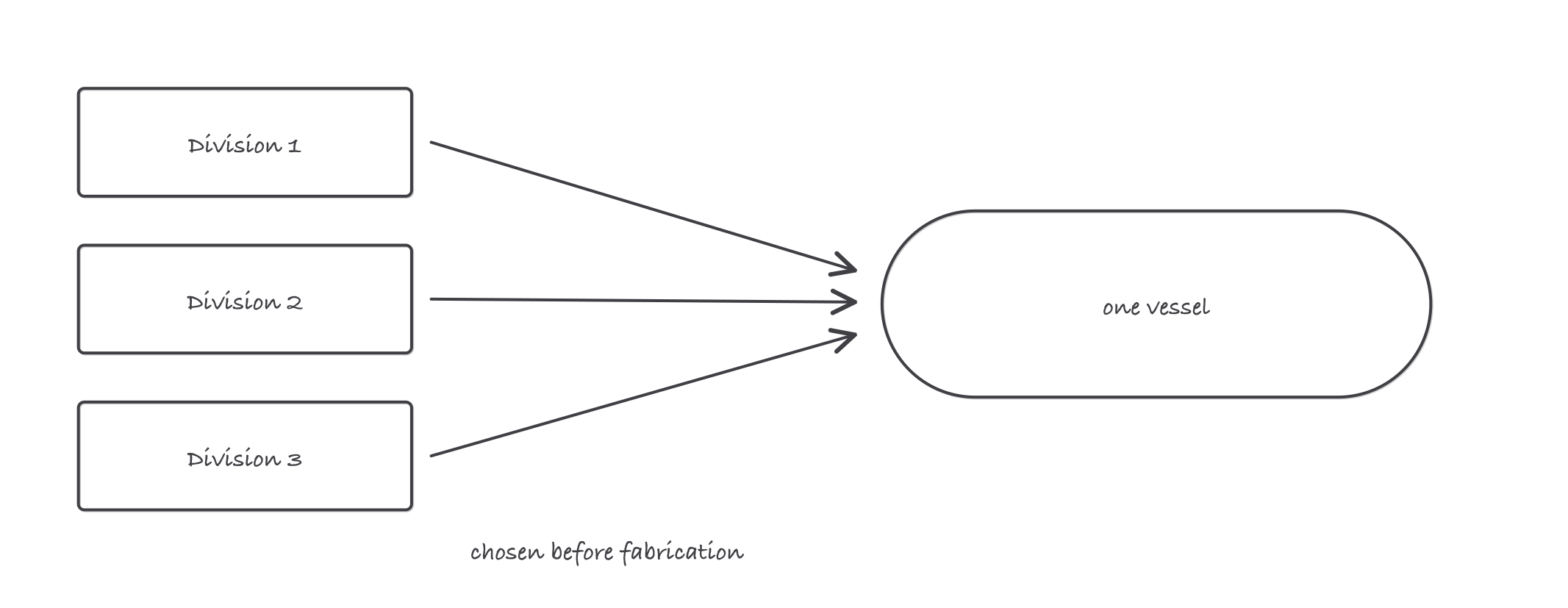
Three alternative rule sets, one finished vessel, and the choice already made upstream of the shop
The criteria that separate the divisions are stated inside Section VIII itself, which is a purchased standard. ASME’s free web pages carry section titles and the certification designator table, and nothing that would let anyone summarize the dividing lines honestly. If a page or a coworker tells you the divisions split at a particular pressure or a particular thickness, ask where they read it, because it is not on any page that is free to read.
The Section VIII designators
Four designator letters sit under Section VIII in ASME’s certification table: U, UM, U2 and U3. They mark the scope of work an organization’s certificate covers.
Read them as scope and never as rank. A shop holding U is not a junior version of a shop holding U2; it holds a certificate reviewed against a different scope of work. The table on ASME’s certification pages is the place to check what a particular letter covers, and reading it there takes less time than guessing wrong once.
Where the U certificate fits
Where it bites
- Divisions are alternatives, not levels. The number after the U is a pointer to a body of rules, and treating it as a rank is the fastest way to insult a shop that is scoped exactly right for the work.
- A Section I qualification does not make you a Section VIII hand on paper. The metalwork transfers; the documentation does not follow you across on its own, because it belongs to an employer’s quality system rather than to you.
- The construction code stops at the door. Once a vessel is in service, the National Board Inspection Code governs its inspection, repair and alteration, exactly as it does for a boiler.
- Free sources have a ceiling here, and it is low. For Section VIII, the honest answer to most detailed questions is that the answer is inside the purchased section. Saying so is better trade practice than repeating a figure that sounded right.