Learn · Boilermaking
Tube Rolling and Replacement
Part of Boilermaker and the Code · step 2 of 22 · next: ASME Welding Qualifications for Boiler Work
In learning paths: Boilermaker and the Code
Assumes you know: Boilers and Pressure Vessels
A boiler tube is not a pipe, and the joint that holds it in is usually not a weld. Tube is specified by outside diameter and wall thickness; pipe is specified by nominal size and schedule. Tube carries heat transfer duty inside the boiler; pipe carries fluid between things. Most boiler tubes are held in a drum or a tubesheet by being expanded into the hole, a cold mechanical process with no arc anywhere near it.
Why it matters on the job
Tube replacement is the bread and butter of this trade. Outage after outage, the work is the same shape: find the failed tubes, get the old ones out without wrecking the seat, get new ones in, roll them, test. The union apprenticeship lists tube rolling as its own skill alongside welding for exactly that reason. A journeyman who cannot roll a tight joint is not much use in a drum.
How an expanded joint holds
The tube is made slightly smaller than the hole so it will go in. A tube expander goes down the bore: a cage of tapered rolls around a tapered mandrel. As the mandrel is driven in and turned, the rolls press outward and travel around the inside of the tube, working the tube wall out against the hole.
Two things happen in that operation, in order:
- The clearance closes. The tube grows until its outside surface is hard against the wall of the hole. Nothing is holding yet.
- The wall thins. Keep rolling and the tube wall is squeezed thinner, so the tube metal is forced to stretch. The tubesheet around it springs back slightly and the tube does not. That residual grip is the joint.
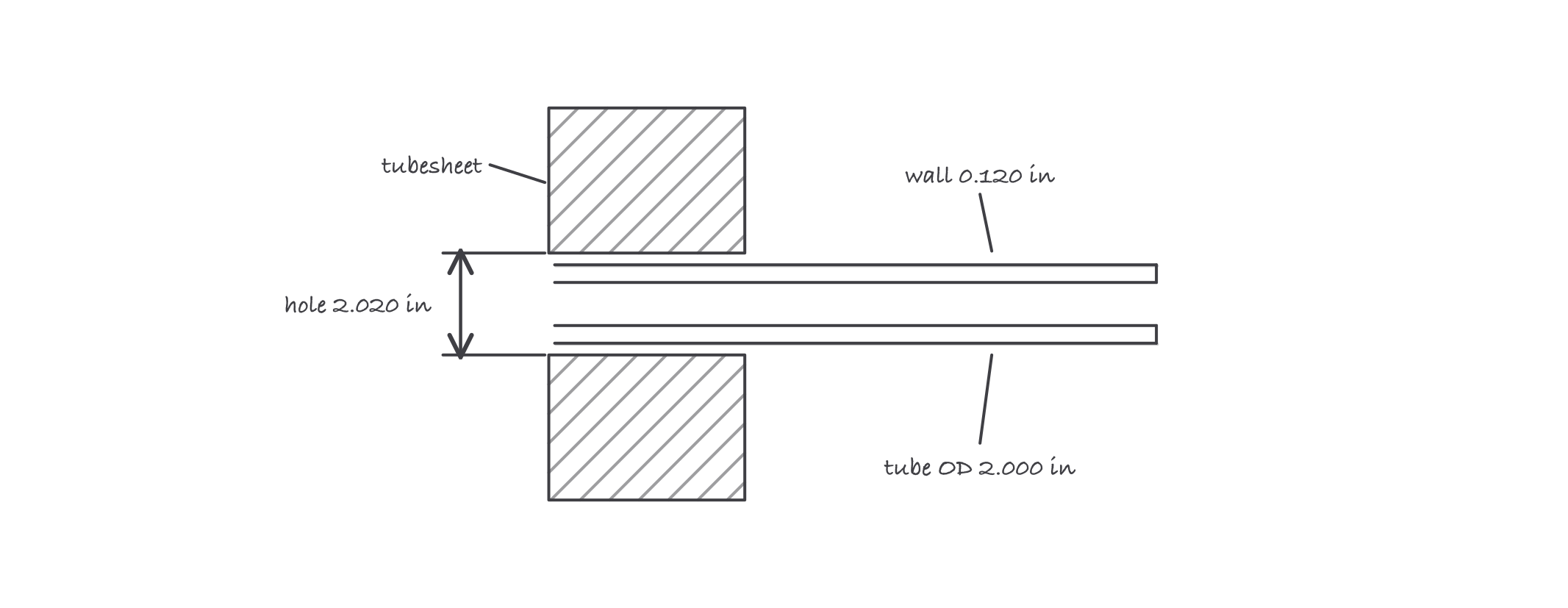
A rolled joint is dimensions, not welding: the clearance closes first, then the wall thins and grips
That second step is where the craft lives. Roll too little and the joint leaks. Roll too much and you have thinned and work hardened the tube, distorted the hole, and possibly pushed the ligament of tubesheet between two holes past what it will take. There is no fix for an over-rolled hole that a foreman enjoys hearing about.
How far to go comes off the procedure, not out of memory. The controlling number is the wall reduction your shop’s procedure calls for, and you hit it with a torque-controlled or gauge-controlled expander rather than by feel.
Some joints get welded too
An expanded joint can stand alone, be seal welded, or be both. The seal weld is a small bead at the face of the tubesheet, and its job is tightness, not strength. Which combination applies to the equipment in front of you is set by the original construction and by the repair procedure, and it changes what qualification the person doing the work needs.
Worked example: what the gauge should read
Take a 2.000 in outside diameter tube with a 0.120 in wall, going into a tubesheet hole drilled to 2.020 in. Suppose the rolling procedure for this job calls for 5 percent wall reduction. Your procedure’s number governs the real job; this one is here to do the arithmetic with.
- Tube bore as delivered. 2.000 minus twice the wall: 2.000 - (2 × 0.120) = 1.760 in.
- Bore at metal-to-metal contact. The tube outside is now the hole size and the wall has not yet thinned: 2.020 - (2 × 0.120) = 1.780 in. The expander has taken up 0.020 in of clearance and gripped nothing.
- Target wall after rolling. 5 percent of 0.120 in is 0.006 in per wall, so the finished wall is 0.120 - 0.006 = 0.114 in.
- Finished bore. 2.020 - (2 × 0.114) = 1.792 in.
- What the gauge is looking for. The roll-in past contact is 1.792 - 1.780 = 0.012 in, which is twice the 0.006 in taken out of each wall.
Note how small the working window is. The difference between an under-rolled joint and an over-rolled one is a few thousandths of an inch on a bore gauge, which is why the setting on the expander matters more than the arm on the gun.
Getting the old tube out
Removal is where seats get ruined. The sequence that protects the hole is always the same: relieve the tube first, then move it.
- Cut the tube back inside the furnace or the gas pass so it is free at the far end.
- Cut or grind away any seal weld at the tubesheet face, taking the weld and not the sheet.
- Collapse the stub inward, usually with a tube cutter run inside the rolled length or by splitting the stub, so it releases its grip on the hole.
- Drive or pull the stub out, then clean the hole and inspect the seat for scoring, ovality and remaining tube metal.
Skipping straight to driving the stub is how you gall the hole, and a scored hole may need the whole joint reworked before a new tube will seal.
Where it bites
- Tube and pipe are not interchangeable words. Order by OD and wall for tube, by nominal size and schedule for pipe. A “2 inch” tube and a “2 inch” pipe are different objects with different outside diameters.
- Rolling is not welding, and welding qualification does not qualify you to roll. They are separate skills with separate procedures and separate consequences.
- Tube ends need to be clean and round before they go in. Scale, burrs and out-of-round ends transfer straight into a bad joint, and no amount of rolling recovers them.
- A tube change on in-service equipment is a code repair. It runs under the National Board Inspection Code rather than the original construction code, with the paperwork and the inspector that implies. The repair lessons in this trade cover what that means for the crew.