Learn · Masonry and Concrete
Concrete Fundamentals: Mix, Water, Strength
Part of Concrete Work to ACI Certification · step 1 of 22 · next: Placing Concrete
In learning paths: Concrete Work to ACI Certification
Concrete is three ingredients: cement, water and aggregate. Cement plus water makes a paste; the paste glues the aggregate (sand and stone) into an artificial rock. Everything that matters about concrete quality traces back to one number inside that paste: the ratio of water to cement.
Why it matters on the job
You will hear “add a little water” on almost every pour, and the person saying it is usually asking you to weaken the concrete. Understanding the water-cement ratio, what slump does and does not measure, and why concrete cures rather than dries is the difference between a finisher who protects the slab and one who quietly wrecks it.
The water-cement ratio controls strength
The w/c ratio is the weight of water divided by the weight of cement in the mix. Cement chemically needs only a fraction of the water a workable mix carries; every pound beyond that need spaces the cement grains further apart and leaves microscopic pores when it eventually leaves. Lower ratio, denser paste, stronger concrete. Typical structural mixes run between about 0.40 and 0.60.
The ratio is fixed at the batch plant to hit the specified strength. Water added afterward, on the truck or on the slab, raises the ratio and lowers the strength, permanently.
Slump measures consistency, not quality
The slump test fills a 12 in cone with fresh concrete, lifts the cone, and measures in inches how far the concrete sags. That number is workability (how wet and mobile the mix is), not strength and not “goodness.” A 5 in slump is not better or worse than a 3 in slump; it is wetter.
The trap is why a slump is high. Water added on site raises slump by raising the w/c ratio: wetter places easier and finishes weaker. A plasticizer (water-reducing admixture) raises slump chemically, without touching the ratio: same strength, easier placement. Same slump cone reading, opposite consequences.
Concrete cures, it does not dry
Hardening is hydration: cement and water reacting to form the binder crystals. Water is a reactant, not a carrier that needs to evaporate. Keep concrete wet and it keeps reacting and gaining strength; let it dry out early and the reaction starves, permanently short of the strength it was designed for. Every “wait for it to dry” sentence about concrete is wrong; the curing lesson covers what to do instead.
Specified strength (f’c, in psi) is measured at 28 days by convention, a standard checkpoint, not a finish line: well-cured concrete keeps gaining strength for years.
Worked example: what 30 gallons does to a truck
A 10 yd load is batched with 564 lb of cement per cubic yard at a 0.50 w/c ratio. The driver is asked to add 30 gallons “to loosen it up.”
- Cement on board: 10 × 564 = 5,640 lb.
- Added water: 30 gal × 8.34 lb/gal = 250.2 lb.
- Ratio increase: 250.2 / 5,640 = 0.044.
- New ratio: 0.50 + 0.044 = 0.54, and the strength the mix was designed for is gone before the first chute of concrete hits the forms.
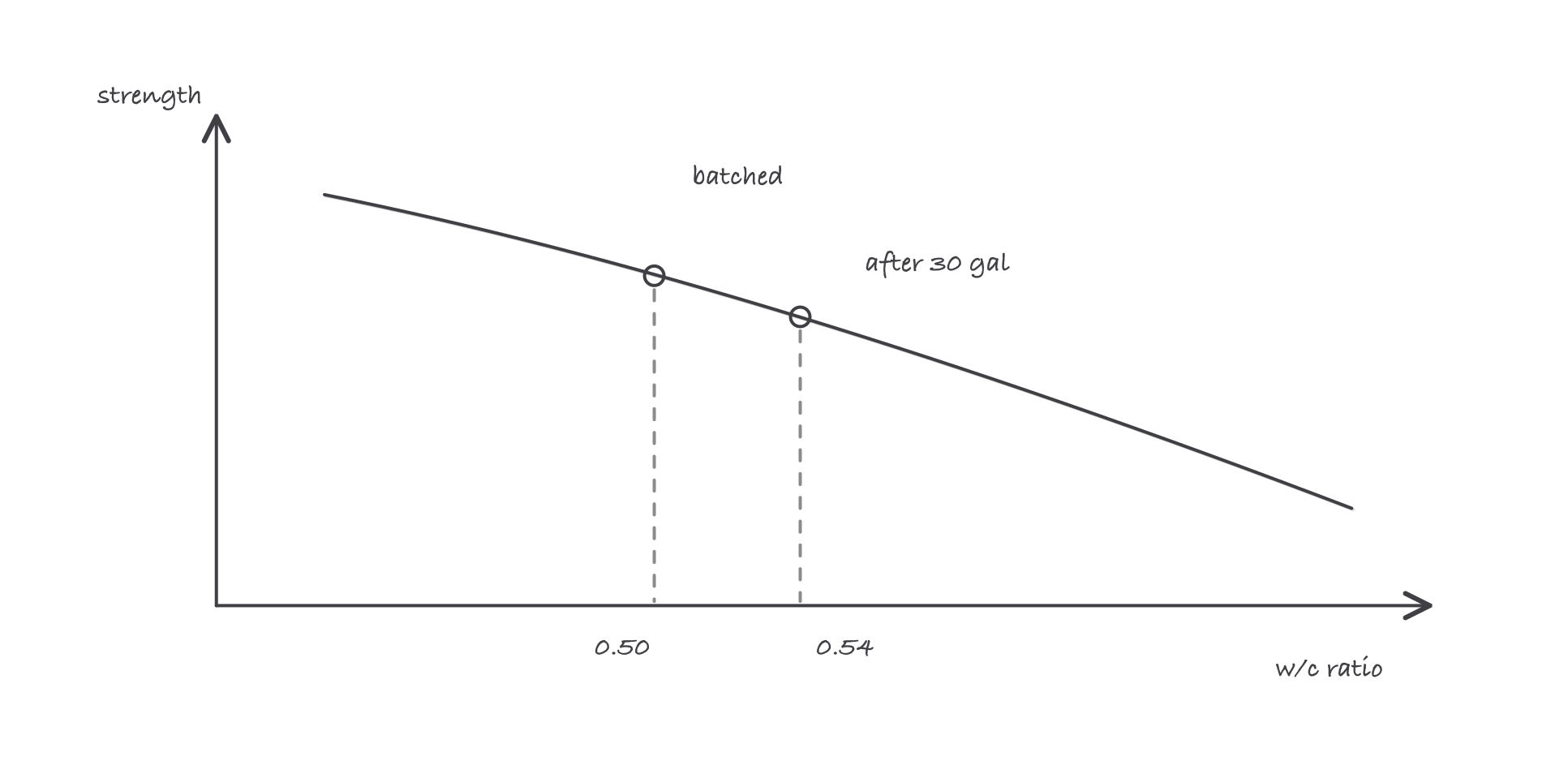
Thirty gallons moves the whole load down the curve: slump went up, strength went with it
Where it bites
- “Just a couple of gallons.” There is no free water. If the mix genuinely needs more workability, the answer is a plasticizer or a rejected load, not the hose.
- Reading slump as a quality score. Slump is a consistency check against the mix design. The spec sets a target and tolerance; matching it matters, beating it means nothing.
- Air is not one thing. Entrained air (microscopic, deliberate bubbles from an admixture) protects exterior concrete from freeze-thaw damage. Entrapped air (big accidental voids from poor consolidation) is a defect. “Air in concrete is bad” is half wrong, and the field tests exist largely to measure the good kind.
- Cement is one ingredient. The truck carries concrete. Say it right on site and in writing.