Learn · Masonry and Concrete
Curing
Part of Concrete Work to ACI Certification · step 5 of 22 · next: Cold and Hot Weather Concreting
In learning paths: Concrete Work to ACI Certification
Assumes you know: Placing Concrete
Curing is the deliberate act of keeping concrete moist (and warm enough) after finishing so hydration keeps running. Concrete does not dry into strength; it reacts its way there, and water is a reactant. Take the water away early and the reaction stops, permanently short of the strength the mix was designed to reach.
Why it matters on the job
Curing is the cheapest strength on any project and the most commonly skipped. The mix design, the placement and the finish can all be perfect, and a slab abandoned to a dry windy afternoon still ends up weak, dusty and crack-prone at the surface, exactly where it needed strength most. Whoever walks away without curing undoes everyone else’s work.
Hydration needs water, time and warmth
Cement grains react with water from the surface inward, growing the crystals that bind the aggregate. The reaction continues for as long as moisture and reasonable temperature hold, which is why “cure” and “dry” are opposites in this trade: a slab kept wet for a week is far stronger than its twin left to dry, made from the same truckload. Drying is what you fight, not what you wait for.
The methods
Two families, both aimed at the same thing: keep the mixing water in the concrete.
Add water continuously: ponding a slab behind small earth dams, sprinklers or soaker hoses, or burlap kept constantly wet. Best curing there is, when the site allows it.
Stop water from leaving: polyethylene sheeting sealed at edges and laps, wet coverings under plastic, leaving forms in place on walls and columns, or a sprayed membrane-forming curing compound. Compound is the low-labor default on big flatwork; the caution is that many compounds act as bond breakers for whatever comes next (tile adhesive, toppings, some coatings), so match the compound to the floor’s future.
Keep it up continuously. As a working rule for conventional mixes, cure for 7 days; intermittent wetting is worse than either extreme, because cycles of wet and dry work the surface.
The 28-day convention
Specified strength f’c is verified by breaking cylinders at 28 days: a standard checkpoint chosen by convention, not the end of strength gain. As a rule of thumb, a normal mix reaches roughly 70 percent of f’c at 7 days, passes f’c at 28, and keeps gaining slowly for years if moisture is available. “Fully cured at 28 days” is the exam-baiting oversimplification: nothing magic finishes on day 28.
Worked example: reading cylinder breaks
A slab is specified at f’c = 4,000 psi. The testing lab reports breaks from the pour’s cylinders:
- 7-day cylinder: 2,900 psi. Fraction of spec: 2,900 / 4,000 = 0.725, or 72.5 percent. Right on the ~70 percent track for a normal mix.
- 28-day cylinder: 4,310 psi. Fraction of spec: 4,310 / 4,000 = 1.078, so 107.8 percent of f’c. The pour passes.
A 7-day break far under the track (say 55 percent) is the early warning that lets you investigate (curing, added water, cold weather) while something can still be done for the in-place concrete, like extending the wet cure.
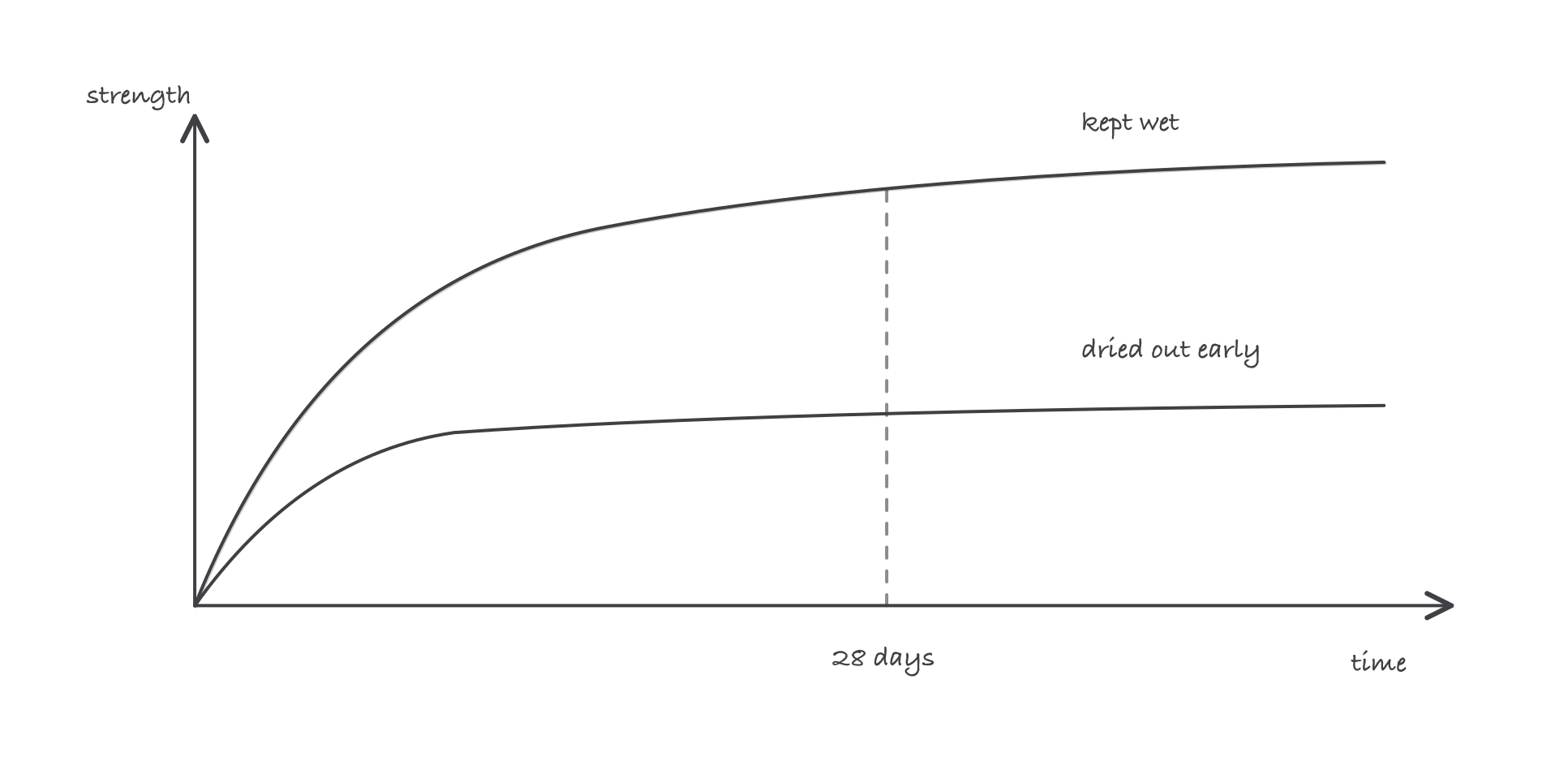
Same truckload, two futures: moisture keeps the reaction climbing, early drying freezes it low, and day 28 is a checkpoint, not a finish line
Where it bites
- “Let it dry” thinking. Every decision that speeds drying (no cover, wind, sun, heaters blowing across a slab) is a decision to stop strength gain early.
- The gap between finishing and curing. Curing starts as soon as the finish can take it, not tomorrow. On a hot, windy day the first hours are the whole game, and plastic-shrinkage cracks form while the crew loads the truck.
- Curing compound under future floors. Sprayed membrane on a slab that will receive adhesives, toppings or moisture-sensitive coverings creates a bond and testing problem. Read the spec both directions in time.
- Cylinders cure in a bath; your slab cures on site. Lab cylinders verify the mix, not your curing. A passing 28-day break does not certify a slab that spent its first week dry; the next lesson (cold and hot weather) is where site curing gets hard.