Qualifications · Masonry and Concrete
ACI Flatwork Finisher: The Three-Level Ladder
Part of Concrete Work to ACI Certification · step 17 of 22 · next: ACI Lab Certifications: Strength and Aggregate Testing
In learning paths: Concrete Work to ACI Certification
Assumes you know: Finishing Flatwork
ACI’s flatwork program is a three-level ladder (Associate, Finisher, Advanced Finisher), and the level most working finishers actually want has no written exam at all. Which level you can hold today depends less on what you know than on how many hours of flatwork you can document.
*Learn the Trades is a free study resource. We are not a licensing body, an authorized training provider, or an exam administrator. Reading this page does not award any card, license, or certification. Always verify requirements with the issuing authority linked in the sources.*Why it matters on the job
When a specification asks for a certified finisher on a slab, this is the program it means. The ladder also settles an argument that costs finishers money: the person who has placed slabs for six seasons and the person fresh out of a training program are not chasing the same certificate, and each wastes time studying for the other one’s exam.
The three levels
- Associate is the written level. There is no hour requirement and no slab demonstration, so it is the level available to someone who knows the material before the hours exist, which usually means students and career changers.
- Finisher is the hands-on level: a performance examination on a slab plus 1,500 hours of documented flatwork experience. No written examination. This is the working finisher’s certificate.
- Advanced Finisher stacks both: the written examination plus the performance examination plus 1,500 hours, with an experience-heavy alternative around 4,500 hours for candidates whose record carries the weight.
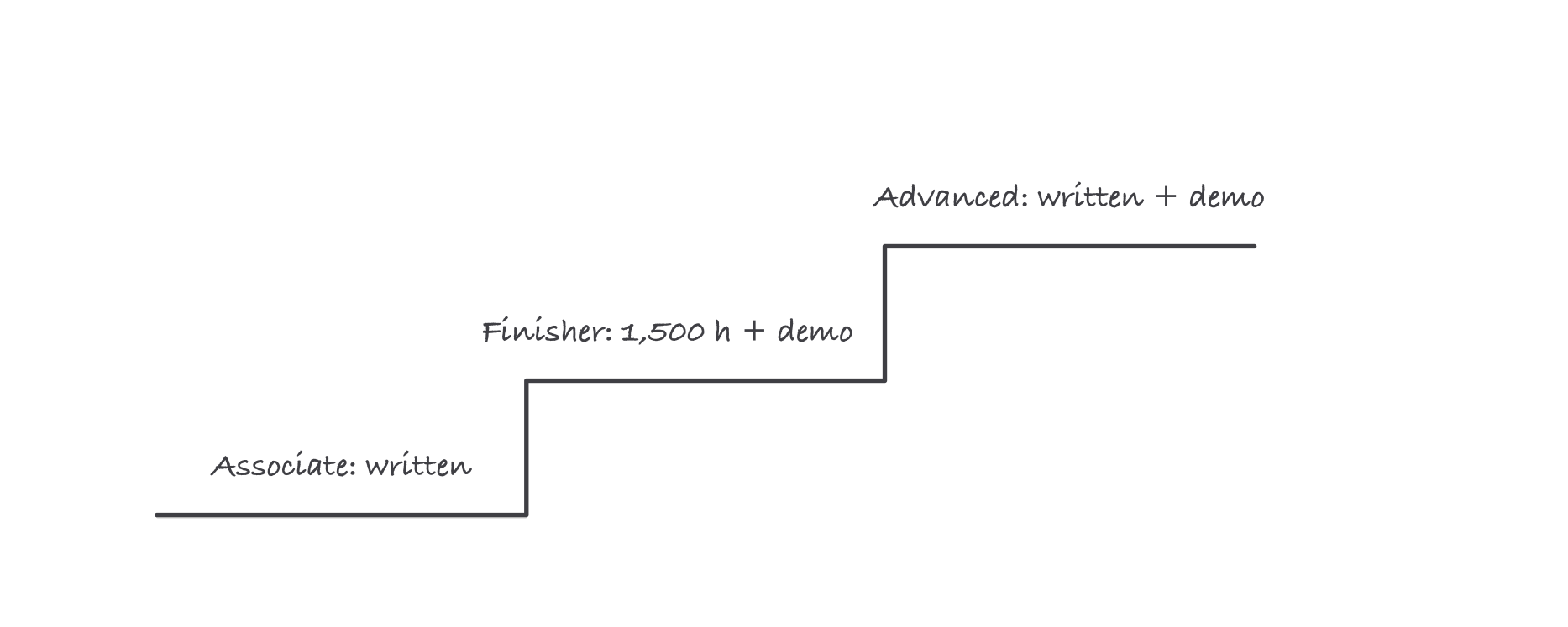
Only the two ends of the ladder sit a written exam; the middle rung is hours and a slab
Worked example: which route your hours pick for you
You finish flatwork two days in a typical week, ten hours on a placement day, and your season runs about 34 weeks once weather and holidays are taken out.
- Hours per week on flatwork: 2 × 10 = 20 hours
- Hours per season: 20 × 34 = 680 hours
- Time to 1,500 documented hours: 1,500 ÷ 680 = 2.2 seasons
- Time to 4,500 hours: 4,500 ÷ 680 = 6.6 seasons
The decision falls out of the arithmetic. Two seasons of documented work puts Finisher in reach, and if Advanced is the goal, sitting the written examination on top of those same 1,500 hours gets you there roughly four seasons before the experience-only route does. Waiting for hours to do the work of an exam is the slowest path on the ladder.
Where it bites
- Hours have to be documented, not remembered. The requirement is verified experience. Finishers who start keeping records the week they decide to certify lose the two seasons they already worked.
- Associate is not a junior Finisher. It is a different examination testing different things, so a candidate who wants the hands-on certificate gains nothing by taking the written one first unless the Advanced level is the plan.
- The performance exam is a slab, not a quiz. It is scored on technique performed in front of an examiner, which rewards practice under time rather than reading.
- Confirm the current structure before you pay. Levels, hour counts and validity periods are program policy and they change; the ACI program page is the authority, not a training provider’s summary.
Exam relevance
Everything in Finishing Flatwork is the syllabus for the performance examination: timing the operations, reading the surface, and knowing when the slab is ready for each step. For the written levels, the same material is tested as knowledge, alongside the reasons behind the sequence.
Verified requirements
| Where | Expires | Renewal | Continuing education |
|---|---|---|---|
| United States (federal) | Yes | 5 years | Recertification: pass the performance exam again, OR 10 hours of approved continuing education plus 1,500 additional hours of verified finishing work within the previous 5 years |
Information comes from issuing-authority sources. Confirm current rules, fees and eligibility with the authority before acting.