Learn · Masonry and Concrete
Masonry Flashing and Weeps
Part of Concrete Work to ACI Certification · step 12 of 22 · next: The OSHA Silica Standard
In learning paths: Concrete Work to ACI Certification
Assumes you know: Block Walls and Reinforcement
A masonry veneer wall is designed on the assumption that water gets through it. Wind-driven rain penetrates the face; the wall’s job is to catch that water in the cavity, direct it onto flashing, and discharge it back outside through weeps before it reaches anything that rots, rusts or stains.
Why it matters on the job
Flashing is the detail that separates a wall that lasts a century from one that grows efflorescence, spalls at the shelf angle and rots the framing behind it. It is also nearly impossible to fix later: buried at the base of the wall and behind the veneer, a bad flashing job means partial demolition. You get one chance at it, at laying time.
The drainage assembly
The cavity is the air space between the veneer and the backup wall, commonly 2 in clear. Water that penetrates the veneer runs down its back face inside this space. The cavity only works if it stays open: mortar droppings that bridge it become water bridges. Bevel your beds, use a mortar-catching device or drainage mat, and keep the cavity clean as you lay.
Flashing is the waterproof membrane (metal, rubberized asphalt or composite) that catches the descending water. It installs at every interruption in the cavity: the base of the wall, above shelf angles and lintels, under sills, at roof intersections. The rules repeat at every location: turn it up the backup wall several inches and terminate it (into a reglet or behind the weather barrier), slope it toward daylight, lap and seal end joints, build end dams where it stops, and carry it to or slightly past the veneer face with a drip. Flashing stopped short inside the wall drains water into the wall.
Weeps are the drains: openings in the veneer directly on top of the flashing. Open head joints (mortar left out every 24 in along the course on the flashing) are the standard; wicks, tubes and cell vents run at closer spacings. Weeps above the flashing level leave a bathtub below them; weeps without flashing under them drain nothing.
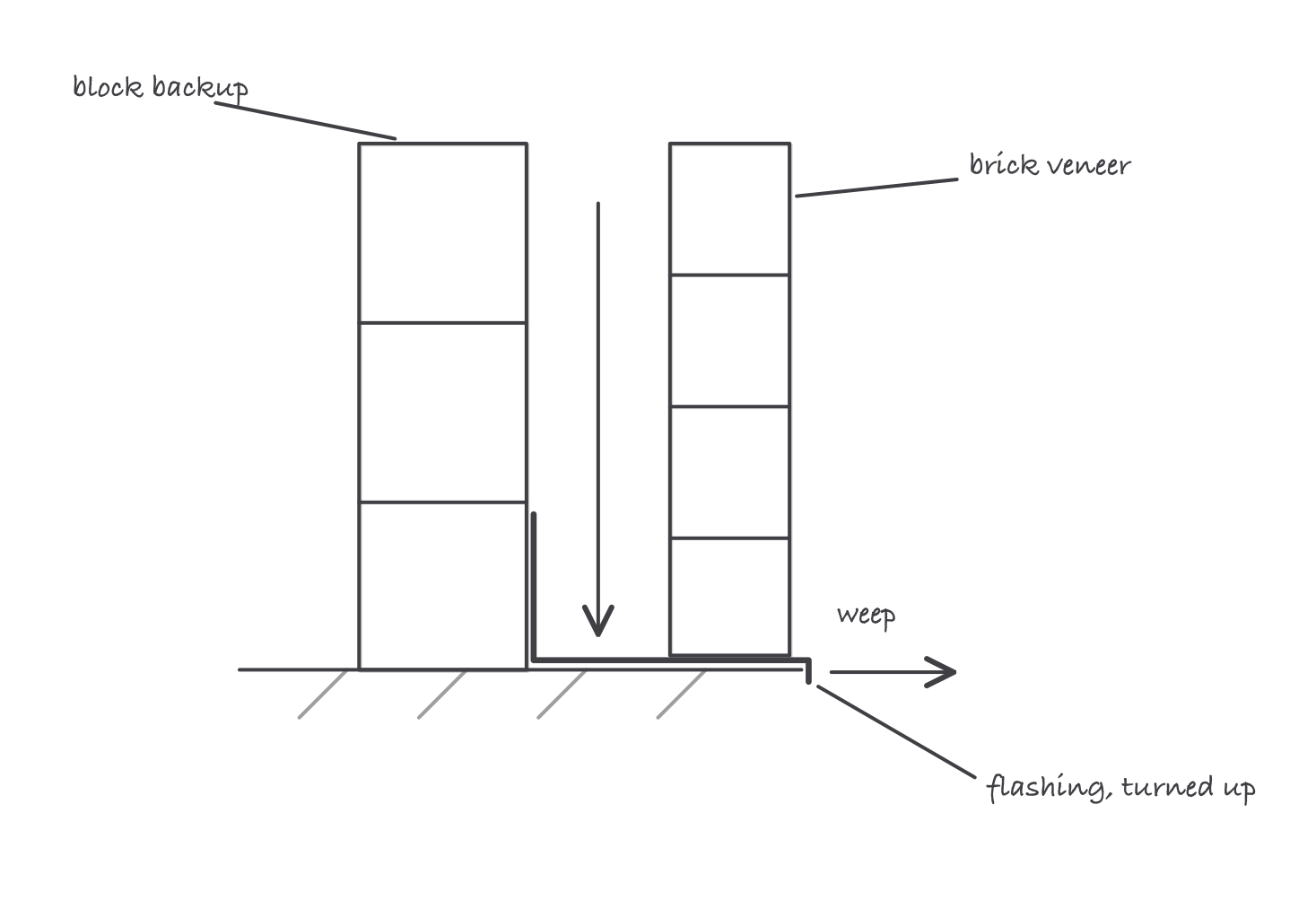
Catch, direct, discharge: the cavity delivers water to the flashing, the flashing delivers it to the weeps
Worked example: weeps on a storefront
A veneer wall runs 40 ft along a storefront, weeping through open head joints at 24 in on center on the base flashing.
- Wall length: 40 ft = 480 in.
- Weep spacing: 480 / 24 = 20 open head joints along the base course.
- Every one must sit directly on flashing, and end dams close the flashing at both ends of the run.
Walk the base course before the scaffold comes down and count them. Twenty joints are easy to lose to an enthusiastic pointing crew.
Movement joints: brick and block are opposites
The same wall system carries two kinds of movement joint, and they are not interchangeable. Fired clay brick expands over its life as it reabsorbs moisture, so brick veneer gets expansion joints: soft, compressible vertical joints (no mortar, just backer and sealant) that give the growing brick room to push into. CMU shrinks as it dries, so block walls get control joints: deliberately weakened vertical planes that invite the shrinkage crack to happen in a straight, sealed line. One joint absorbs growth; the other schedules a crack. Call them by name, because detailing a control joint where an expansion joint belongs (or the reverse) builds the wrong behavior into the wall.
Where it bites
- Sealed weeps. To a caulking crew or a painter, weeps look like missed joints. Walls drown this way; protect the openings and say so at handoff.
- Mortar bridges. Droppings hardened across the cavity, or on top of flashing, dam and redirect water to wherever you least want it.
- Flashing without end dams. Water runs along flashing sideways and pours off the open end into the wall. Every terminated run gets a dam.
- “It is all expansion joint.” Brick grows, block shrinks; the joints differ in construction and purpose, and mislabeling them on site leads to mis-building them.