Learn · Masonry and Concrete
Placing Concrete
Part of Concrete Work to ACI Certification · step 2 of 22 · next: Finishing Flatwork
In learning paths: Concrete Work to ACI Certification
Assumes you know: Concrete Fundamentals: Mix, Water, Strength
Placing concrete is the art of moving a perishable material from the truck into the forms without damaging it. The mix leaves the plant with its strength already decided; from the chute onward your job is to not take any of it away. Two sins do most of the damage: added water and segregation.
Why it matters on the job
A pour is a one-way event on a clock. Once the truck starts discharging, there is no pause button: the crew, the access, the consolidation and the strike-off either happen in rhythm or the defects are permanent. Cold joints, honeycomb, rock pockets and weakened slabs are all placement failures, and all preventable.
Before the truck arrives
Placement is won in the setup. Forms tight, oiled and braced; subgrade compacted and dampened (a dry subgrade sucks water out of the bottom of the slab); rebar, mesh and embedments positioned and secured; screeds set to grade; enough hands and tools for the pour rate. Order the concrete to arrive at the pace you can place it, because concrete waiting in a drum on a hot day is losing slump you will be tempted to replace with water.
Move it without separating it
Concrete is a suspension of heavy rock in paste, and it segregates whenever you let the rock travel differently than the paste: long free falls, bouncing down a steep chute, or being dragged sideways across the forms.
The rules that prevent it:
- Place concrete at or near its final position. Do not deposit in one spot and flow it long distances with rakes or the vibrator; the paste travels and the stone stays.
- Limit free fall. Keep drops short; for tall forms and walls, use drop chutes or a tremie so the mix does not rattle off the rebar on the way down.
- Work in horizontal layers on deep pours, each layer consolidated into the one below it while both are plastic. A layer placed on concrete that has stiffened makes a cold joint, a weak unplanned seam.
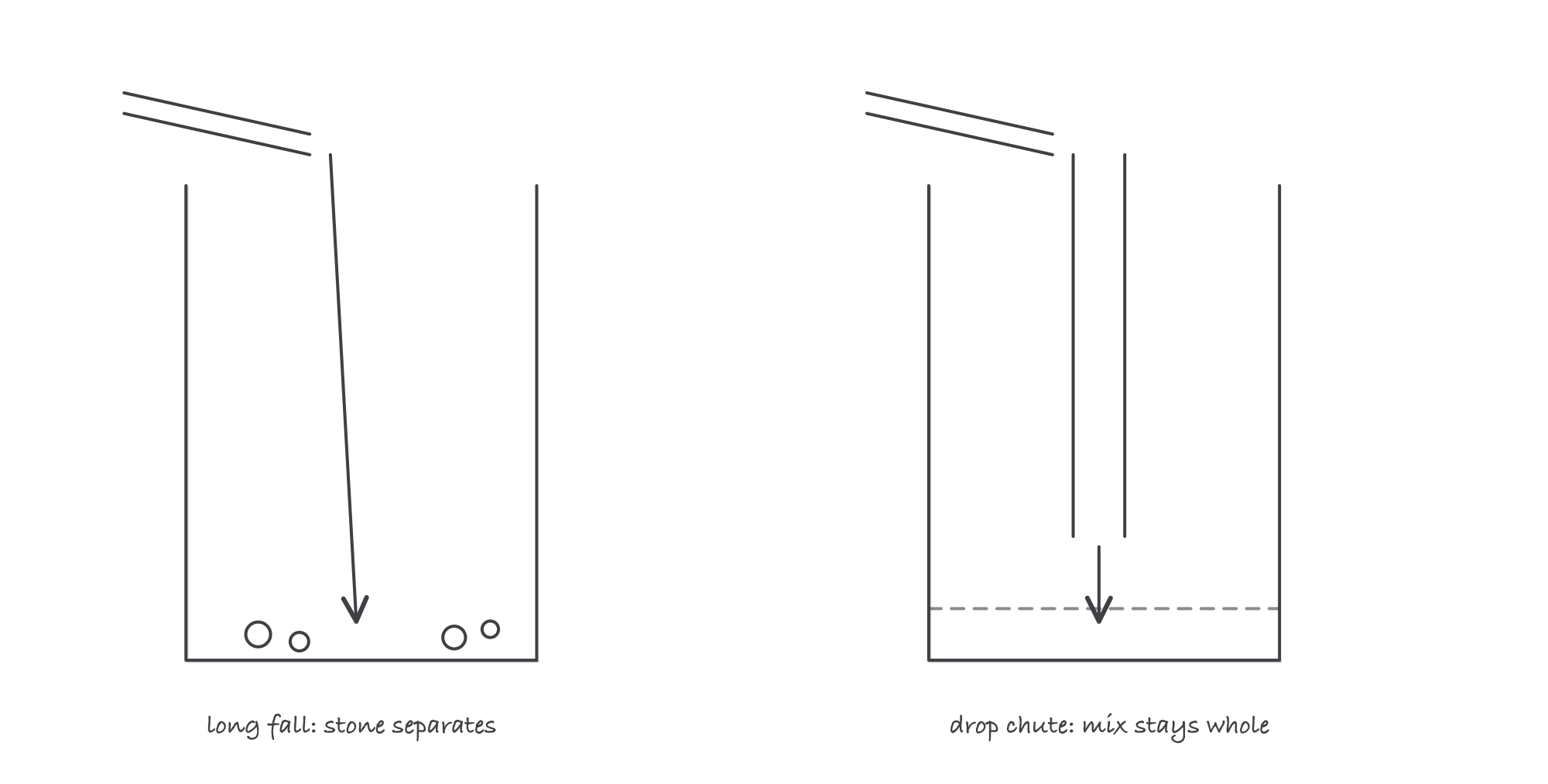
The stone and the paste must arrive together: long falls separate them, short controlled drops keep the mix whole
Consolidate, then strike off
Fresh concrete traps air pockets against forms and rebar. Consolidation (usually an immersion vibrator) liquefies the mix briefly so the entrapped air escapes and the concrete closes around the steel and fills the form faces. Work a systematic pattern: vertical insertions, spaced so the visible circles of influence overlap, down into the previous layer, a few seconds each until the surface glistens and large bubbles stop. Under-vibration leaves honeycomb; grossly over-vibrating a spot, or using the vibrator to drag concrete sideways, segregates the mix.
Screeding (strike-off) comes right behind: a straightedge riding the screed rails or form edges, sawed side to side, cutting the surface to grade. Screeding ends placement; finishing starts after.
Worked example: ordering the slab
A patio slab measures 30 ft by 20 ft at 4 in thick.
- Volume: 30 × 20 × (4 / 12) = 200 cu ft.
- In yards: 200 / 27 = 7.41 cu yd.
- With 5 percent for waste and grade variation: 7.41 × 1.05 = 7.78, so order 8 cu yd.
Order short and the last truck costs you a cold joint or a short-load fee; order long and you pay to dispose of the excess. Measure the forms, not the plan.
Where it bites
- The hose at the truck. Slump lost to a hot wait gets “fixed” with water, and the strength goes with it (the fundamentals lesson runs the numbers). Plasticizer or patience, not water.
- Vibrating as transport. The vibrator is for air removal in place, not for pushing concrete across the form. Moving it that way segregates exactly like a long fall does.
- Cold joints hide in slow pours. Plan layer heights and truck spacing so fresh always lands on plastic. If a delay is coming, consolidate a sloped working face and plan the joint deliberately.
Exam relevance
Fresh-concrete testing happens at placement, so the ACI Field Testing Technician Grade I exam leans on this moment: sampling from the discharge stream, running slump, temperature, unit weight and air tests, and molding cylinders, all against the clock the standards impose. The flatwork certifications’ written exams (Associate and Advanced Finisher levels) also expect you to know placement practice: segregation causes, free-fall limits and cold-joint prevention.
Verified requirements
| Where | Expires | Renewal | Continuing education |
|---|---|---|---|
| United States (federal) | Yes | 5 years | Confirm with issuer |
| United States (federal) | Yes | 5 years | Recertification: pass the performance exam again, OR 10 hours of approved continuing education plus 1,500 additional hours of verified finishing work within the previous 5 years |
Information comes from issuing-authority sources. Confirm current rules, fees and eligibility with the authority before acting.