Business · Masonry and Concrete
Masonry and Concrete Contractor Licensing by State
Part of Concrete Work to ACI Certification · step 21 of 22 · next: Inside the BAC/IMI Apprenticeship
In learning paths: Concrete Work to ACI Certification
Assumes you know: Becoming a Masonry/Concrete Contractor
There is no national masonry or concrete contractor license, so there is no single answer to “what do I need.” Each state runs its own system, and they differ on nearly every axis that matters: how finely the work is classified, how many years of experience count and how far back they may reach, which exams you sit, and whether the state licenses this trade at all or leaves it to cities and counties. What does not differ is the shape of the question, which makes the pattern learnable even though the numbers are not.
*Learn the Trades is a free study resource. We are not a licensing body, an authorized training provider, or an exam administrator. Reading this page does not award any card, license, or certification. Always verify requirements with the issuing authority linked in the sources.*Why it matters on the job
Getting the classification wrong is expensive in a specific way: you pass an exam, pay the fees, win the bid, and then discover that half the scope on the drawings sits outside the classification you hold. The fix at that point is a second license or a subcontractor, both of which come out of a price you already gave.
California: two classifications, one job
California’s Contractors State License Board splits this trade between two specialty classifications, and the split runs along the material rather than the crew:
- C-29 Masonry covers installing concrete units and baked clay products; concrete, glass and clay block; natural and manufactured stone; terra cotta; and fire brick or other refractory material.
- C-8 Concrete covers forming, pouring, placing and finishing specified mass, pavement, flat and other concrete work, and placing and setting screeds. It excludes plaster coatings, and it excludes placing and erecting reinforcing steel as a primary business.
The qualifier for either one documents four years of journeyman-level or higher experience in that classification within the last ten years, verified by someone with direct knowledge of the work, then passes the trade exam for the classification plus the law and business exam.
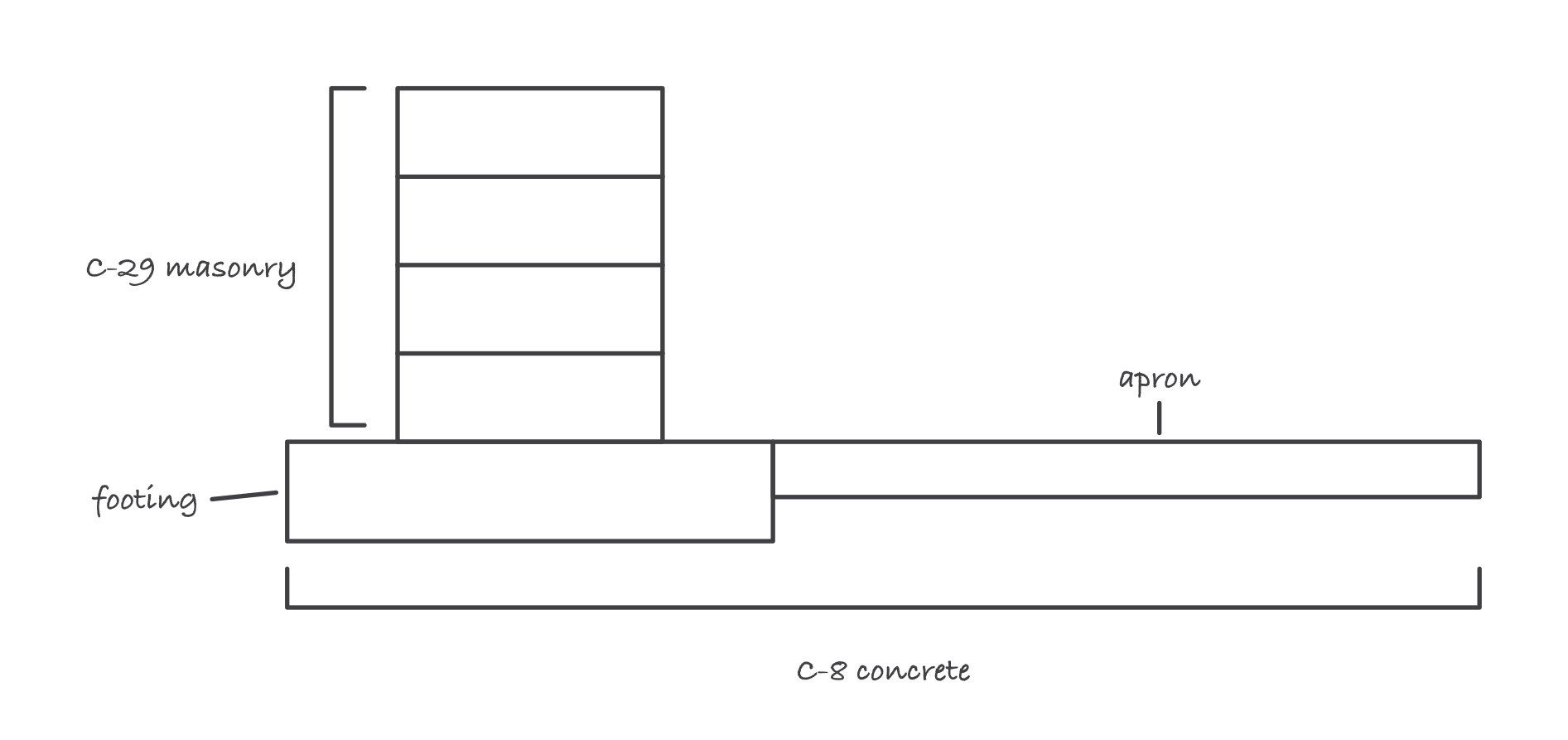
One retaining wall job, two California classifications: the units are C-29 work and the concrete under and beside them is C-8 work
Worked example: reading a job against the classifications
A homeowner wants a 40 ft CMU retaining wall on a poured footing, with a 6 ft wide concrete apron along its base. Break the scope by material:
- Poured footing. Formed, placed and finished concrete: C-8.
- CMU wall. Installing concrete units: C-29.
- Concrete apron. Flat concrete work, placed to screeds: C-8.
Two of the three line items are C-8 work. A business holding only C-29 has to sub out the footing and the apron, or hold both classifications, and whether any of it can be treated as incidental to the other classification is a question for the board’s own rules rather than for trade custom. Ask before you bid, not after.
Nevada: the same trade, a different machine
Nevada’s State Contractors Board builds its system differently. Licenses fall under Classification A (engineering), B (general building) or C (specialty), and the specialty class is subdivided into 42 subclassifications defined by regulation in Nevada Administrative Code Chapter 624. The masonry work sits in one of those C subclassifications, and the board’s classification list is the place to read which one and exactly what scope it carries.
The experience rule is recognizably the same idea with different dials: at least four full years as a journeyman, supervising employee or contractor in the classification, within the fifteen years before the application, with training at an accredited college able to substitute for up to three of those four years. The applicant then passes a business and law exam plus a trade exam for the classification.
The same resume, two answers
Take the applicant from the previous lesson (three years as a journeyman from August 2017 to August 2020, then two years as a foreman from August 2022 to August 2024) and have them apply in August 2029:
- California, ten-year window opening August 2019: the journeyman stretch contributes only its last year (August 2019 to August 2020), so the count is 1 + 2 = 3 years. Short of four.
- Nevada, fifteen-year window opening August 2014: both stretches fall entirely inside, so the count is 3 + 2 = 5 years. Clear of four.
Same career, same four-year headline requirement, opposite outcomes. The window length decides the application.
Reading your own state in five steps
- Find the actual board (search for your state plus “contractors license board”), and confirm whether licensing is at state level or delegated to cities and counties.
- Find the classification list and read the scope text for masonry and for concrete. Match it against the work you intend to sell.
- Find the experience rule: how many years, at what level, inside what window, verified by whom.
- Find the exams: trade exam, business and law exam, and how each is scheduled.
- Find the thresholds and standing requirements: the contract value above which a license is required, the bond, workers’ compensation and insurance.
Where it bites
- The dollar threshold is not permission to be careless. States that only require a license above a contract value still enforce it, and splitting a job into small contracts to stay under the line is a well-known way to attract attention.
- Reciprocity is narrow where it exists at all. Some states waive parts of the exam for holders of comparable licenses elsewhere, usually under specific agreements. Assume nothing transfers until the board says so in writing.
- Classification numbers do not travel. A “C-29” means masonry in California and nothing at all in the next state. Quote scope text, never the code letter, when you are comparing across state lines.
- Registration is not always licensing. Several states register contractors (name, insurance, a fee) without a trade exam. That is a lower bar, not an equivalent one, and it changes what you can legally hold yourself out as.