Learn · Masonry and Concrete
Masonry Materials: Brick, Block, Stone, Mortar
Part of Concrete Work to ACI Certification · step 7 of 22 · next: Mortar Types and Mixing
In learning paths: Concrete Work to ACI Certification
Four materials do almost all the work in this trade: fired clay brick, concrete masonry units (block), natural stone, and the mortar that beds them. Learn what each one actually is and how it behaves in the wall, and half the rules you meet later stop being rules and start being obvious.
Why it matters on the job
You will order these materials, carry them, cut them and bed them every working day. Mixing up cement and concrete marks you as green; mixing up mortar and concrete wastes a wall. And the long-term behavior of brick and block (one grows, one shrinks) drives joint details you will build years from now, so the habits start here.
Cement is not concrete
Cement is a gray binder powder, one ingredient. Add water and it becomes a paste that hardens by chemical reaction. Add sand and you have the basis of mortar. Add sand plus coarse aggregate (gravel or crushed stone) and you have concrete.
So a “cement truck” is really a concrete truck, and a “cement sidewalk” is a concrete sidewalk. On site, say what you mean: cement is the powder in the bag, concrete is the composite you place. The one place the civilian word is correct is the job title: BLS calls the concrete finishing occupation cement mason, and that name is standard in the industry.
Mortar sits in its own lane: cement (usually a blended masonry cement, or Portland cement plus lime), fine sand and water, with no coarse aggregate. It beds and bonds masonry units. Concrete mix is not mortar and mortar is not concrete; substituting either way is a first-week materials error.
The units
Brick is clay, fired hard in a kiln. It is durable, strong in compression, and it slowly expands over its service life as it reabsorbs moisture.
Block (CMU, concrete masonry unit) is molded concrete. It gives you a big, economical unit with hollow cells that can carry rebar and grout. Because it is concrete, it shrinks as it dries out, the opposite of brick’s slow growth. Same-looking walls, opposite movement: that is why later lessons give brick walls expansion joints and block walls control joints.
Stone is the original masonry unit: cut (ashlar) or irregular (rubble), laid in the same mortar-bedded logic but without manufactured, repeatable dimensions.
Units are sized to a module
Manufactured units are dimensioned so that unit plus one mortar joint hits a round number. A standard CMU face is 15 5/8 in long and 7 5/8 in high; add one 3/8 in joint each way and every block occupies exactly 16 in by 8 in in the wall. Layout, estimating and coursing all run on that module.
Worked example: counting block
A foundation wall runs 12 ft long and 4 ft high in standard CMU.
- Length: 12 ft = 144 in. At 16 in per block and joint, 144 / 16 = 9 blocks per course.
- Height: 4 ft = 48 in. At 8 in per course, 48 / 8 = 6 courses.
- Count: 9 × 6 = 54 blocks, before waste and cuts.
The joint is part of the arithmetic. Forget it and you order a wall that does not fit.
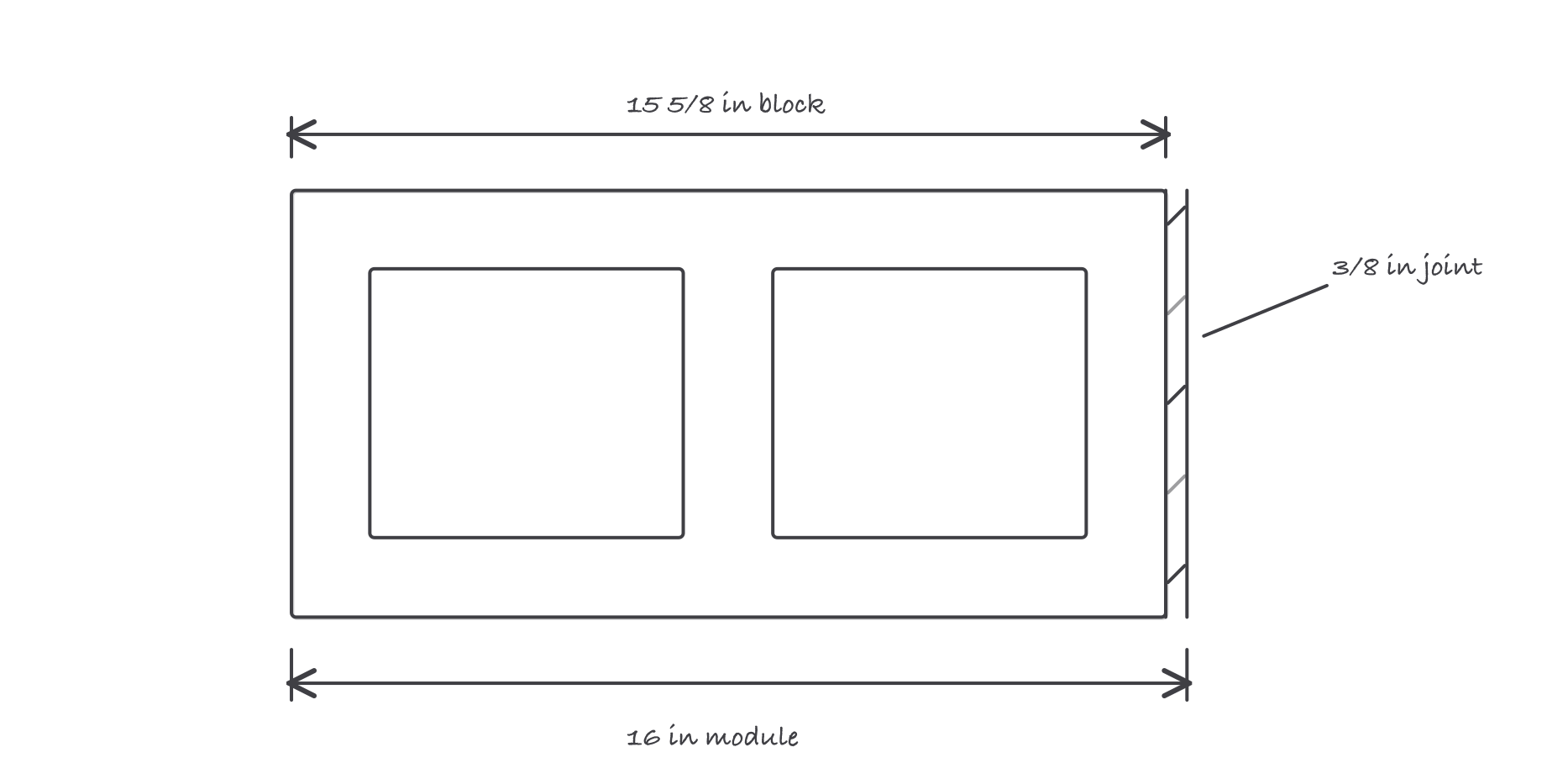
The unit is undersized by one joint: block plus mortar always lands on the 16 in module
Where it bites
- “Cement” for “concrete” in writing or estimates reads as inexperience, and worse, it invites real substitution errors (bagged concrete mix used as mortar, or straight Portland paste used where a sand mix belongs).
- Brick grows, block shrinks. Treating all movement joints as interchangeable “expansion joints” builds the wrong detail into the wrong wall.
- Nominal vs actual dimensions. The block is called 8 in by 16 in but measures 7 5/8 in by 15 5/8 in. Cut lists and openings use actual dimensions; layout uses nominal modules.