Learn · Masonry and Concrete
Working Table 1: Silica Controls for Saws, Grinders and Drills
Part of Concrete Work to ACI Certification · step 14 of 22 · next: ACI Certifications
In learning paths: Concrete Work to ACI Certification
Assumes you know: The OSHA Silica Standard
Table 1 of the silica standard is a trade: run the listed controls on a listed task exactly as the table specifies, and you are deemed compliant without measuring anyone’s exposure. Wet the saw blade, use the shroud and vacuum on the grinder, and the whole apparatus of air sampling, exposure assessment and monitoring never starts.
Why it matters on the job
Cutting, grinding, drilling and chipping masonry and concrete are the tasks that generate respirable crystalline silica, and they are most of what the trade does. The alternative to Table 1 is the exposure assessment route, which means sampling employees, comparing results against limits, repeating the sampling on a schedule, and defending the whole file. Crews that work the table have a simpler day: the control is the compliance.
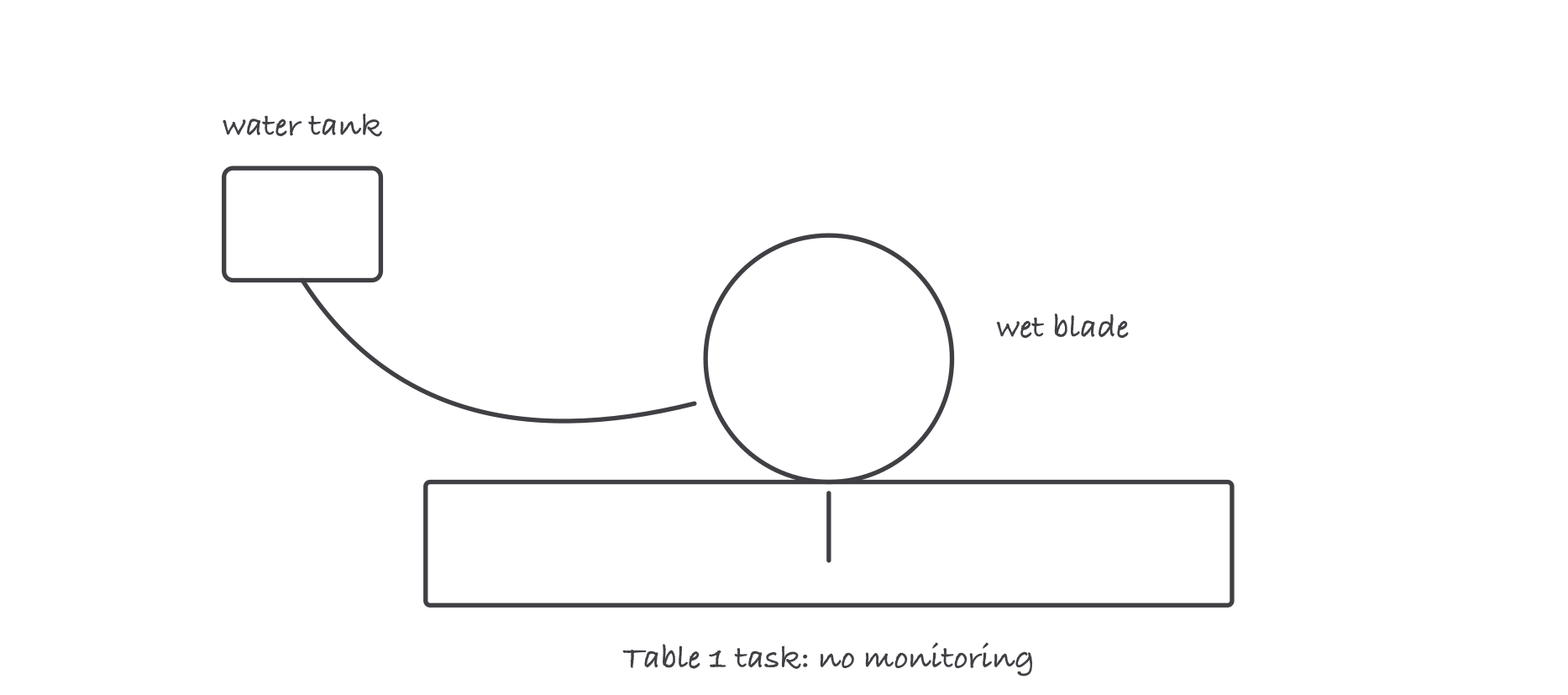
Water at the blade is not housekeeping: it is the control that makes the task compliant
How the table actually works
Each row is a task, and each row names the control that goes with it. The pattern is consistent across the rows:
- Water at the point of dust generation, integrated into the tool rather than sprayed nearby, for saws, core drills and masonry cutters.
- Local exhaust ventilation, meaning a shroud or hood on the tool feeding a dust collector with the filtration and cleaning the table specifies, for grinders and handheld drills.
- Enclosure or isolation where the task allows it, so the dust never reaches the operator.
- Respirators for some rows, depending on the task and how long it runs in a shift, listed in the table itself rather than left to judgment.
The table also specifies conditions around the control: whether the task is indoors or outdoors, and how long it runs. A row followed only partly is not a row followed, and the deemed-compliance protection is lost the moment the control is not the one named.
Worked example: the arithmetic you avoid
A cutting operator works off the table for a shift because the water tank ran dry, so the crew samples the exposure instead. The result is four hours at 80 µg/m³ while cutting, then four hours at 10 µg/m³ on other work. Exposure limits are 8-hour time-weighted averages, so the day is averaged:
- Cutting contribution: 4 × 80 = 320
- Other-work contribution: 4 × 10 = 40
- 8-hour TWA: (320 + 40) ÷ 8 = 45 µg/m³
That sits under the 50 µg/m³ permissible exposure limit, so no respirator is required by the exposure itself. It also sits above the 25 µg/m³ action level, which is the number that keeps the crew inside the assessment and monitoring regime: more sampling, on a schedule, with records. A full water tank would have produced no number at all, and no schedule to keep.
Where it bites
- A dry tank turns a compliant task into an assessed one. The control has to run for the whole task, which makes water supply and filter changes a production item, not an afterthought.
- Respirator days add up into medical surveillance. Once an employee wears a respirator for silica work 30 or more days in a year, medical surveillance is required, with examinations on a three-year cycle. Three days a week for eleven weeks is 33 days, and no one notices it happening.
- Dry sweeping and compressed air are not cleanup methods here. Both are prohibited as ways of clearing settled dust where a safer alternative is available, and both are the reflex on a busy site.
- Housekeeping water is not a Table 1 control. Hosing the slab afterwards does nothing for the row you were supposed to be working; the water has to be at the point where the dust is made.