Learn · Masonry and Concrete
Finishing Flatwork
Part of Concrete Work to ACI Certification · step 3 of 22 · next: Joints and Crack Control
In learning paths: Concrete Work to ACI Certification
Assumes you know: Placing Concrete
Finishing turns a screeded slab into a floor, and every pass in the sequence is timed off one signal: the bleed water. Concrete finishing is less about technique than about patience, because the surface tells you when it is ready and punishes you for going early.
Why it matters on the job
The finish is the part of the slab everyone sees and walks on forever. Blisters, delaminations, dusting surfaces and scaled exterior slabs are almost all timing failures: someone worked bleed water back into the surface, or sealed it under a troweled skin. A finisher who reads the slab correctly produces durable floors; one who finishes by habit produces callbacks.
Bleed water sets the clock
After placement, the heavy solids settle and a film of water rises to the surface: bleed water. It shows as a sheen. The iron law of finishing: do nothing to the surface while bleed water is present. Working it back in raises the water-cement ratio of the top fraction of an inch, exactly where wear resistance lives, and floating a skin over rising bleed traps it as blisters and delaminations.
The sequence
- Screed (strike-off). The straightedge cuts the surface to grade. This ends placement.
- Bull float (or darby), immediately. Large flat blade on a long handle, worked before bleeding starts: knocks down screed ridges, fills voids, embeds coarse aggregate slightly. Then hands off.
- Wait. The sheen appears, sits, and evaporates. Nothing touches the slab.
- Edge and joint. When the water has left, run the edger along the forms and cut or groove the control joints (the joints lesson covers layout).
- Float. Magnesium or wood float, by hand or machine: compacts the surface, cuts high spots, prepares paste for troweling. The slab is ready when it carries your weight with only a shallow footprint.
- Trowel. Steel blade, one or more passes, each later pass at a steeper angle on a harder slab, densifying the surface into a smooth, tight finish for interior floors.
- Broom (exterior). Drag a broom across the fresh troweled or floated surface for a non-slip texture on drives, walks and patios.
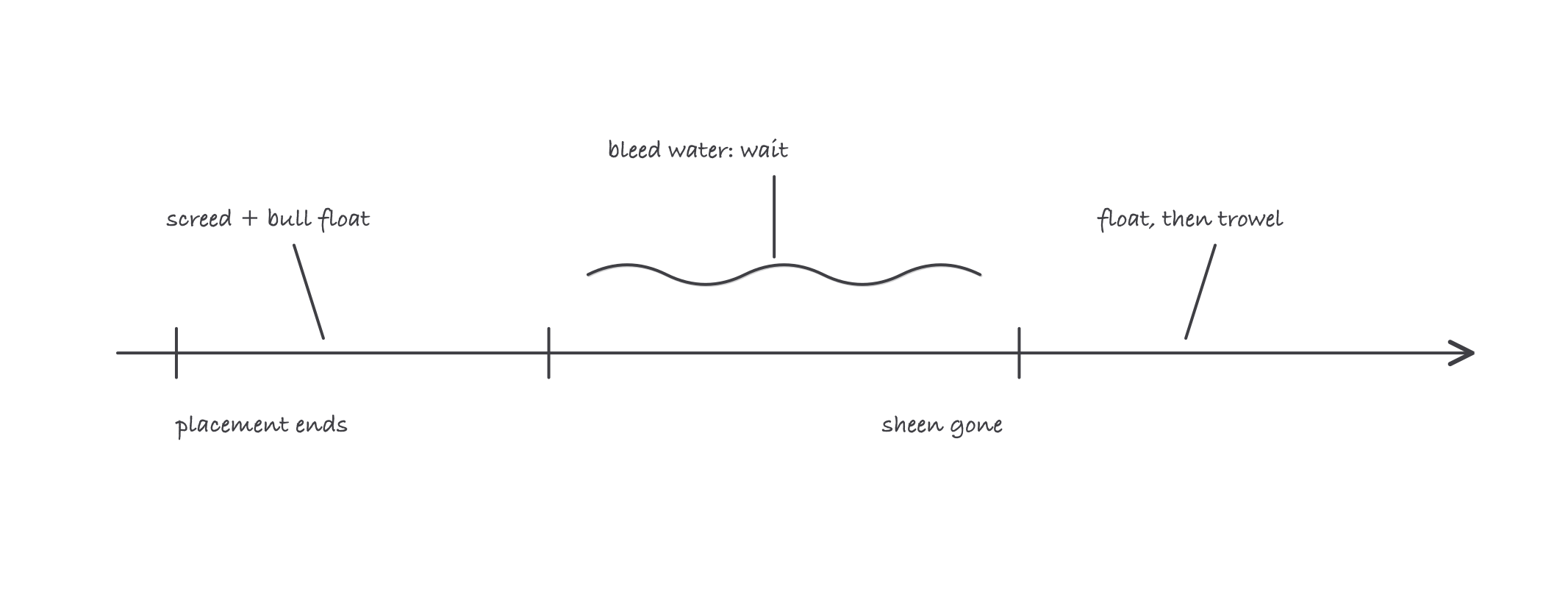
Two working windows separated by a wait: bull float before the bleed, float and trowel only after the sheen is gone
Worked example: the footprint test
The float window is read off the slab with your boot. Step on the slab near an edge:
- Print sinks about 1/2 in and the surface still glistens: too early, keep waiting.
- Print about 1/4 in deep, no water sheen in the print: float now. This is the working criterion.
- Print barely marks the surface: the float window is closing; on a machine job this is pan-to-blade territory, and troweling follows close behind.
The numbers move with weather (a hot windy day can close the whole sequence in an hour; a cool damp one can stretch it past three), which is why the test is a depth criterion and never a clock time.
Where it bites
- Finishing the bleed in. The sheen is not “moisture to smooth with”: it is a stop sign. Dusting and delamination trace back to this one habit.
- Steel troweling exterior air-entrained slabs. A hard-troweled skin seals the entrained air system’s escape routes and invites scaling in freeze-thaw weather. Exterior flatwork gets a float or broom finish, not a burnished trowel finish.
- “Blessing” a dry surface with water. Sprinkling water on a slab to ease troweling is the same crime as finishing bleed in: it weakens the wear surface directly.
- Cutting joints on the calendar instead of the slab. Joint timing belongs to the concrete’s stiffness, covered next lesson, and waiting for tomorrow is usually waiting for a random crack.
Exam relevance
The ACI flatwork program tests exactly this material: the Associate and Advanced Finisher written exams cover pass sequence, bleed-water discipline and finish selection, while the Finisher level proves it hands-on (a performance evaluation plus 1,500 verified work hours; there is no written exam at the Finisher level). Expect questions that hinge on what you must not do while bleed water stands on the slab.
Verified requirements
| Where | Expires | Renewal | Continuing education |
|---|---|---|---|
| United States (federal) | Yes | 5 years | Recertification: pass the performance exam again, OR 10 hours of approved continuing education plus 1,500 additional hours of verified finishing work within the previous 5 years |
Information comes from issuing-authority sources. Confirm current rules, fees and eligibility with the authority before acting.