Business · Masonry and Concrete
Inside the BAC/IMI Apprenticeship
Part of Concrete Work to ACI Certification · step 22 of 22
In learning paths: Concrete Work to ACI Certification
The union route into masonry runs through one door: your local Joint Apprentice and Training Committee. Apply there, get accepted, and you are indentured into a three to four year apprenticeship that combines classroom instruction, shop practice and paid work on signatory jobs. The union is the International Union of Bricklayers and Allied Craftworkers (BAC), and the training is delivered through its training arm.
Why it matters on the job
Training in this trade is only as good as the crew you land on, and that is a lottery every apprentice plays. The BAC structure hedges the lottery: the curriculum is standardized across locals, the classroom and shop portions do not depend on whether your current job happens to have interesting work on it, and instructors are journeymen from the trade rather than general educators. If the work runs out with your contractor, the training does not stop.
Who is who
- BAC is the union: the local negotiates the agreement, and the local is where you apply.
- The local JATC is the joint labor-management committee that runs the apprenticeship: it takes applications, indentures apprentices, keeps your record and signs off your progression.
- IMI, the International Masonry Institute, is the labor-management partnership between BAC and its signatory contractors. IMTEF, its training and education foundation, delivers the instruction to BAC members nationally.
“Joint” is the word doing the work in all of it: the employers who will hire you sit on the same committee that trains you, which is why the curriculum tracks what contractors are actually building.
One apprenticeship, all the trowel trades
The BAC and IMI scope is wider than brick. IMTEF trains members across the whole family of trowel trades, and the branch you specialize in is a choice inside the program rather than a different program:
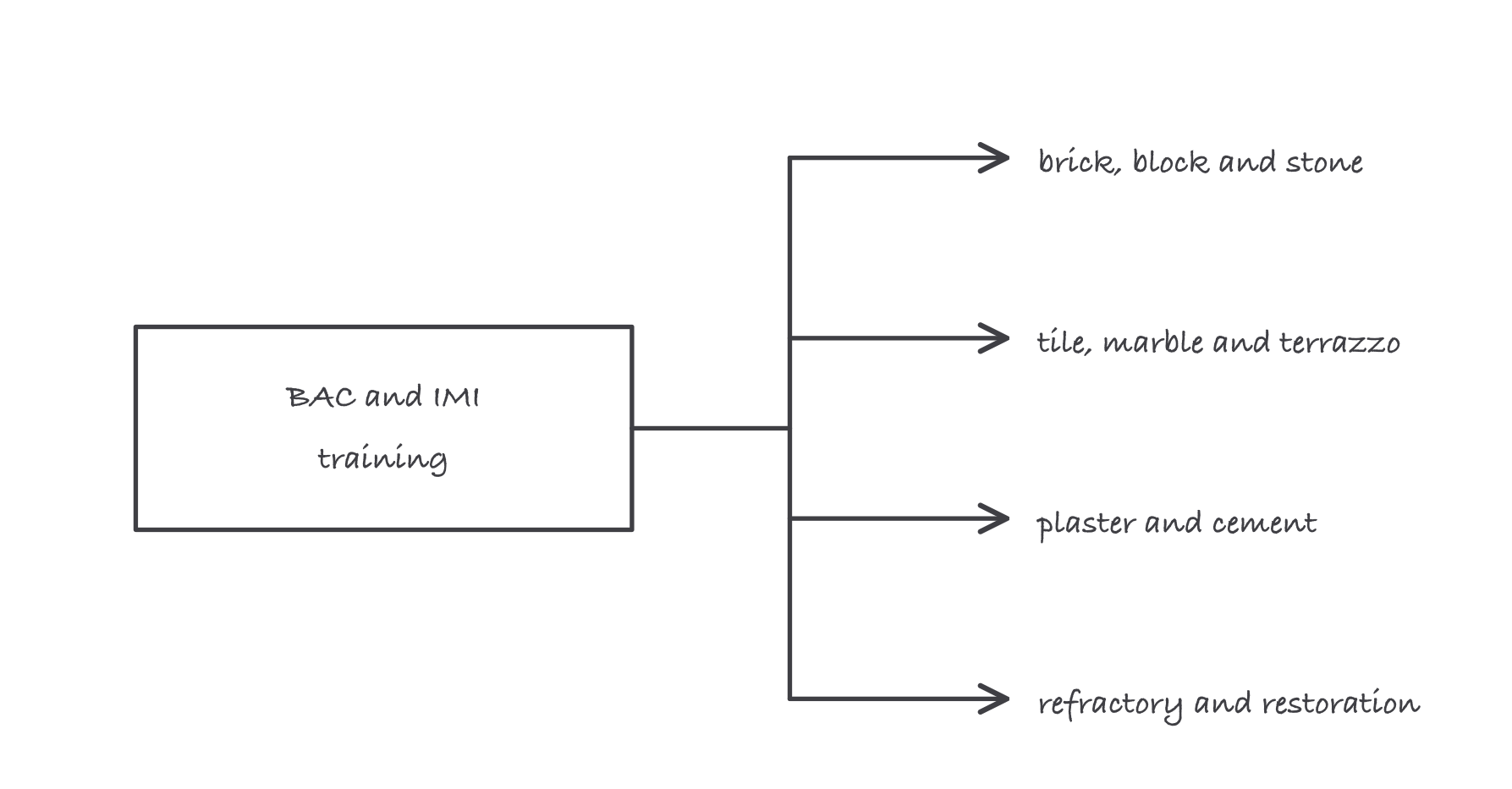
The trowel trades under one training structure: brick is one branch of it, not the whole tree
That breadth matters when work shifts. A member trained in brick, block and stone is nearer to tile, terrazzo, plaster or refractory work than an outsider is, and IMTEF’s job is to make crossing between them a course rather than a career restart.
What the program contains
The apprenticeship runs three to four years, and three things run through all of them at once:
- Classroom instruction on layout, prints, math, materials, codes and estimating.
- Shop training on practice panels, where a badly built lead costs mortar instead of a day’s production.
- On-the-job training, paid, on signatory contractors’ work, supervised by a journeyman.
Safety is inside the curriculum rather than beside it: BAC programs include OSHA 10 and OSHA 30, fall protection, scaffolding and silica awareness training. The silica component earns its place on the schedule, because this trade cuts and grinds the material that causes silicosis every working day, and the silica standard lesson covers the rule that training exists to satisfy.
Getting in
Application is local and periodic: the JATC opens a window, takes applications, and interviews. Expect the entry requirements common to registered apprenticeship (a minimum age, a high school diploma or equivalent, and the physical capacity to do the work), with the specifics set by your local rather than nationally. Two practical points: find the local before the window opens rather than after, and treat the interview as a hiring interview, because it is one.
Where it bites
- There is no national application. BAC apprenticeships are administered by locals, so “how do I apply to BAC” has a different answer in every metro area. Find your local’s JATC and ask them directly.
- No published national hours total. The programs advertise three to four years. The on-the-job hours requirement behind that is set by the local program, so get the number from the JATC that will be counting yours.
- Signatory means the contractor, not you. Your dispatch depends on which contractors in your area have agreements with the local, which is worth understanding before you assume a steady stream of work.
- The trowel-trades breadth cuts both ways. Being trained across the family is an advantage; drifting between branches without finishing one is not. Pick a branch and finish it, then cross over.