Learn · Masonry and Concrete
Mortar Types and Mixing
Part of Concrete Work to ACI Certification · step 8 of 22 · next: Laying Brick to the Line
In learning paths: Concrete Work to ACI Certification
Assumes you know: Masonry Materials: Brick, Block, Stone, Mortar
Mortar comes in four standard types, M, S, N and O, and the letters rank them by strength. The mnemonic is the word MaSoNwOrK: take every other letter and you get M, S, N, O, strongest to softest. Pick the type by matching it to the unit and the exposure, then mix it to a consistency that bonds.
Why it matters on the job
The specification names the mortar type; you batch it. Batch it wrong and the wall fails slowly: joints that are too strong crack the units they were meant to protect, and joints that are too weak wash out. Mortar is also the material you handle more than any other, so consistent batching is the first skill a mason’s tender is judged on.
What the letters mean
Each type carries a minimum compressive strength under ASTM C270, the mortar specification your project documents cite:
- Type M: 2,500 psi minimum. Heavy loads, below-grade work in contact with earth.
- Type S: 1,800 psi minimum. Structural work needing flexural strength (below grade, seismic detailing).
- Type N: 750 psi minimum. The everyday default for above-grade exterior walls, chimneys and veneer.
- Type O: 350 psi minimum. Interior, non-loadbearing work and repointing soft, older masonry.
Two traps live in this table. S does not stand for “standard” (none of the letters stand for anything; they are alternating letters of a mnemonic). And stronger is not better: you specify the weakest type that meets the job’s structural and exposure demands.
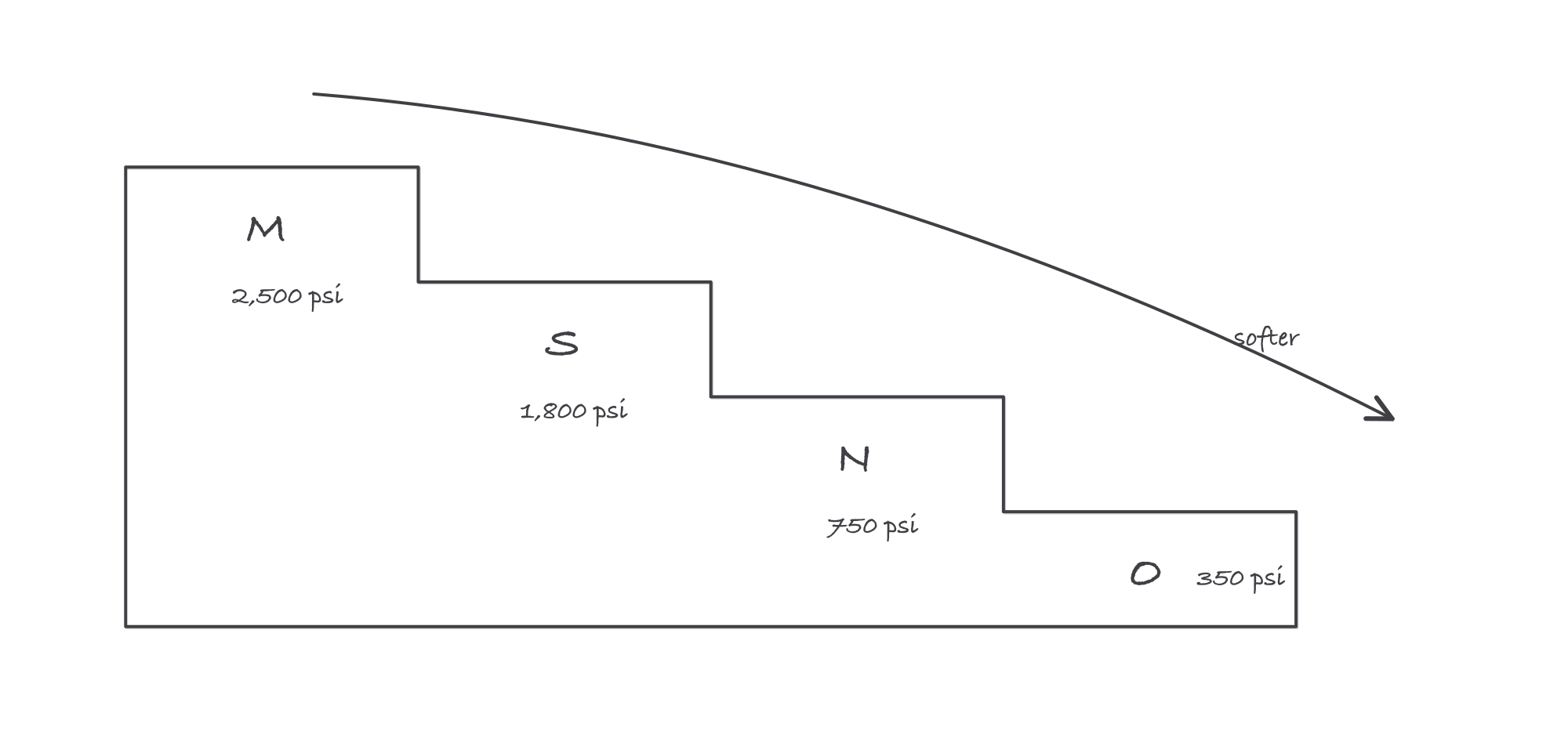
Every other letter of MaSoNwOrK: strength steps down from M to O, and you choose the softest step the job allows
Mortar should lose to the unit
Mortar is designed to be softer than the units it beds. The wall moves (thermally, structurally, with moisture), and the joint is the sacrificial part: hairline cracking in a mortar joint is repointable in an afternoon, while a spalled brick face is permanent damage. This is why repointing old, soft brick with hard Type M or S mortar is a classic destructive error: the new joint is now stronger than the old brick, so the brick edges spall and the face sheds. Old lime-mortar buildings usually call for Type O or a specified lime mix.
Mixing
Mortar is batched by proportions: cementitious materials (Portland cement plus hydrated lime, or a blended masonry cement) and damp loose sand. Under the proportion method, sand runs from 2 1/4 to 3 times the total cementitious volume. Water is not a fixed number. You add it to workability: a mortar that hangs on the trowel, spreads without running and holds a furrow.
Machine-mix three to five minutes after all materials are in. Mortar stiffening from evaporation may be retempered (a little water remixed in) but mortar that has begun hydrating is done; as a working rule, use or discard within about 2 to 2 1/2 hours of mixing, sooner in hot weather.
Worked example: batching by proportion
A Type N mix is specified as 1 part Portland cement, 1 part lime, with sand at 2 1/4 to 3 times the cementitious total.
- Batch 1 cu ft of cement and 1 cu ft of lime: cementitious total = 2 cu ft.
- Sand range: 2.25 × 2 = 4.5 cu ft minimum, 3 × 2 = 6 cu ft maximum.
- Batch 5 cu ft of sand (inside the range), then water to workability.
Measure sand the same way every batch (a counted number of identical shovels or a batching box). Drifting sand volume between batches changes both strength and color from one lift to the next.
Where it bites
- “Type S means standard” is wrong twice: the letter means nothing, and N, not S, is the everyday default.
- Retempering has a limit. Water restores workability, not hydration time. After roughly 2 1/2 hours the batch is trash, not thirsty.
- Masonry cement is not Portland cement. A blended masonry cement already contains its plasticizing ingredients; adding lime to it, or substituting straight Portland paste, produces an unclassified mix.
- Grout is not stiff mortar. The soupy mix that fills block cells follows opposite consistency rules, covered with block walls.