Learn · Masonry and Concrete
The OSHA Silica Standard
Part of Concrete Work to ACI Certification · step 13 of 22 · next: Working Table 1: Silica Controls for Saws, Grinders and Drills
In learning paths: Concrete Work to ACI Certification
29 CFR 1926.1153 is OSHA’s respirable crystalline silica standard for construction, and it governs almost everything this trade cuts, grinds, drills or demolishes. Concrete, brick, block, mortar and stone all contain crystalline silica; power tools turn it into respirable dust; and breathing that dust scars lungs permanently. The standard has been fully enforceable since September 23, 2017.
Why it matters on the job
Silicosis is incurable, progressive and entirely preventable, and it is not an old-timer’s disease: the exposures that cause it are happening on saws and grinders today, which is why the standard regulates concentrations measured in millionths of a gram. The crew that shrugs it off risks lungs and citations together.
The two numbers
Both are 8-hour time-weighted averages (TWA), meaning exposure averaged across a full shift:
- Permissible exposure limit (PEL): 50 µg/m³. No worker may be exposed above this, period. Engineering and work-practice controls must be used to get under it before respirators make up any difference.
- Action level (AL): 25 µg/m³. Half the PEL. At or above this level, the standard’s assessment machinery switches on even though the PEL is not exceeded.
Read those units carefully: the limit is a concentration, not a quantity. It is 50 micrograms of respirable dust suspended in a cubic meter of air, averaged over eight hours, which is a level you cannot see, smell or judge by eye. Visible dust in the air is not the threshold; it is well past it.
Three ways to comply
Table 1 lists common silica-generating tasks (saws, grinders, drills, jackhammers and more) with specified controls; run the listed controls fully and properly and you are deemed compliant for that task, no air monitoring required. It is the practical path for most crews, and the next lesson works through it.
The performance option uses objective data (industry or manufacturer exposure data matching your task and conditions) to characterize exposures without your own sampling.
Scheduled monitoring measures actual worker exposures. Results at or above the AL but at or below the PEL require repeat monitoring within 6 months; results above the PEL require repeat monitoring within 3 months, and controls to bring exposure down.
The written plan and the competent person
Every covered employer needs a written exposure control plan: the tasks that generate silica, the controls and housekeeping for each, and procedures to restrict access to high-exposure areas. The plan names a competent person: someone able to identify silica hazards and with the authority to correct them, who implements the plan on site.
Medical surveillance
An employee required by the standard to wear a respirator 30 or more days per year gets medical surveillance at no cost: an initial exam and then exams every three years, including a chest X-ray and a lung function test. The purpose is early detection, and the trigger is respirator days, not diagnosed symptoms.
Housekeeping: the banned shortcuts
Dry sweeping, dry brushing and cleaning with compressed air are prohibited where they could contribute to exposure, unless wet methods or HEPA-filtered vacuuming are infeasible. The broom and the blow-gun are how settled dust gets back into the air and into lungs; wet it or vacuum it.
Training
Covered workers must be trained on the health hazards of silica, the tasks on their job that generate it, the controls and work practices for each, the identity of the competent person, and the purpose of medical surveillance.
Worked example: reading two monitoring results
Your employer samples two workers on a block-cutting operation. Results, as 8-hour TWAs:
- Worker A: 32 µg/m³. Compare: 32 ≥ 25 (at or above the AL) and 32 ≤ 50 (at or below the PEL). Consequence: repeat monitoring within 6 months.
- Worker B: 61 µg/m³. Compare: 61 > 50, above the PEL. Consequence: additional controls to get under the limit, and repeat monitoring within 3 months.
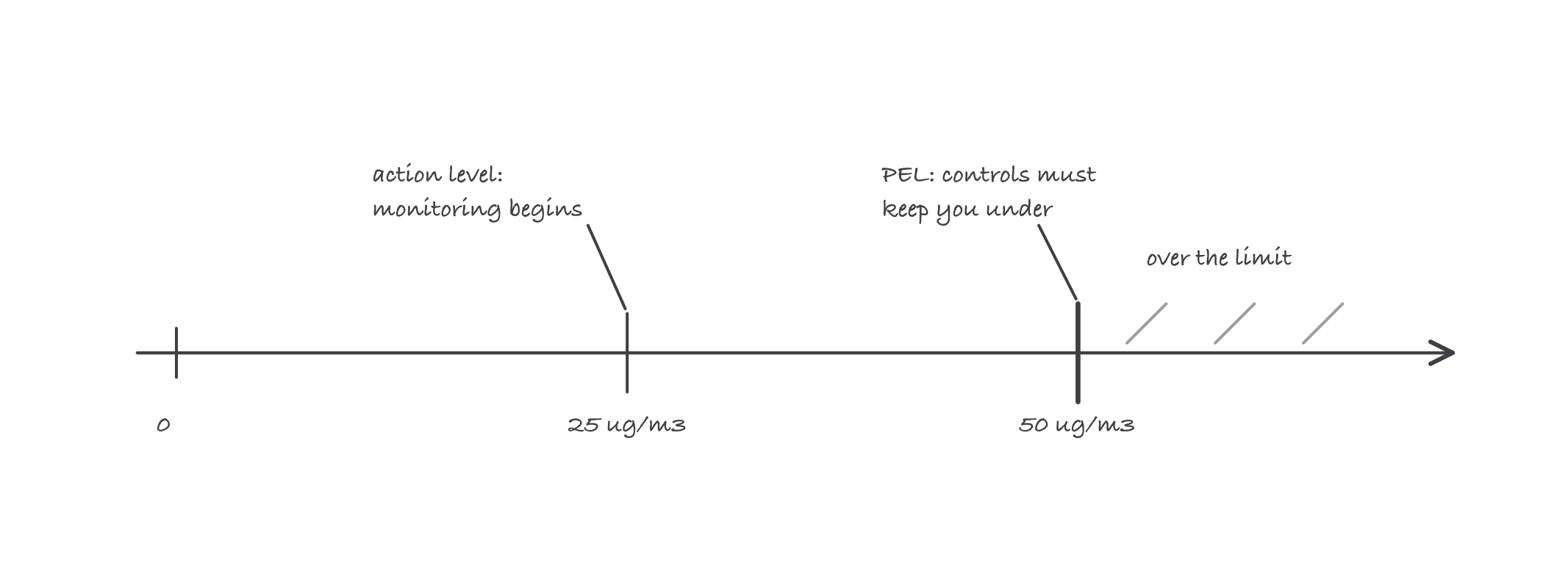
Two trigger points on one scale: 25 starts the monitoring machinery, 50 is the line controls must keep everyone under
Where it bites
- “A dust mask handles it.” The standard is a hierarchy: engineering controls and wet methods first, respirators last. A mask over an uncontrolled dry cut is noncompliant and unsafe.
- Sweeping the cut dust. The prohibition on dry sweeping and compressed air is explicit, and the broom at the end of the shift is where it gets broken.
- Thinking small jobs are exempt. One worker with one saw is covered. Table 1 exists precisely to give small employers a monitoring-free path.
- Confusing the AL with the PEL. 25 triggers assessment and surveillance machinery; 50 is the exposure ceiling. Exams and inspectors both probe the difference.