Qualifications · Masonry and Concrete
ACI Lab Certifications: Strength and Aggregate Testing
Part of Concrete Work to ACI Certification · step 18 of 22 · next: The Masonry Apprenticeship
In learning paths: Concrete Work to ACI Certification
Assumes you know: ACI Field Testing Technician Grade I: The Exam
The two ACI laboratory certifications cover the tests that happen after the concrete leaves your hands: Strength Testing Technician, which breaks the cylinders, and Aggregate Testing Technician Level 1, which grades the rock before it ever reaches the mix. Both are laboratory credentials rather than field ones, and both are the natural second step for a technician who already holds field testing.
*Learn the Trades is a free study resource. We are not a licensing body, an authorized training provider, or an exam administrator. Reading this page does not award any card, license, or certification. Always verify requirements with the issuing authority linked in the sources.*Why it matters on the job
Field testing produces the acceptance numbers for fresh concrete; these two produce the numbers that decide whether the hardened concrete and the raw materials were ever going to work. A cylinder break is the number that appears in a dispute, and a gradation is the number that explains why a mix behaved the way it did on the deck. Labs hire for these certificates directly, and for a field technician they are the ordinary route off the jobsite and into testing work that runs year round.
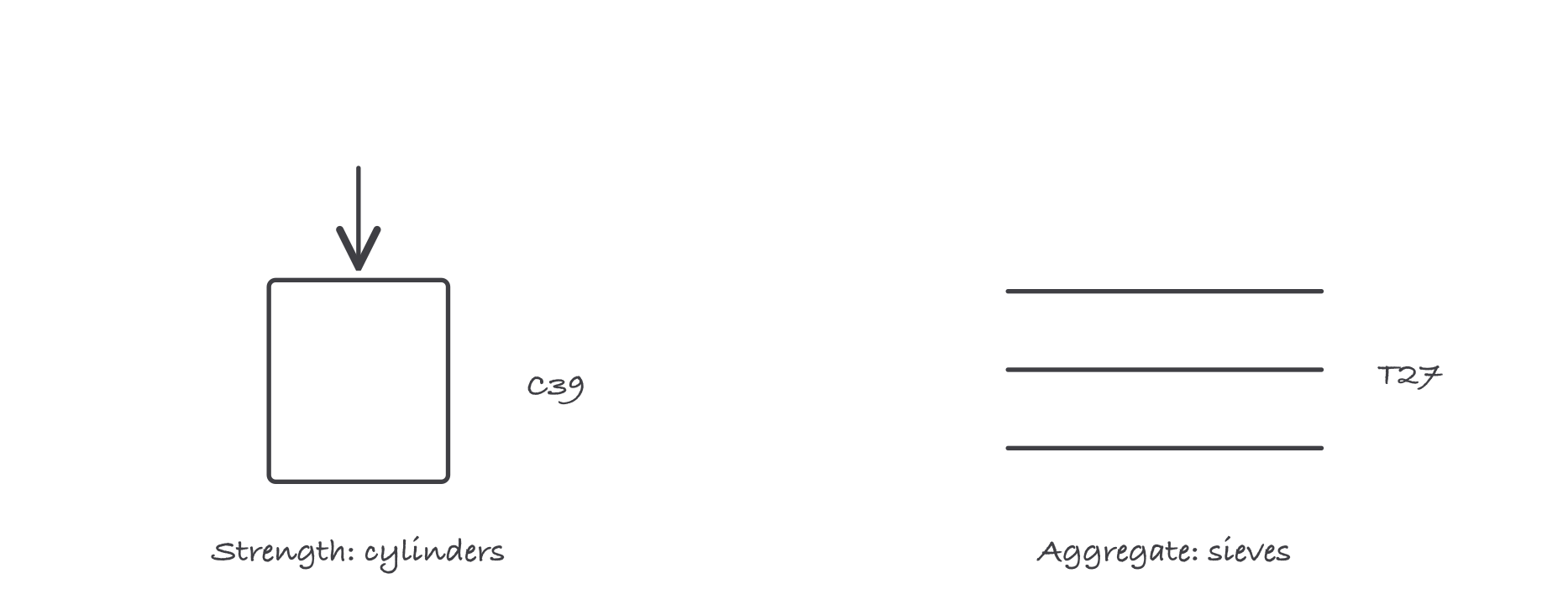
Two laboratories, two materials: one breaks the finished cylinder, the other sizes the rock that went into it
What each one covers
Strength Testing Technician is about load and geometry. C39 is compressive strength of cylinders, C78 is flexural strength of beams, C617 is capping specimens with a bonded cap and C1231 is capping with unbonded neoprene pads. The performance examination is procedural: how the specimen is measured, how it is seated, how fast the load is applied, and how the fracture is reported.
Aggregate Testing Technician Level 1 is about sampling and separation. R90 is sampling aggregates, R76 is reducing a sample to testing size, T11 is the wash test for material finer than the 75 µm sieve and T27 is sieve analysis. The written examination is open book, which sounds generous and is not: it is long, and it rewards a candidate who already knows where in the method each answer lives.
Worked example: the area is the whole test
A 6 by 12 inch cylinder breaks at 113,000 lbf. Compressive strength is load divided by the cross-sectional area.
- Radius: 6 ÷ 2 = 3 in
- Area: π × 3² = 28.274 in²
- Strength: 113,000 ÷ 28.274 = 3,996 psi
Against a specified 3,500 psi, that placement is accepted. Now make the error the performance examination is built to catch: use the area of a 4 by 8 inch cylinder (π × 2² = 12.566 in²) by habit, and the same break reports as 113,000 ÷ 12.566 = 8,992 psi, which is 2.25 times the real strength. Nothing about the break looked wrong. The number was wrong before the specimen went in the machine, which is why the examination watches you measure.
Where it bites
- Specimen size travels with the number. Report the strength without the specimen dimensions and the next person cannot check your arithmetic, which is exactly when a low break becomes an argument.
- Capping method changes the result. Bonded caps and unbonded pads are different methods with different limits, and using pads outside their strength range produces breaks that fail for reasons that have nothing to do with the concrete.
- Aggregate results depend on the sample, not the sieve. Most gradation disputes trace back to R90 and R76, the sampling and reduction that happened before anyone touched a sieve stack.
- Open book is not easy book. Candidates who plan to look everything up run out of time. The book is there for the numbers, not the procedure.
Exam relevance
ACI Field Testing Technician Grade I is the natural prerequisite in practice, because the sampling discipline it teaches is assumed here. Working through the four methods in each program with the standards open, then running each one under time, is the preparation that matches how both examinations are scored.
Verified requirements
| Where | Expires | Renewal | Continuing education |
|---|---|---|---|
| United States (federal) | Yes | 5 years | Confirm with issuer |
| United States (federal) | Confirm with issuer | Confirm with issuer | Confirm with issuer |
Information comes from issuing-authority sources. Confirm current rules, fees and eligibility with the authority before acting.