Learn · Masonry and Concrete
Cold and Hot Weather Concreting
Part of Concrete Work to ACI Certification · step 6 of 22 · next: Masonry Materials: Brick, Block, Stone, Mortar
In learning paths: Concrete Work to ACI Certification
Assumes you know: Curing
Temperature is the third party on every pour. Hydration is a chemical reaction, and like most reactions it runs slow when cold and fast when hot. Both directions can wreck the work: cold concrete may freeze before it has strength to resist, and hot concrete may set before you can place and finish it. Weather concreting is the foreman’s discipline of adjusting the mix, the schedule and the protection so the reaction runs at a speed the crew and the concrete can both survive.
Why it matters on the job
The mix design assumes a mild day. You rarely get one. Reading a forecast and translating it into concrete decisions (order changes, pour timing, protection materials on site before the truck) is exactly the judgment that separates a foreman from a finisher, and the failures are expensive: a frozen slab is often a demolished slab, and a flash-set wall full of cold joints is not much better.
Cold weather: the reaction starves, then the water freezes
Cold-weather practice kicks in when temperatures hang low, commonly treated as mean daily temperatures below about 40 °F. Two dangers stack:
- Slow strength gain. Cold hydration crawls. Forms and shores stay in place longer, and the slab that would take foot traffic tomorrow in June takes days in January.
- Freezing. If fresh concrete freezes before gaining modest early strength, the mixing water expands as ice and breaks the young paste from the inside: a permanent strength loss no amount of later curing repairs. Early strength is the armor; protection buys the time to build it.
The playbook: never place on frozen subgrade or against ice (it thaws, settles and robs heat); order heated mix in cold spells (plants heat the water and sometimes aggregate); consider accelerating admixtures or higher early-strength mixes; and protect after placing with insulated blankets or heated enclosures, keeping the concrete comfortably warm through the protection period (the first several days). Vent fuel-burning heaters: their exhaust can carbonate and dust the surface of fresh slabs.
Hot weather: the reaction sprints
Heat, wind, sun and low humidity attack from the other side, and hot-weather trouble starts well before triple digits:
- Slump loss and flash set. Hot concrete stiffens fast; the working window shrinks, and the temptation to add water (and destroy strength) grows with it.
- Plastic shrinkage cracking. When surface evaporation outruns bleeding, the still-plastic surface tears in shallow parallel cracks. Hot wind on a big slab is the classic setup.
- Cold joints. A delayed truck on a fast-setting day leaves the last load bonding to concrete that already stiffened.
The playbook: pour early morning or at night; dampen the subgrade and forms; batch with chilled water or ice when specified; keep trucks moving with tight spacing and short waits; use retarders or plasticizers rather than the hose; put windbreaks, sunshades, fog sprays or an evaporation retarder on exposed flatwork; and start curing immediately, because the first hour is the most dangerous.
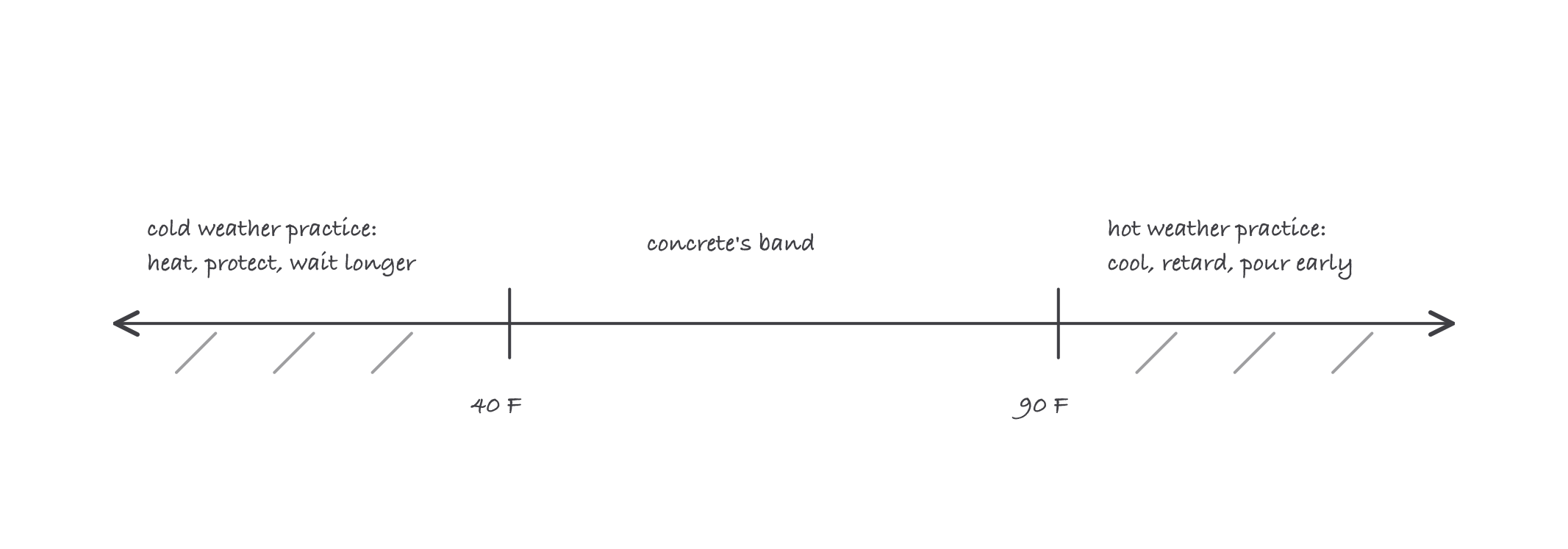
Both ends of the scale steal the same things, working time and strength, by opposite mechanisms: plan the pour for the band, not the calendar
Worked example: reading a winter forecast
A 4 in exterior slab is scheduled for Thursday. Forecast: high 38 °F, overnight low 22 °F.
- Mean daily temperature: (38 + 22) / 2 = 30 °F, well under the 40 °F line: cold-weather practice governs.
- Subgrade check Wednesday: probe for frost. Frozen ground postpones the pour, not just the finish.
- Order heated mix, and have insulated blankets on site before the truck (a 22 °F night will freeze an unprotected fresh slab).
- Hold protection in place through the early strength-gain days (at least 48 to 72 hours for a conventional mix), and expect strength on site to run days behind a mild-weather pour.
The decision chain runs off two numbers from a free forecast, which is why there is no excuse for being surprised.
Where it bites
- “It survived the night” optimism. Freeze damage in young concrete is internal and permanent; a surface that looks fine can still break weak. Prevent it; do not hope past it.
- Fighting hot-weather slump loss with water. The fundamentals lesson already ran that math; the answer on a hot day is admixtures, scheduling and truck management.
- Protecting the top and forgetting the edges. Blankets on the slab with exposed slab edges, or a heated enclosure with a frozen subgrade under it, protects only part of the pour.
- Unvented heaters. Direct-fired heaters in a closed enclosure over fresh concrete can soften and dust the surface; vent them or use indirect heat.