Business · Masonry and Concrete
Becoming a Masonry/Concrete Contractor
Part of Concrete Work to ACI Certification · step 20 of 22 · next: Masonry and Concrete Contractor Licensing by State
In learning paths: Concrete Work to ACI Certification
A contractor license is not a higher grade of mason. It is permission to sell the work, and states grant it on evidence of two different things: that somebody in the business knows the trade, and that the business itself can be held responsible. You can be the best bricklayer in the county and still fail the application, because most of what boards examine is the second half.
*Learn the Trades is a free study resource. We are not a licensing body, an authorized training provider, or an exam administrator. Reading this page does not award any card, license, or certification. Always verify requirements with the issuing authority linked in the sources.*Why it matters on the job
In licensing states, contracting without the license the work requires is an enforcement matter, and it also tends to be a collections matter: an unlicensed contractor’s ability to sue for unpaid work is restricted or eliminated in many jurisdictions. General contractors and public owners will not put you on a bid list without the number, and neither will most insurers. The license is the price of being a business rather than a subcontractor’s labor.
The qualifier: a person, attached to a business
Boards do not license companies for skill; they license companies that have a qualifying individual (commonly the qualifier or responsible managing employee/officer) whose personal experience backs the classification. The qualifier is the trade knowledge on the license, and the exams are that person’s exams. That is why a contractor license is a career step for a journeyman and also why “we will find someone to qualify us” is a fragile plan: if the qualifier leaves, the classification goes with them.
The four gates
- Experience. Documented, verifiable, journeyman-level or above, in the classification you are applying for, inside a window of recent years.
- Exams. Typically two: a trade exam for the classification, and a law and business exam covering contracts, lien law, employment, safety and bookkeeping.
- Financial and legal standing. A bond, workers’ compensation coverage where you have employees, liability insurance, an entity and a tax registration.
- Application and fees, with the board auditing what you claimed in gate 1.
Gates 2 through 4 are where most masons lose time, and gate 1 is where most masons lose the application.
Worked example: counting experience inside a sliding window
California requires the qualifier to document at least four years of journeyman-level or higher experience within the last ten years, in the classification applied for, verified by a qualified person who has direct knowledge of the work. Take an applicant applying in August 2026, so the window opens in August 2016:
- 2013 to 2017, masonry apprentice. Apprentice time is below journeyman level, so it contributes 0 years regardless of the window.
- August 2017 to August 2020, journeyman bricklayer. 3 years, entirely inside the window. Counts 3.
- 2020 to 2022, out of the trade. Counts 0.
- August 2022 to August 2024, masonry foreman. 2 years at above journeyman level, inside the window. Counts 2.
Total: 3 + 2 = 5 years of qualifying experience against a 4-year requirement. The application clears, with one year to spare.
Now delay the application three years to August 2029. The window slides to August 2019, and the journeyman stretch loses two of its three years (only August 2019 to August 2020 remains, which is 1 year). The count becomes 1 + 2 = 3 years, and the same applicant now falls a year short with no new trade work to fix it.
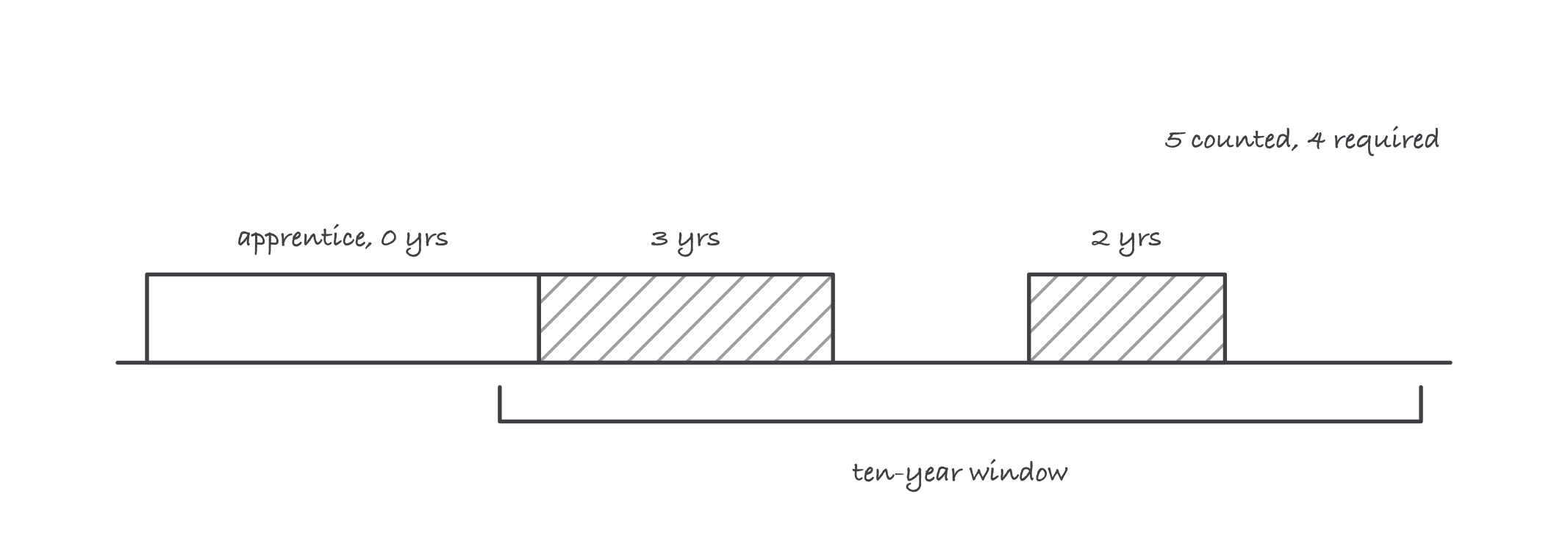
Only the shaded years inside the window count, and the window slides forward every day you wait
The half of the job that is not masonry
The law and business exam covers the half of contracting that happens off the wall, and the board weights it as heavily as the trade exam because that is where contractors actually fail. The topics: contracts and change orders, mechanics lien deadlines, payroll and workers’ compensation, OSHA duties as an employer, estimating and job costing, and the cash-flow arithmetic of carrying material and payroll while a general contractor pays in 60 days.
Where it bites
- Nobody can verify experience you did not record. Boards want dates, employers and a verifier with direct knowledge. Keep signed records from your apprenticeship onward, and keep contact details for supervisors who will still answer a phone in ten years.
- Self-employment is not automatically disqualifying, but it is harder to prove. If you have worked for yourself, expect to substantiate the work with contracts, permits, invoices and client statements rather than a supervisor’s signature.
- One classification rarely covers a whole job. Masonry and concrete are separate classifications in some states, and the mix of work you sell decides how many you need. The next lesson works through that split.
- The window punishes waiting. Recent experience is the requirement, so time out of the trade quietly erodes an application that was complete two years ago.