Qualifications · Masonry and Concrete
ACI Field Testing Technician Grade I: The Exam
Part of Concrete Work to ACI Certification · step 16 of 22 · next: ACI Flatwork Finisher: The Three-Level Ladder
In learning paths: Concrete Work to ACI Certification
Assumes you know: Concrete Fundamentals: Mix, Water, Strength, Placing Concrete
Concrete Field Testing Technician Grade I certifies that you can run seven ASTM test methods on fresh concrete exactly as written. It is the credential public work asks for by name. It has no education or experience prerequisite, and it is won and lost on procedural detail rather than on how much concrete you have placed.
*Learn the Trades is a free study resource. We are not a licensing body, an authorized training provider, or an exam administrator. Reading this page does not award any card, license, or certification. Always verify requirements with the issuing authority linked in the sources.*Why it matters on the job
The numbers a field technician produces are acceptance numbers. A slump outside the specified range can send a truck back down the road; an air content reading below the specified minimum on a freeze-thaw slab can condemn a placement; cylinders cured wrong on site produce low breaks that get blamed on the mix. Specifications require certified technicians because the tests only mean anything when everybody runs them the same way, which is precisely what the certification tests.
The seven methods
The whole exam, written and performance, is built on these:
- ASTM C172, sampling freshly mixed concrete. The one everything else depends on: an unrepresentative sample makes all six other results meaningless.
- ASTM C1064, temperature of freshly mixed concrete.
- ASTM C143, slump of hydraulic-cement concrete.
- ASTM C138, density (unit weight), yield and gravimetric air content.
- ASTM C231, air content by the pressure method. For normal-weight concrete.
- ASTM C173, air content by the volumetric method. For lightweight and porous aggregates, where pressure readings mislead.
- ASTM C31, making and curing concrete test specimens in the field.
Two of them measure the same property by different routes (C231 and C173 both give air content), and knowing which one belongs on which concrete is standard exam material.
The written exam
55 multiple-choice questions, one hour, closed book. Two thresholds have to be cleared at once:
- At least 60% on each of the seven methods, scored method by method.
- At least 70% overall.
Both, not either. The per-method floor exists so a candidate cannot bury total ignorance of one procedure under strong scores everywhere else, which is exactly what happens on a job when a technician is fluent on slump and vague on volumetric air.
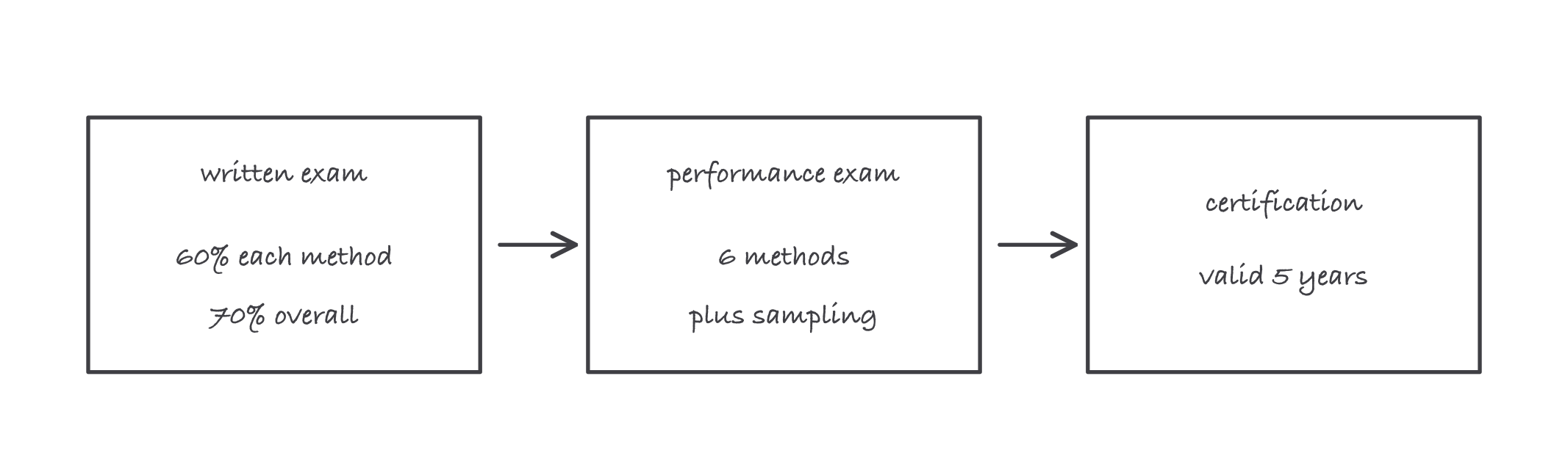
Both gates, in series: the written exam carries two thresholds at once and the performance exam is a separate pass of its own
Worked example: three score sheets
- 40 correct out of 55. Overall: 40 ÷ 55 = 0.727, so 72.7%, clear of the 70% bar. But the misses cluster, and on the volumetric air method (C173) you answer 55% of that method’s questions correctly. 55 is below 60, so that method fails and the written exam fails with it.
- 37 correct out of 55. Overall: 37 ÷ 55 = 0.673, so 67.3%. Below 70%, so this fails on the overall bar even if all seven methods happen to sit above their 60% floors.
- The arithmetic floor. 70% of 55 is 38.5 questions, and you cannot answer half a question. 38 correct gives 38 ÷ 55 = 69.1%, which fails; 39 correct gives 39 ÷ 55 = 70.9%, which passes. So 39 is the minimum overall score, and it is still only a pass if no single method has dropped below 60%.
Read that third line again before you plan to scrape through. The realistic target is not the floor: it is a comfortable margin on every one of the seven.
The performance exam
Hands-on, in front of an examiner: you demonstrate six of the methods and give a verbal description of sampling practice C172. Sampling is described rather than performed because a ready-mix truck discharging at the correct intervals is not available in an exam room, and it is still examined because it is the method most often abused in the field.
The performance exam is scored on procedure. Not “is the slump number plausible” but did you dampen the cone, fill in three equal layers by volume, rod 25 times per layer, distribute the rod strokes, penetrate the layer below correctly, strike off, lift the cone in the specified time, and measure to the displaced original center. Field habit is the enemy here: shortcuts that never changed a number on a real job will still fail the exam, and they are shortcuts precisely because they sometimes do change the number.
Validity and recertification
The certification runs five years. Recertification means sitting both exams again, so the honest way to hold it long term is to keep running the methods to the written procedure between certifications rather than relearning them every fifth year.
Where it bites
- Rod counts and layer counts are per method, and they differ. C143 slump is three layers of 25 rod strokes. C31 cylinder casting depends on the mold size and consolidation method. Candidates blend them together under exam pressure.
- C231 on lightweight concrete. The pressure method assumes normal-weight aggregate. Porous lightweight aggregate holds air that the pressure method reads as entrained air, which is why C173 exists. Expect to be asked.
- Field-cured is not standard-cured. C31 covers both, and the cylinders that verify f’c are the standard-cured set. Cylinders left on the slab overnight in a January wind answer a different question, and the answer will be low.
- The sample is the whole exam. Composite sampling, the interval of discharge it is taken from, and the time limits between sampling and testing are all scored, and all are the first things to slip on a busy pour.
Exam relevance
This lesson is the exam. Everything in the concrete fundamentals and placing lessons appears here in applied, procedural form: the difference between knowing that entrained air protects a slab and being able to measure it to C231 in front of an examiner who is watching your rod strokes.
Verified requirements
| Where | Expires | Renewal | Continuing education |
|---|---|---|---|
| United States (federal) | Yes | 5 years | Confirm with issuer |
Information comes from issuing-authority sources. Confirm current rules, fees and eligibility with the authority before acting.