Learn · Masonry and Concrete
Bond Patterns
Part of Concrete Work to ACI Certification · step 11 of 22 · next: Masonry Flashing and Weeps
In learning paths: Concrete Work to ACI Certification
Assumes you know: Laying Brick to the Line
A bond pattern is the arrangement of units in the wall face: how each course overlaps the one below it. The overlap is structural before it is decorative, because lapped units interlock the wall and spread every load sideways as it travels down.
Why it matters on the job
The pattern decides your layout, your cut list and your production rhythm before the first unit is bedded. It also carries code consequences: walls that give up the overlap (stack bond) need reinforcement to replace the interlock the pattern no longer provides. Read the pattern off the drawings, plan it from the openings, then lay it without breaking rhythm.
The vocabulary: how a brick can face you
Each orientation has a name, and patterns are described with them: a stretcher shows its long face (the default), a header shows its end, a soldier stands upright showing its long face, a rowlock lies on its face showing its end, and a sailor stands upright showing its broad side. Soldier courses band openings and parapets; rowlocks cap sills; headers make patterns and, in old multi-wythe walls, structure.
The working patterns
Running bond is the default: every course is stretchers, each lapping the course below by half a unit. Maximum interlock, no cuts except at ends and openings, fastest to lay. Brick veneer and block walls are overwhelmingly running bond.
Stack bond aligns every head joint vertically: no lap, no interlock, a clean modern grid. The look costs structure, so the continuous vertical joint lines must be compensated: codes require horizontal joint reinforcement in masonry not laid in running bond, and the layout demands dead-plumb head joints because every error reads as a broken grid line.
Header patterns come from the era of solid multi-wythe walls, where header courses tied the front wythe to the wythe behind. Common (American) bond is running bond with a full header course at a regular interval (traditionally every fifth to seventh course). Flemish bond alternates stretcher and header within every course; English bond alternates full stretcher courses with full header courses. In modern single-wythe veneer there is no back wythe to tie, so pattern headers are half-bricks (snapped headers) and the tying is done by metal veneer anchors.
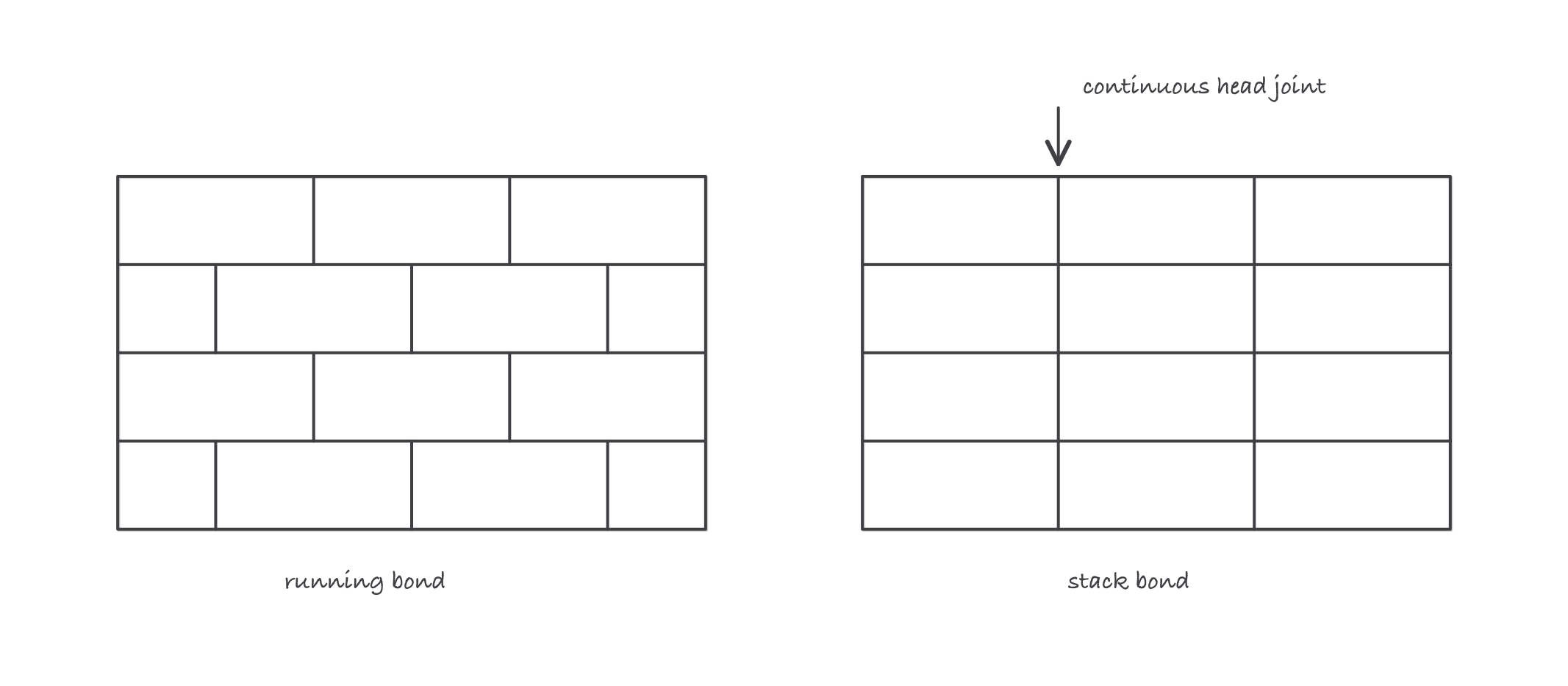
Running bond interlocks every course; stack bond stacks its head joints into one continuous vertical line that reinforcement must compensate
Worked example: bricks per square foot
Modular brick occupies an 8 in by 2 2/3 in module in the wall (unit plus joint).
- Module area: 8 × 2.667 = 21.33 sq in.
- Bricks per square foot: 144 / 21.33 = 6.75.
- A 100 sq ft running bond veneer: 100 × 6.75 = 675 bricks before waste and cuts.
Header courses change the count: a header face occupies only a 4 in by 2 2/3 in module, so every header course doubles the units in that course. Estimate pattern bonds course by course, not with the running bond factor.
Where it bites
- Stack bond laid like it is only a look. The pattern removes the interlock; horizontal joint reinforcement is a code requirement, not a suggestion, and it must be in the spec before the wall goes up.
- Starting layout from a corner instead of the openings. Dry-bond the course (or run the spacing rule) so cuts land equal at both ends and the pattern arrives whole at windows and doors. A pattern that dies into an opening with a 1 in sliver was lost at layout, not at laying.
- Reading old walls with modern eyes. Headers in a 1920s wall are structure (they tie wythes). Cutting them out during alterations, or repointing them casually, is structural work, not cosmetics.