Learn · Construction Safety
Navigating 29 CFR 1926
Part of From the Tools to Safety Professional · step 19 of 24 · next: OSHA 10: What It Is and Who Actually Issues Cards
In learning paths: From the Tools to Safety Professional
Assumes you know: How OSHA Works: Standards, Citations, Inspections
The construction standards are a filing cabinet, and Part 1926 is organized well enough that finding any rule takes under a minute once you know the drawers. Navigating it is a skill worth deliberately building, because the tradesperson who can look up the actual rule stops arguing from memory and starts settling questions on the spot.
*Learn the Trades is a free study resource. We are not a licensing body, an authorized training provider, or an exam administrator. Reading this page does not award any card, license, or certification. Always verify requirements with the issuing authority linked in the sources.*Why it matters on the job
Half the safety arguments on a jobsite are two people quoting rules neither has read. The trigger height, the inspection frequency, the required overlap: these are written down, in public, for free, on osha.gov. Being the person who can pull the actual text changes your standing on site and occasionally changes the plan before someone gets hurt.
The structure: four levels deep
The rules nest in four layers, and the address tells you the whole path:
- Title 29 of the Code of Federal Regulations: everything the Department of Labor writes.
- Part 1926: the construction standards. Its sibling, Part 1910, covers general industry, and some 1910 rules reach construction work where 1926 is silent.
- Subparts, lettered A through Z and beyond: the drawers of the cabinet, one per subject area.
- Sections, numbered within the part, holding the actual requirements.
You rarely need to memorize section numbers. You do need to know which drawer holds your work.
The drawers you will actually open
A working map of the subparts that cover most construction trades:
- Subpart C: general safety and health provisions, including the competent person definition that the whole part leans on.
- Subpart E: personal protective equipment.
- Subpart K: electrical.
- Subpart L: scaffolds.
- Subpart M: fall protection, the trigger heights and system requirements.
- Subpart P: excavations and trenching.
- Subpart X: stairways and ladders.
Read that list twice and you already know where roughly 80 percent of jobsite questions live.
The lookup skill
Four habits turn the cabinet into a tool:
Start from the work activity, not the hazard. Falls appear in Subpart M generally, but scaffold falls live in L and ladder falls in X. The activity picks the drawer.
Read the front of the subpart first. Most subparts open with scope and definitions. The definitions matter: words like hole, competent person, and qualified person carry precise meanings that decide how the rest reads.
Check the appendices. Many subparts carry appendices with worked methods, sample calculations, and diagrams. Some are mandatory, most are guidance, and each appendix says which it is.
Search the source, cite the source. The standards are free on osha.gov with a working search. A screenshot of the actual text ends debates that a recollection never will.
Worked example: settling a ladder argument in three steps
A foreman insists your extension ladder only needs to reach the roof edge. You remember a 3 ft rule but want the text.
- Pick the drawer by activity. Ladder work: Subpart X, stairways and ladders.
- Scan the section on ladder use. Within a minute you find the requirement: side rails of a portable ladder used to access an upper landing must extend at least 3 ft above the landing surface, or be secured with a grab device.
- Show, do not recite. The foreman reads it on your phone. The ladder gets extended, and the exchange took less time than the argument it replaced.
The clause number is not the skill. The path is: activity, subpart, section, text.
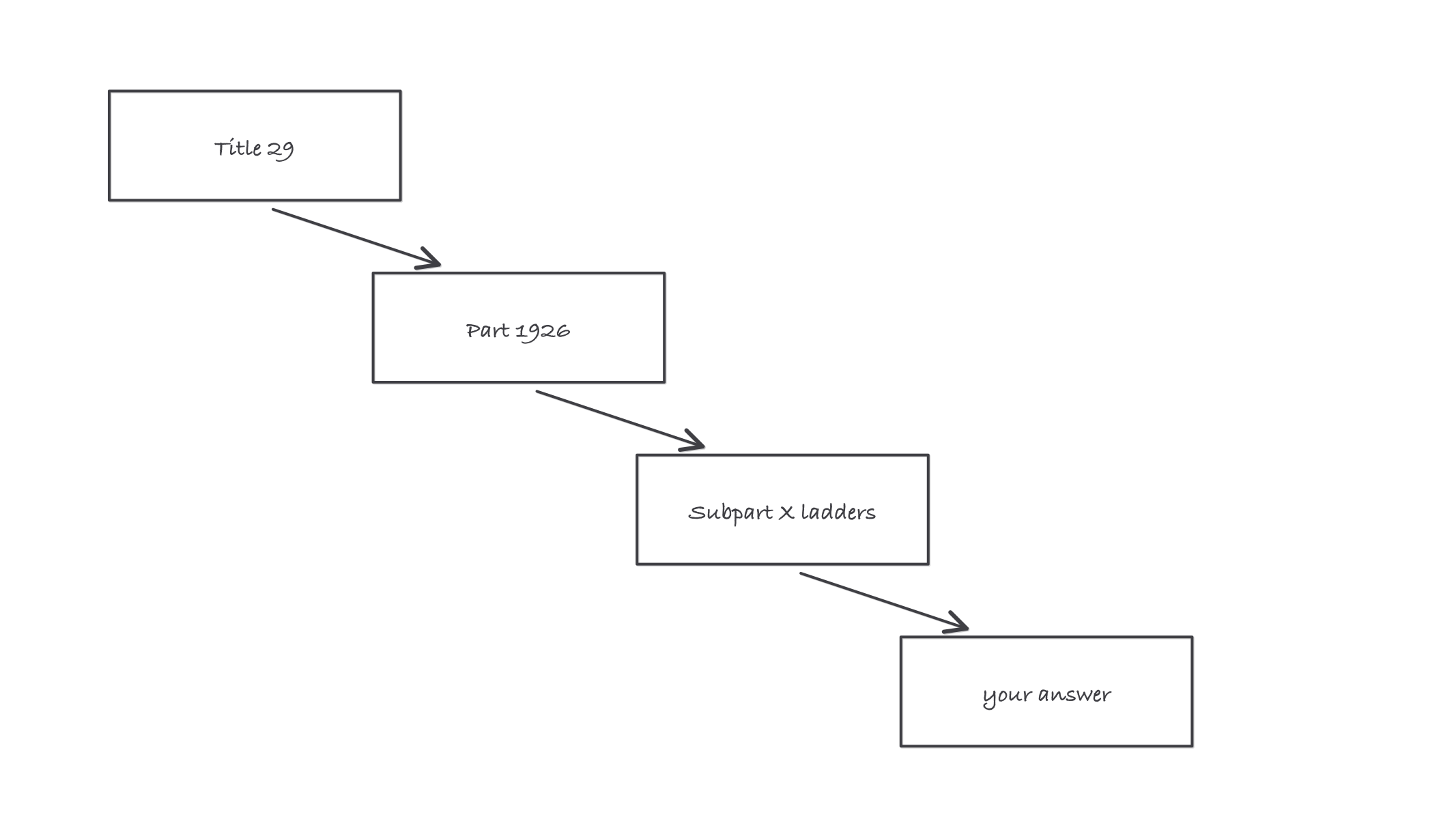
Four levels from the whole rulebook to the sentence you need: title, part, subpart, section
Where it bites
- Searching 1910 for construction work. The parts overlap in subject but differ in numbers. Confirm you are in 1926 before quoting anything on a construction site.
- Silence in the standards is not permission. Where no specific standard covers a recognized serious hazard, the employer’s general duty still applies. Absence of a clause is not absence of an obligation.
- Skipping the definitions. Terms of art read like plain English and are not. What counts as a hole or an opening decides which protections apply.
- Treating every appendix as optional. Each one states whether it is mandatory. Guessing the wrong way on a trench sloping appendix is an expensive mistake.
- Forgetting state plans. A state-plan state may have renumbered, tightened, or added rules. The federal text is the floor, not always the final word on your site.
Verified requirements
| Where | Expires | Renewal | Continuing education |
|---|---|---|---|
| United States (federal) | Confirm with issuer | Confirm with issuer | Confirm with issuer |
| United States (federal) | Confirm with issuer | 5 years | Confirm with issuer |
Information comes from issuing-authority sources. Confirm current rules, fees and eligibility with the authority before acting.