Learn · Construction Safety
HazCom and GHS
Part of From the Tools to Safety Professional · step 11 of 24 · next: Ladder Safety
In learning paths: From the Tools to Safety Professional
Hazard communication is your right to know what is in the containers around you, delivered through three channels that only work together: labels on the containers, safety data sheets behind the labels, and training that teaches you to read both. Lose any one channel and the other two stop protecting you.
*Learn the Trades is a free study resource. We are not a licensing body, an authorized training provider, or an exam administrator. Reading this page does not award any card, license, or certification. Always verify requirements with the issuing authority linked in the sources.*Why it matters on the job
Construction chemicals rarely announce themselves. Adhesives, form release agents, fuels, epoxies, and cutting fluids all look like liquids in buckets, and the difference between an irritant and something that quietly damages lungs over a season is printed on the label, if you can read it. The Globally Harmonized System, GHS, standardized that printing worldwide, so one afternoon of pictogram literacy pays off on every product you will ever open.
The label: six things in the same places
Every GHS-formatted shipped container label carries the same elements:
- Product identifier: the name that matches the safety data sheet.
- Signal word: exactly one of two. Danger marks the more severe hazards; Warning the less severe. A product gets one word, never both.
- Pictograms: red diamond symbols flagging hazard classes.
- Hazard statements: standard phrases stating the hazard itself.
- Precautionary statements: what to do about it, handling, storage, first aid.
- Supplier identification: who makes it and how to reach them.
Pictogram literacy
Nine diamonds exist. Six of them do most of the work on a construction site:
- Flame: flammables. The most common diamond on site.
- Health hazard (silhouette with a starburst chest): the serious long-game hazards, carcinogens, respiratory sensitizers, organ toxicity.
- Exclamation mark: irritants and less severe toxicity. Common, and commonly misread as trivial.
- Corrosion: destroys skin and eyes on contact, and metals too.
- Skull and crossbones: acutely toxic, small exposures can kill.
- Gas cylinder: contents under pressure.
The diamonds flag hazard class, not rank. A product with one health hazard diamond can be a worse long-term bet than one wearing three others.
The safety data sheet: 16 sections, always in order
The SDS is the label’s full story, and its power is that every SDS in the world uses the same 16 sections in the same order. You do not read an SDS front to back; you go straight to the section that answers your question:
- Section 2: hazard identification, the label information expanded.
- Section 4: first aid measures.
- Section 8: exposure controls and personal protection, which gloves, what ventilation, which respirator.
SDSs must be readily accessible during your shift. Your employer’s training covers the specific products in your workplace; that training is the third channel, and this page does not substitute for it.
Worked example: reading an adhesive before opening it
A new pail of solvent-based contact adhesive arrives. The label reads: signal word Danger, pictograms flame and health hazard, hazard statements including highly flammable liquid and vapor, and may cause damage to organs through prolonged exposure.
- Danger plus flame: vapor control is the immediate issue. No hot work nearby, ventilation before the lid comes off.
- Health hazard diamond: this is not just a smell. Go to Section 8 of the SDS: it specifies the glove material and when respiratory protection is required.
- Section 8 names an organic vapor concern in enclosed spaces: your enclosed stairwell application means raising it with the foreman before work starts, because engineering controls beat cartridges.
Two minutes of reading converted an anonymous pail into a specific plan.
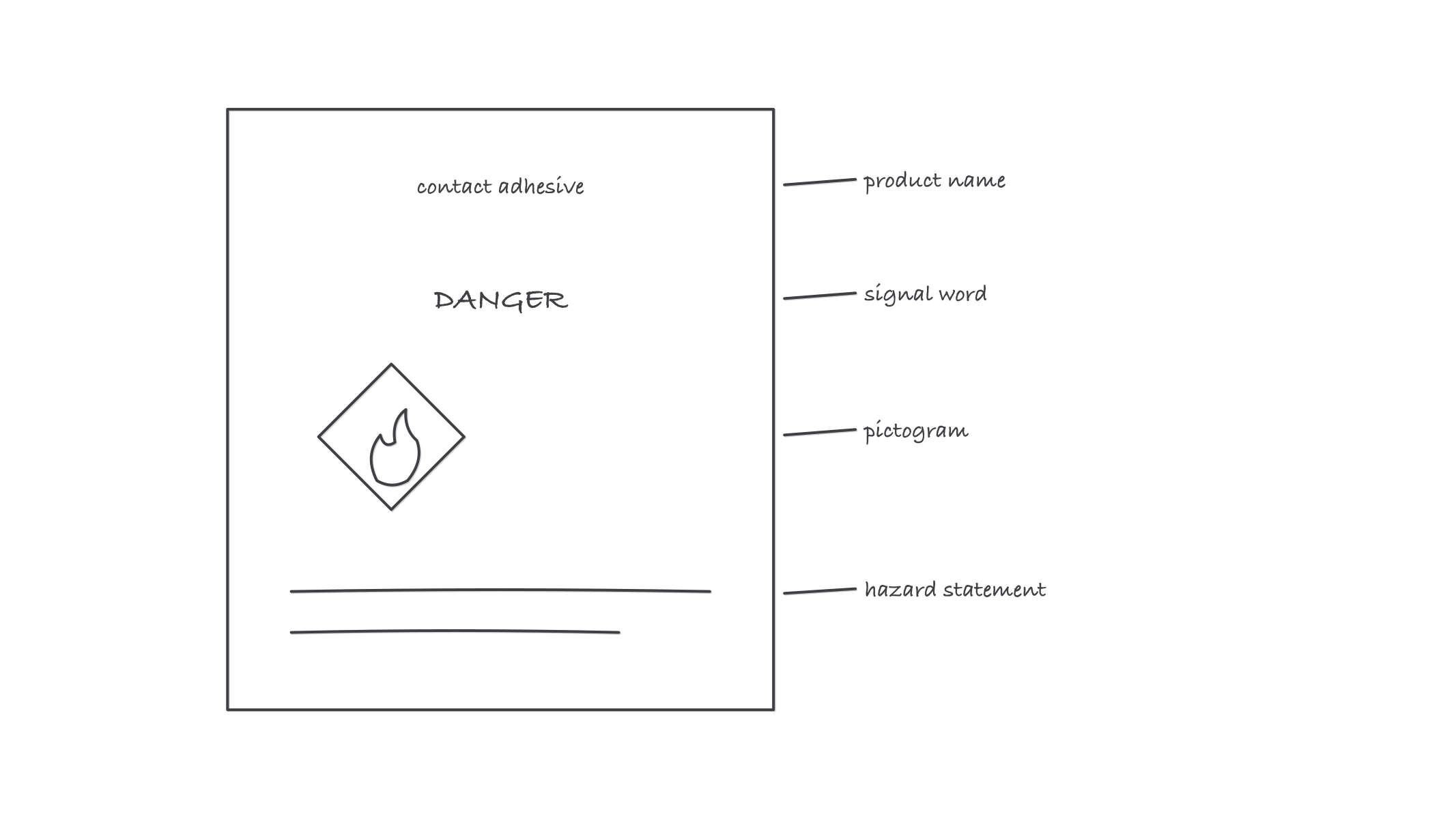
The GHS label: identifier, signal word, pictogram, hazard statement, always the same anatomy
Where it bites
- The secondary container trap. Adhesive decanted into an unmarked coffee can has exited the entire HazCom system. Portable containers need labeling unless they stay under the immediate control of the person who filled them, within the shift.
- Warning does not mean safe. It is the milder of two words on a scale that starts at hazardous.
- The exclamation mark gets dismissed. Irritant today can still mean sensitizer over a season of exposure.
- An SDS binder nobody can find fails the accessibility test. Electronic access counts only if it actually works from where the crew is standing.
- Reading labels does not replace training. HazCom requires employer-provided training on the products in your workplace before you work with them.
Verified requirements
| Where | Expires | Renewal | Continuing education |
|---|---|---|---|
| United States (federal) | Confirm with issuer | Confirm with issuer | Confirm with issuer |
| United States (federal) | Confirm with issuer | Confirm with issuer | Confirm with issuer |
Information comes from issuing-authority sources. Confirm current rules, fees and eligibility with the authority before acting.