Learn · Construction Safety
Struck-By Hazards
Part of From the Tools to Safety Professional · step 4 of 24 · next: Confined Spaces in Construction
In learning paths: From the Tools to Safety Professional
A struck-by injury is what happens when a moving object hits a person: a reversing truck, a dropped hammer, a swinging crane load, a nail fired through a stud. It is one of construction’s Focus Four killers, and it is the one where the hazard is usually moving faster than you can react.
*Learn the Trades is a free study resource. We are not a licensing body, an authorized training provider, or an exam administrator. Reading this page does not award any card, license, or certification. Always verify requirements with the issuing authority linked in the sources.*Why it matters on the job
Struck-by deaths cluster around two situations: workers on foot near operating vehicles and equipment, and workers below other people’s work. Both share a trait: the person injured usually did nothing at the moment of impact. The wrench was dropped by someone else. The truck was backed by someone else. Struck-by protection is therefore mostly about where you stand, not what you do.
The four kinds of moving object
Safety training sorts struck-by hazards by how the object moves, because each kind has its own control:
- Flying: something under power or pressure, like a nail gun discharge, a shattered abrasive wheel, or debris blown by compressed air. Controls are guards, sequential triggers, and eye and face protection.
- Falling: tools and material dropped from above. Controls are toeboards, debris nets, tool tethers, barricaded drop zones, and hard hats as the last line.
- Swinging: crane and rigging loads that rotate or slew. Control is an exclusion zone: nobody under a suspended load, nobody inside the swing radius.
- Rolling: vehicles and equipment on the move. Controls are spotters, backup alarms, high-visibility clothing, and traffic plans that separate machines from people on foot.
Distance is the control
Guards and PPE matter, but the struck-by hierarchy is dominated by one idea: keep people out of the path. A barricaded swing radius, a signed drop zone under overhead work, and an internal traffic control plan that routes foot traffic away from equipment all work while everyone is tired, distracted, or new. Never position yourself under a suspended load, even a “stationary” one: rigging failures give no warning.
Make eye contact with operators before crossing their path. A machine whose operator has not seen you should be treated exactly like a machine with nobody at the controls.
Worked example: what a dropped wrench is doing when it arrives
An 8 lb wrench slips off a beam 50 ft up. Falling objects accelerate at about 32 ft per second every second, and the speed at impact follows from the drop height:
- Speed = the square root of (2 × 32.2 ft/s² × 50 ft).
- That is the square root of 3,220, which is about 57 ft per second.
- Convert: 57 ft/s is roughly 39 mph.
An 8 lb object arriving at 39 mph is not a bump on the hard hat. It is why drop zones get barricaded and why overhead work gets toeboards and tethers, not just a warning shout.
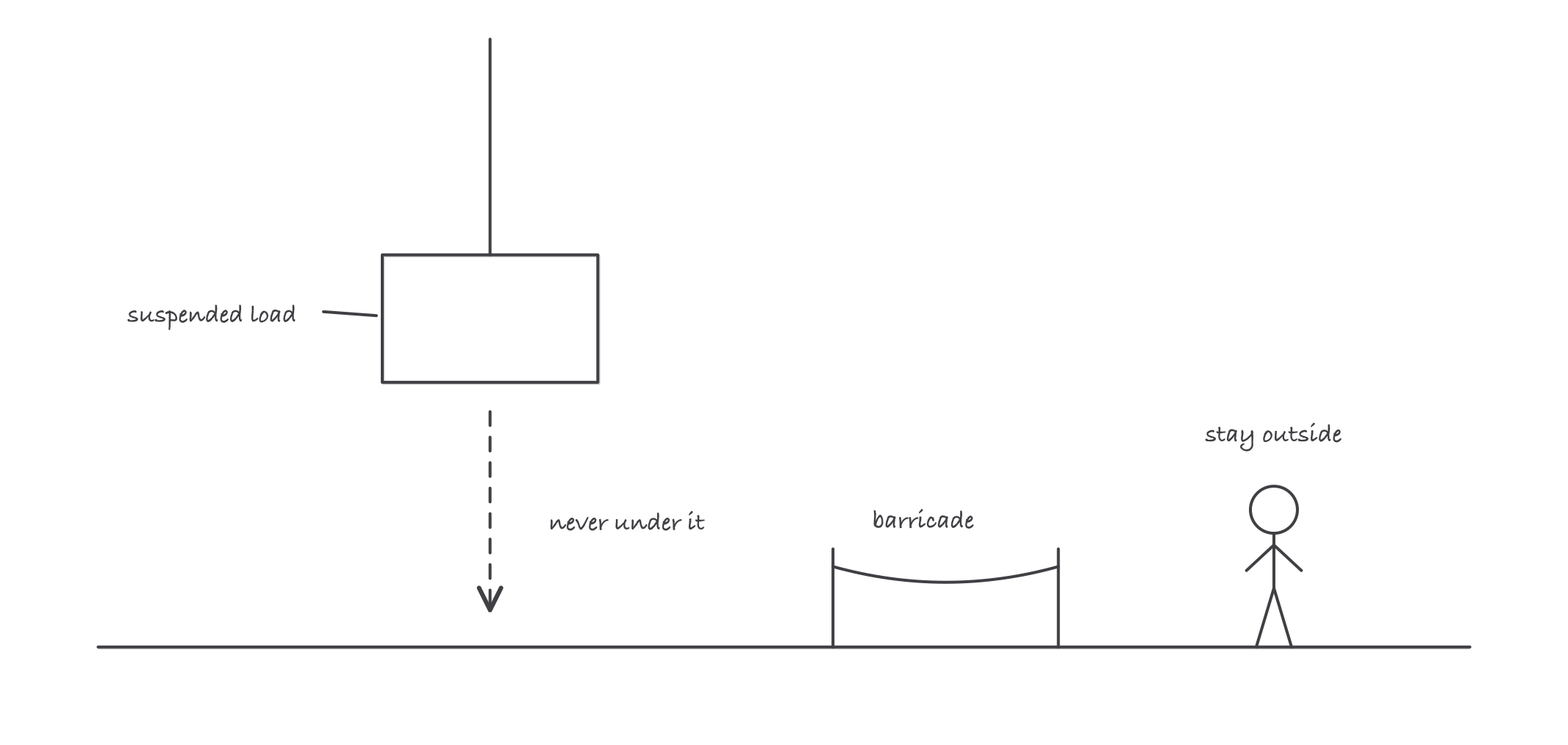
The control that always works: nobody inside the zone where the load could land or swing
Where it bites
- Backing vehicles kill workers who knew the truck was there. Familiarity is not visibility. If you are not in the mirrors or the spotter’s plan, you are in the blind spot.
- Nail guns fire through and past material. Sequential-trigger discipline and never keeping a hand in line with the fastener path prevent most of the classic injuries.
- Compressed air is a projectile launcher. Blowing down surfaces turns chips and grit into flying hazards for everyone nearby, which is one reason cleanup methods matter.
- A hard hat is the last control, not the first. It moderates an impact that every upstream control existed to prevent. Standing outside the drop zone beats any hat.
Verified requirements
| Where | Expires | Renewal | Continuing education |
|---|---|---|---|
| United States (federal) | Confirm with issuer | Confirm with issuer | Confirm with issuer |
| United States (federal) | Confirm with issuer | Confirm with issuer | Confirm with issuer |
Information comes from issuing-authority sources. Confirm current rules, fees and eligibility with the authority before acting.