Learn · Construction Safety
Heat Illness Prevention
Part of From the Tools to Safety Professional · step 7 of 24 · next: Scaffolding Safety
In learning paths: From the Tools to Safety Professional
Heat illness is a progression, not an event. It climbs a ladder from cramps to heat exhaustion to heat stroke, and every rung is a chance to stop it. Workers die when nobody recognizes the climb until the top rung, because heat stroke, the only stage that reliably kills, announces itself mainly through a symptom the victim cannot see in themselves: confusion.
*Learn the Trades is a free study resource. We are not a licensing body, an authorized training provider, or an exam administrator. Reading this page does not award any card, license, or certification. Always verify requirements with the issuing authority linked in the sources.*Why it matters on the job
Construction concentrates every heat risk factor: heavy physical work, direct sun, radiant heat off slabs and steel, PPE that blocks evaporation, and schedule pressure that discourages breaks. The body sheds work heat almost entirely by sweating, and sweating only works if there is water going in and somewhere for the heat to go. Take away either and core temperature starts climbing at a rate measured in minutes.
The ladder
Heat cramps are the early warning: painful muscle spasms, usually in legs or abdomen, from salt and fluid loss. Treatment is water, rest in shade, and easing back into work.
Heat exhaustion is the body losing the battle: heavy sweating, weakness, dizziness, headache, nausea, clammy skin, a fast weak pulse. The worker is still thinking clearly. Move them to shade, loosen clothing, give water, cool them, and do not send them back out that shift. Watched and cooled, heat exhaustion recovers. Ignored, it climbs.
Heat stroke is a medical emergency: the body’s cooling system has failed and core temperature is running away. The signs are confusion, slurred speech, irrational behavior, collapse, possible seizures, skin that may be hot and dry or may still be sweaty. Call 911 immediately, then cool the victim aggressively while you wait: shade, ice packs to neck, armpits and groin, soak their clothing. Minutes of delay translate directly into organ damage.
The line that matters on a crew is mental status. Cramps hurt and exhaustion feels awful, but a worker who is confused, stumbling, or arguing nonsense has crossed into emergency territory, whatever their skin feels like.
Water, rest, shade
Prevention is three words backed by numbers. OSHA and NIOSH guidance for hot conditions is about one cup, 8 oz, of water every 15 to 20 minutes, before thirst arrives, because thirst lags dehydration. Rest breaks in real shade let core temperature reset before it ratchets upward. And the schedule itself is a control: heaviest work early, rotation on brutal tasks, and someone assigned to actually watch the crew for symptoms.
The other pillar is acclimatization: the body adapts to working in heat over 1 to 2 weeks of gradually increasing exposure, sweating earlier and more efficiently. New workers and anyone returning from a week away have not adapted, which is why a large share of heat deaths hit workers in their first days on a job. Ramping a new hire to full production in July is not toughness. It is the setup for a fatality.
Worked example: what a hot shift costs in water
A 10-hour summer concrete pour, drinking to the guidance:
- One 8 oz cup every 20 minutes is 3 cups, 24 oz per hour.
- Over 10 hours: 10 × 24 = 240 oz.
- That is 240 ÷ 128 = about 1.9 gallons for the day, per worker.
If the crew of six brought one 5-gallon cooler, they are carrying less than half of what the day actually requires.
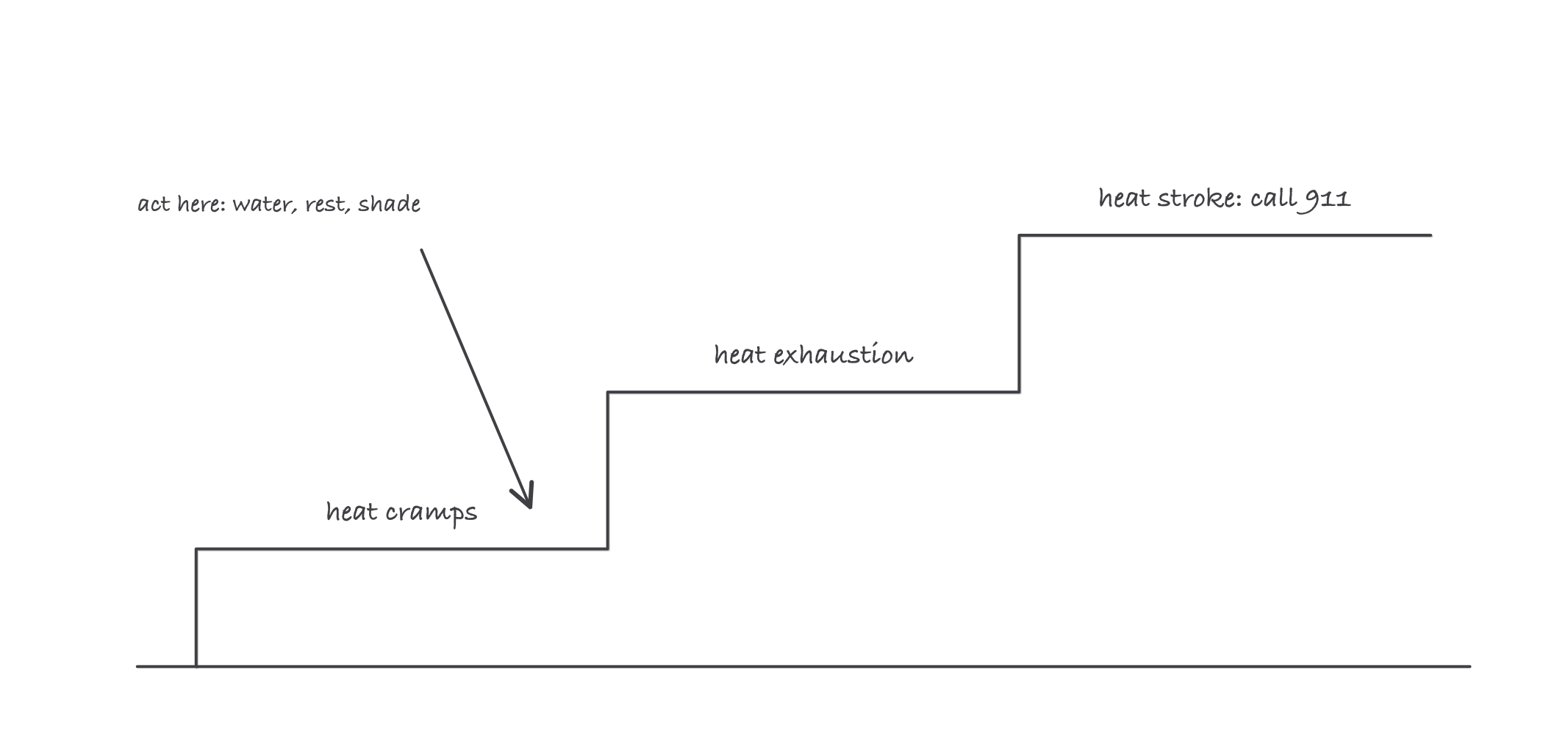
The climb you interrupt at the bottom: by the top rung it is a 911 call, not a break
Where it bites
- “I’ll drink at lunch” fails because thirst runs behind fluid loss. By the time you feel it, you are already down more than a cup.
- Waiting for dry skin to call it heat stroke kills people. Workers doing hard physical work can still be sweating as they cook. Confusion is the alarm, not dryness.
- The victim will argue. Confused workers insist they are fine. The crew treats what they see, not what the victim says.
- Energy drinks and alcohol work against you, adding caffeine load and fluid loss to the deficit the sun is already running.
Verified requirements
| Where | Expires | Renewal | Continuing education |
|---|---|---|---|
| United States (federal) | Confirm with issuer | Confirm with issuer | Confirm with issuer |
| United States (federal) | Confirm with issuer | Confirm with issuer | Confirm with issuer |
Information comes from issuing-authority sources. Confirm current rules, fees and eligibility with the authority before acting.