Learn · Construction Safety
Confined Spaces in Construction
Part of From the Tools to Safety Professional · step 5 of 24 · next: Excavation and Trenching Safety
In learning paths: From the Tools to Safety Professional
A confined space is any space big enough to work in, with limited ways in and out, that was never designed for people to occupy: manholes, tanks, pits, lift stations, crawl spaces, large pipe runs. The danger is that a confined space can hold an atmosphere that will drop you in seconds, and that atmosphere is invisible, often odorless, and completely undetectable without an instrument.
*Learn the Trades is a free study resource. We are not a licensing body, an authorized training provider, or an exam administrator. Reading this page does not award any card, license, or certification. Always verify requirements with the issuing authority linked in the sources.*Why it matters on the job
Your senses cannot do this job. Air with no oxygen looks and smells exactly like air. Carbon monoxide and hydrogen sulfide at fatal levels give little or no sensory warning, and the same geometry that makes a space confined also traps gases, concentrates vapors, and slows any rescue. Every rule in confined-space work flows from one admission: inside the space, you find out the air was bad by collapsing.
Permit logic: what upgrades a space
Not every confined space needs the full program. The question is whether the space has, or could develop, a serious hazard: a hazardous atmosphere, material that could engulf someone, walls that converge to trap, or any other serious threat. A yes to any of those makes it a permit-required confined space, and entry then runs on a system: a written permit for this entry, atmospheric testing, an attendant stationed outside, a way to communicate, and a rescue plan that exists before anyone goes in.
The permit is not paperwork for its own sake. It is a forcing function: someone competent must think through this specific space, today, and sign that the hazards are controlled, before a body crosses the plane of the opening.
Test before entry, from outside
Air gets tested before entry, with the tester outside the space, using a calibrated gas meter, and in a set order: oxygen first, then flammable gases, then toxic contaminants. Order matters because most meters need normal oxygen to read flammables correctly.
Test at multiple depths. Gases stratify: some settle to the bottom, some rise to the top, so clean air at the opening proves nothing about waist height in the pit. And keep monitoring during the work: welding, coatings, engine exhaust drifting in, or disturbed sludge can turn good air bad an hour into the shift.
Worked example: reading the oxygen number
Normal air is 20.9% oxygen, and the acceptable band for entry runs from 19.5% to 23.5%. Your meter, lowered into a manhole, reads 18.9% O2.
- 18.9% is below the 19.5% floor: the space is oxygen deficient. No entry.
- Just as important: 2 percentage points of oxygen went somewhere. Something displaced or consumed it, and until you know what, you do not know what you would be breathing.
- Ventilate with fresh air, never with oxygen, retest at top, middle, and bottom, and only enter when the numbers hold in the acceptable band.
High oxygen is not a bonus, either: above 23.5%, ordinary sparks and materials burn ferociously.
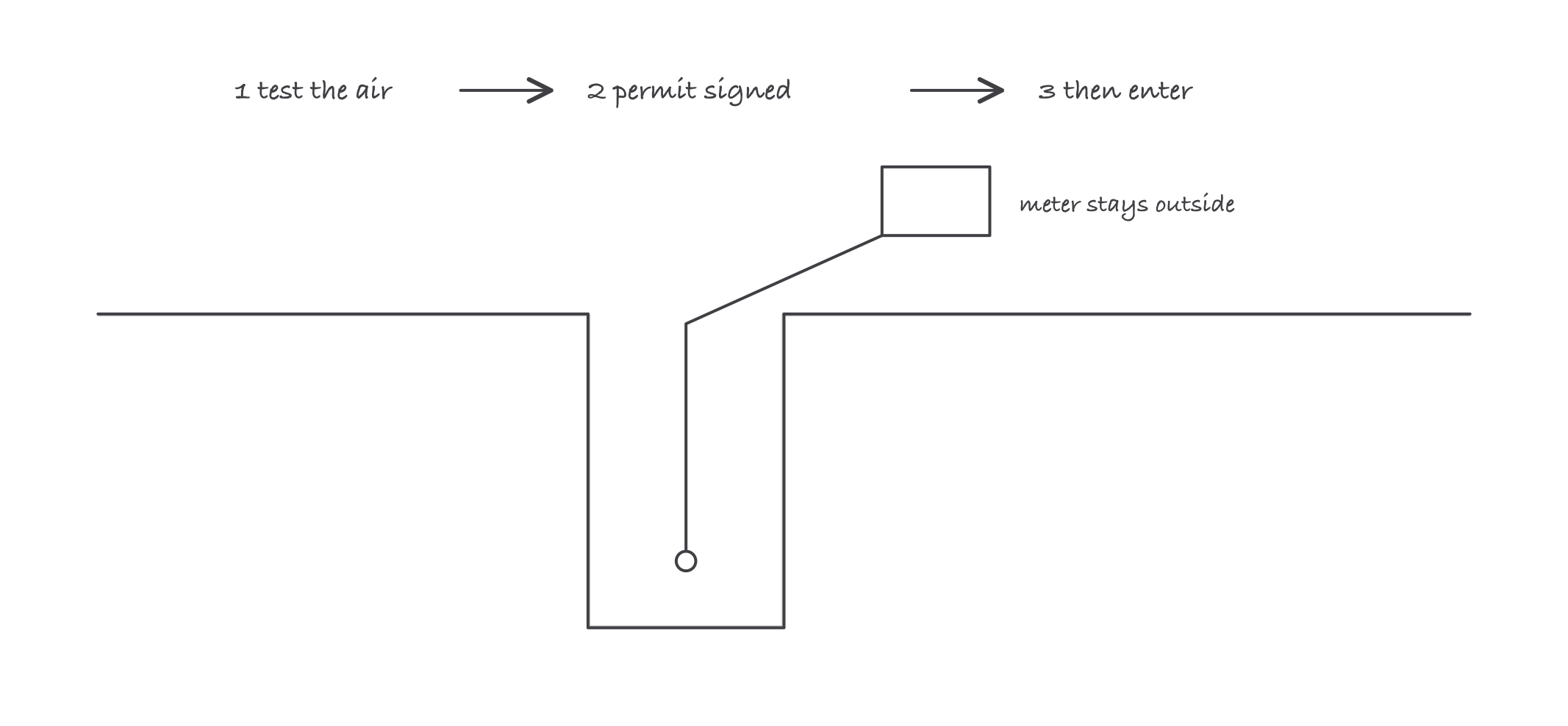
The sequence that keeps the first person alive: test from outside, control on paper, then enter
Where it bites
- Would-be rescuers die in confined spaces at a terrible rate, often outnumbering the original victim in multi-fatality incidents. The attendant’s hardest job is staying outside and calling the trained rescue team. An untrained rescue attempt is how one fatality becomes three.
- “It was fine yesterday” is not a test. Atmospheres change overnight: curing, rusting, groundwater, a sewer surge. Every entry gets its own test.
- The hazard often arrives with you. A gas generator near the opening or a solvent bucket carried inside can poison a space that tested clean.
- Crawl spaces and attics count when they meet the definition. The word “manhole” is not in the definition; the geometry is.
Verified requirements
| Where | Expires | Renewal | Continuing education |
|---|---|---|---|
| United States (federal) | Confirm with issuer | Confirm with issuer | Confirm with issuer |
| United States (federal) | Confirm with issuer | 5 years | Confirm with issuer |
Information comes from issuing-authority sources. Confirm current rules, fees and eligibility with the authority before acting.