Learn · Construction Safety
Excavation and Trenching Safety
Part of From the Tools to Safety Professional · step 6 of 24 · next: Heat Illness Prevention
In learning paths: From the Tools to Safety Professional
Assumes you know: Caught-In and Caught-Between Hazards
A trench is an excavation deeper than it is wide, and it is the most dangerous common workplace in construction. You already know from the caught-in lesson what a cave-in weighs. This lesson is about the system that keeps trench walls from ever getting the chance: a depth trigger, three protective methods, and one accountable person.
*Learn the Trades is a free study resource. We are not a licensing body, an authorized training provider, or an exam administrator. Reading this page does not award any card, license, or certification. Always verify requirements with the issuing authority linked in the sources.*Why it matters on the job
Trench walls fail without warning because soil is a material under load, not a solid. Cutting a trench removes the support one wall of soil was providing to the other, and the remaining walls carry that stress until something, vibration, rain, drying, a spoil pile too close, tips them past their limit. A wall that has stood open all morning has proven nothing about the next five minutes.
The 5-foot trigger
OSHA’s construction standards require a protective system in any trench 5 feet deep or more, unless the excavation is entirely in stable rock. Below 5 feet, protection is still required whenever the competent person sees signs of a possible cave-in. Depth is measured where you stand, so a trench that steps deeper as it runs can cross the trigger partway along.
Getting in and out matters too: deeper trenches need a ladder, ramp, or other safe exit close enough that nobody has a long escape run, and excavated spoil stays set back from the edge so its weight is not loading the wall you are standing under.
Slope it, shore it, or shield it
Every protective system is one of three ideas:
- Sloping cuts the walls back at an angle the soil can hold on its own, so there is no vertical face to fail.
- Shoring supports the walls with hydraulic or timber systems that press against both faces, so the soil cannot move.
- Shielding puts a trench box around the workers. The box does not stop a collapse; it survives one with the crew inside it.
Which method fits depends on soil type, depth, groundwater, and how much room the site allows. That judgment belongs to the competent person: someone trained to identify existing and predictable hazards and, critically, with the authority to stop work and fix them. The competent person classifies the soil, selects the protective system, and inspects the excavation daily and after every rainstorm or other change.
Worked example: why sloping needs so much room
For the weakest common soil classification (Type C, which includes granular and submerged soils), the standard slope is 1.5 horizontal to 1 vertical.
- Trench depth: 6 ft. Each wall must be cut back 1.5 × 6 = 9 ft horizontally.
- Bottom width for the pipe crew: 3 ft.
- Top opening: 9 + 3 + 9 = 21 ft wide.
A 3 ft trench becomes a 21 ft excavation. In a street or beside a foundation, that room does not exist, which is why utility crews live in trench boxes.
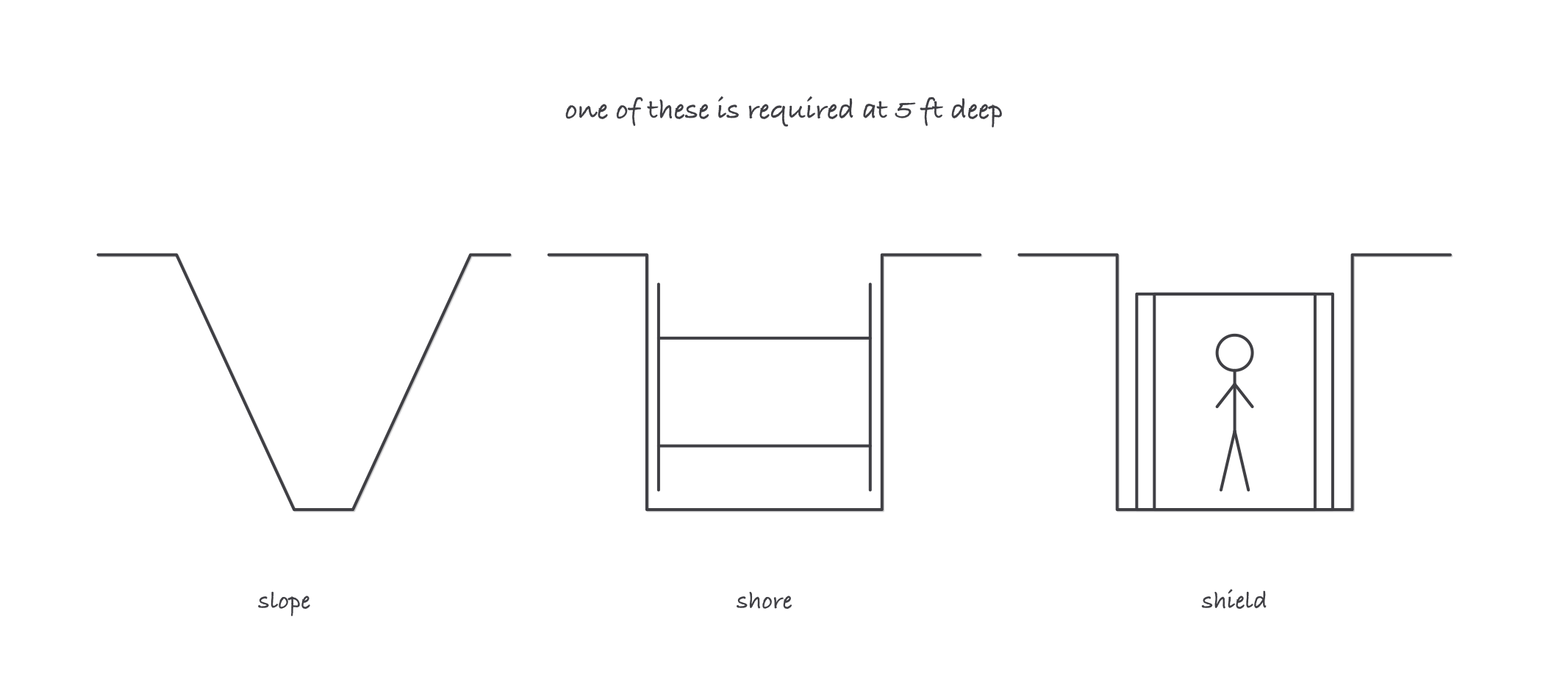
The three protective systems: cut the walls back, hold them in place, or survive them failing
Where it bites
- “I’ll only be in there a minute.” Cave-ins take seconds and do not check your schedule. The trigger is depth, not duration.
- Previously disturbed soil is weaker than it looks. A trench dug along an old utility line is cutting through soil that has already failed once.
- A trench box protects only the people inside it. Stepping out of the box in an unprotected trench, even to grab a tool, is unprotected work.
- Water changes the classification. Rain overnight or seepage in the wall can turn yesterday’s soil call into today’s wrong answer. That is exactly what the daily inspection exists to catch.
Verified requirements
| Where | Expires | Renewal | Continuing education |
|---|---|---|---|
| United States (federal) | Confirm with issuer | Confirm with issuer | Confirm with issuer |
| United States (federal) | Confirm with issuer | 5 years | Confirm with issuer |
Information comes from issuing-authority sources. Confirm current rules, fees and eligibility with the authority before acting.