Learn · Construction Safety
Caught-In and Caught-Between Hazards
Part of From the Tools to Safety Professional · step 1 of 24 · next: Electrocution Hazards on Site
In learning paths: From the Tools to Safety Professional
Caught-in and caught-between injuries happen when part of you, or all of you, ends up squeezed, crushed, or pinned between two things: soil and a trench wall, a rotating shaft and your sleeve, a reversing machine and the wall behind you. Where struck-by is about impact, caught-in is about compression, and compression is often unsurvivable.
*Learn the Trades is a free study resource. We are not a licensing body, an authorized training provider, or an exam administrator. Reading this page does not award any card, license, or certification. Always verify requirements with the issuing authority linked in the sources.*Why it matters on the job
The defining feature of caught-in incidents is that escape time is close to zero. A trench wall fails in about the time it takes to read this sentence. A glove caught in a rotating coupling pulls the hand in faster than any reflex. So caught-in safety is built almost entirely on prevention: guarding, positioning, and de-energizing before the hazard exists, because there is no reacting to it afterward.
The three big scenarios
Cave-ins. Excavation collapse is the deadliest caught-in hazard in construction, deadly enough that trench work has its own protection rules, covered in the excavation and trenching lesson. The short version: unprotected trench walls are not stable just because they are standing.
Machinery. Rotating parts, gears, belts, and pinch points grab whatever touches them: clothing, hair, jewelry, gloves. Controls are machine guarding that stays on, and de-energizing equipment before reaching into it. A machine that is switched off but still connected to its energy source is not safe to work inside; stored energy in hydraulics, springs, and raised components can move parts with nobody at the controls.
Between equipment and a fixed object. A worker standing between a backing machine and a wall, a swinging counterweight and a barrier, or a load and a trailer has placed themselves in a closing gap. The control is positional: never put your body where one moving thing and one fixed thing can meet, and never assume the operator knows you are there.
Worked example: what a cave-in actually weighs
Soil looks soft. Do the arithmetic on a small collapse:
- A single cubic yard of soil weighs roughly 3,000 lb, about the weight of a small car.
- A modest wall failure in a 6 ft deep trench can drop 2 to 3 cubic yards onto a worker.
- That is 6,000 to 9,000 lb of material, arriving in seconds.
Even a partial burial to the chest can kill: the soil’s pressure stops the chest from expanding, so the victim suffocates while their head is clear. This is why trench rescue is a technical operation and why digging someone out by hand routinely fails.
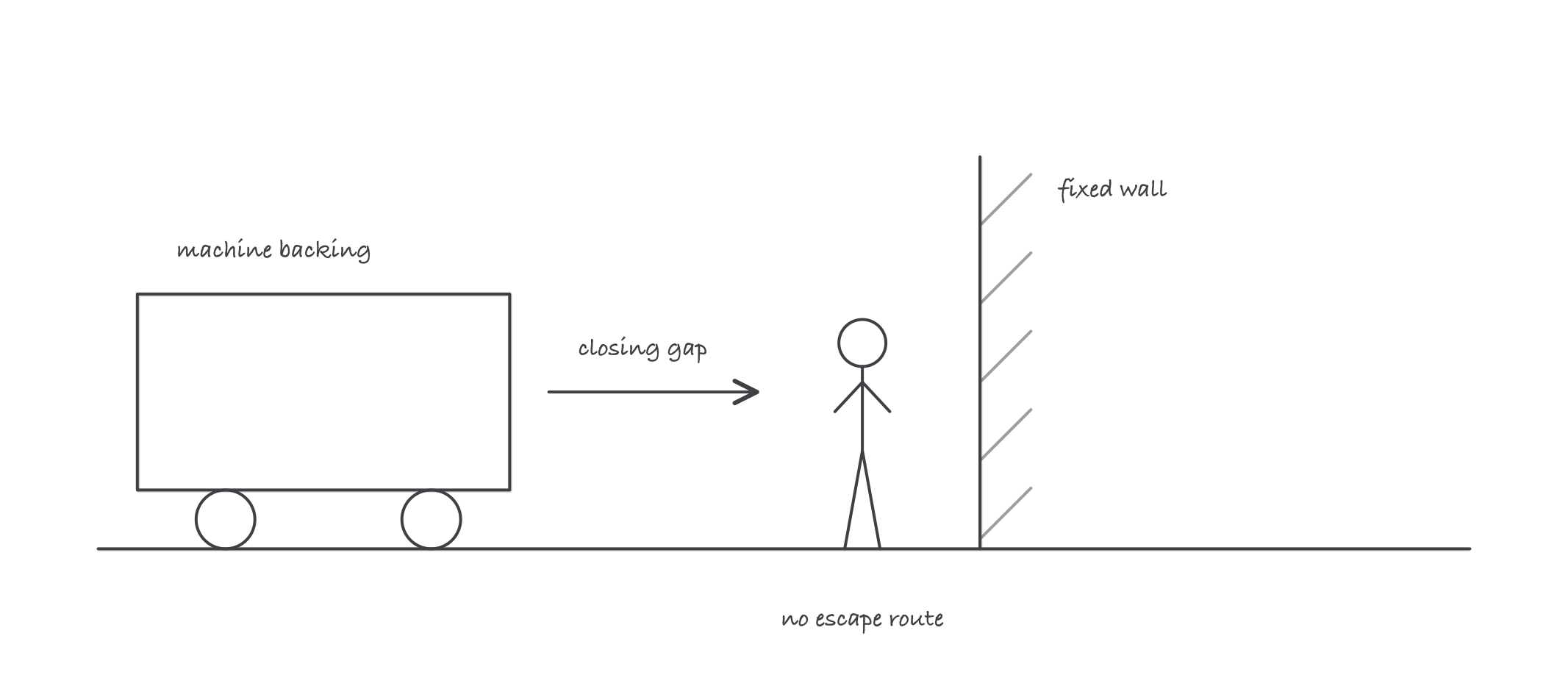
The caught-between setup: one thing moving, one thing fixed, and a person in the space that is disappearing
Where it bites
- “It will hold for the minute I need.” Nearly every cave-in victim believed exactly that. Soil gives no useful warning before it fails.
- Off is not de-energized. Hydraulic pressure, suspended loads, and compressed springs move equipment that is switched off. Release or restrain stored energy before putting any part of you inside.
- Guards removed for maintenance have a way of staying off. A missing guard is an open invitation to the next person’s sleeve.
- The escape route check takes two seconds. Before stepping between anything moving and anything fixed, ask where you go if the gap closes. If the answer is nowhere, do not step in.
Verified requirements
| Where | Expires | Renewal | Continuing education |
|---|---|---|---|
| United States (federal) | Confirm with issuer | Confirm with issuer | Confirm with issuer |
| United States (federal) | Confirm with issuer | Confirm with issuer | Confirm with issuer |
Information comes from issuing-authority sources. Confirm current rules, fees and eligibility with the authority before acting.