Learn · Construction Safety
What OSHA Actually Cites
Assumes you know: How OSHA Works: Standards, Citations, Inspections
Federal OSHA publishes what it cites. In fiscal year 2025 (October 2024 through September 2025) it issued 26,558 citations to construction employers across 10,791 inspections, carrying $109,102,466 in penalties, and it publishes the breakdown by standard number. That table is a public record of which hazards clear the bar of being found, seen and written up on a US construction site.
*Learn the Trades is a free study resource. We are not a licensing body, an authorized training provider, or an exam administrator. Reading this page does not award any card, license, or certification. Always verify requirements with the issuing authority linked in the sources.*Why it matters on the job
An inspection is not an audit of your whole program. An inspector arrives, walks the work, and writes what can be seen and documented in the time available. The cited-standard list therefore tells you two different things at once: which conditions get caught, and (by their absence from the top of the list) which hazards an inspection struggles to prove. A supervisor who reads only the first half plans a tidy site. A supervisor who reads both plans a safe one.
What construction actually gets cited for
Federal OSHA, NAICS 23 (construction), all establishment sizes, October 2024 through September 2025:
| Standard | Citations | Inspections | Penalties |
|---|---|---|---|
| 1926.501 Duty to have fall protection | 6,772 | 6,639 | $45,031,069 |
| 1926.1053 Ladders | 2,760 | 2,388 | $9,589,460 |
| 1926.503 Fall protection training | 2,171 | 2,119 | $4,635,096 |
| 1926.451 Scaffolds, general requirements | 2,152 | 1,093 | $7,646,617 |
| 1926.102 Eye and face protection | 1,927 | 1,924 | $6,605,593 |
| 1926.20 General safety and health provisions | 866 | 787 | $3,490,380 |
| 1926.100 Head protection | 853 | 853 | $2,566,628 |
| 1903.19 Abatement verification | 805 | 656 | $313,247 |
| 1910.1200 Hazard communication | 698 | 340 | $984,054 |
| 1926.502 Fall protection systems criteria | 664 | 487 | $2,060,981 |
| 1926.1153 Respirable crystalline silica | 632 | 271 | $1,219,150 |
Three entries in that table are not what they look like. 1903.19 is not a hazard standard at all: it is abatement verification, the citation you collect for failing to document that you fixed an earlier one. 1910.1200 is a general industry standard, cited on construction sites because hazard communication applies wherever chemicals are used. And 1926.20 is the general safety and health provisions section, which is where a missing program (rather than a missing guardrail) tends to land.
Two numbers per row, not one
The rank comes from the citation count. The teaching comes from dividing it by the inspection count.
When citations and inspections are nearly equal, the standard describes one discrete condition that an inspector finds once and writes once. Head protection sits at 853 citations across 853 inspections, a ratio of exactly 1.00: one crew, one missing hard hat rule, one citation. Eye and face protection runs 1,927 across 1,924, which is 1.00 to two places.
When citations run well ahead of inspections, the standard has many paragraphs that fail together, so one visit produces a stack of them. Scaffolds come in at 2,152 citations across 1,093 inspections, which is 1.97 citations per inspection. Silica runs 632 across 271, or 2.33. Those are not sites that made one mistake. Those are sites with no scaffold program and no silica program, cited paragraph by paragraph.
That distinction changes what you do about it. A ratio near 1.00 is fixed by a rule and a habit. A ratio near 2.00 is telling you a whole system is absent.
Worked example: how much of construction enforcement is falls
Three standards in the table are the same subject. Add them:
- 1926.501, duty to have fall protection: 6,772
- 1926.503, fall protection training: 2,171
- 1926.502, fall protection systems criteria: 664
Total: 6,772 + 2,171 + 664 = 9,607 citations, out of 26,558 for all of construction. That is 9,607 ÷ 26,558 = 0.3617, or 36.2% of every citation written.
The money concentrates harder than the count. Section 1926.501 alone is 6,772 ÷ 26,558 = 25.5% of citations but $45,031,069 ÷ $109,102,466 = 41.3% of penalty dollars. Per citation that works out at $45,031,069 ÷ 6,772 = $6,650, against a construction-wide average of $109,102,466 ÷ 26,558 = $4,108. Ladders, for comparison, average $9,589,460 ÷ 2,760 = $3,474 each.
So a fall protection citation costs roughly $6,650 against roughly $3,474 for a ladder citation, close to twice as much for the same single piece of paper. Penalty amounts reflect gravity and probability of harm, and OSHA’s own arithmetic is saying that an unprotected leading edge is not in the same category as a ladder set at the wrong angle.
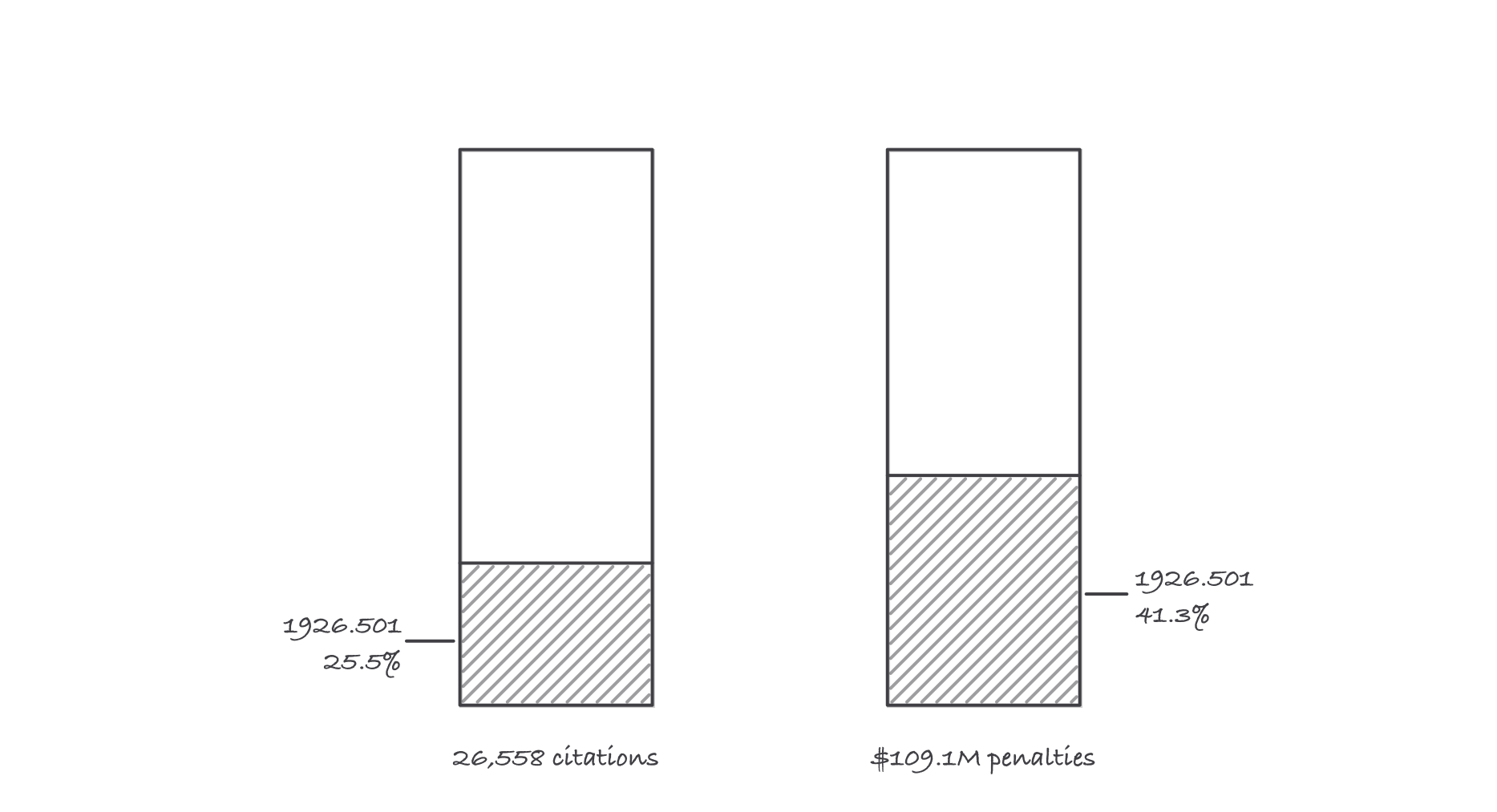
One standard, two very different shares: 1926.501 is a quarter of construction citations and over two fifths of the penalty dollars
Where it bites
- The famous top 10 is not the construction list. OSHA publishes a Top 10 Most Frequently Cited Standards for all industries, and for FY2025 five of its ten entries are general industry sections (1910.1200 hazard communication, 1910.147 lockout/tagout, 1910.134 respiratory protection, 1910.178 powered industrial trucks, 1910.212 machine guarding). Read as a construction list it ranks hazard communication, lockout/tagout and respiratory protection above scaffolding, fall protection training and eye and face protection, and it carries machine guarding, which drew 17 construction citations in the whole year. Pull the NAICS 23 query instead.
- Rank is not risk. These counts measure what got found on inspections that are targeted rather than randomly sampled. A guardrail missing from a leading edge is visible from the gate in the first two minutes. An overexposure to respirable silica has to be sampled, analyzed and tied to a task before anyone can write it, which is part of why 1926.1153 sits at 632 while its 2.33 ratio says the sites that do get sampled are failing broadly.
- One standard number is not one hazard. Section 1926.501 has paragraphs covering leading edges, holes, formwork, roofs, ramps, excavations and wall openings. Its 6,772 citations are one line in the table and many different failures on the ground.
- These are federal numbers only. The query covers citations issued by federal OSHA. States running their own approved plans enforce separately and their citations are not in this count, so a contractor working in a state-plan state is reading a partial picture of their own jurisdiction.
- The General Duty Clause hides under a code. It appears in the data as 5A0001, with 141 citations and $1,176,994, which averages $8,347 each. It is a small count carrying a higher average penalty than any row in the table above, and it is the entry that exists because a hazard was recognized and left alone with no specific standard to cite.
- A top-10 list is not a compliance plan. Working down the ranking gets you the conditions inspectors write up. Everything that was never inspected for is still on your site.
Reading the list on your own site
The list is most useful backward. Take your last three months of inspection findings, sort them by standard number, and compute your own citations-per-finding ratio the way the table does. Anywhere you are generating repeat findings under one section, you have a missing system rather than a careless crew, and the fix is a program element rather than a talking-to.
The 30-hour Outreach course aimed at supervisors covers most of the subjects at the top of this table, which is the sense in which the ranking and the syllabus agree. They part company on what follows. A 30-hour card is a record of attending voluntary awareness training, and it is not a certification and not a substitute for the training a specific standard requires. Section 1926.503, the fall protection training standard, is itself the third most cited entry in construction at 2,171 citations, and a crew holding cards does not answer it. That standard asks whether a competent person trained each exposed worker in the specific hazards of the specific site, and whether it is written down.
Verified requirements
| Where | Expires | Renewal | Continuing education |
|---|---|---|---|
| United States (federal) | Confirm with issuer | Confirm with issuer | Confirm with issuer |
Information comes from issuing-authority sources. Confirm current rules, fees and eligibility with the authority before acting.