Learn · Construction Safety
Electrocution Hazards on Site
Part of From the Tools to Safety Professional · step 2 of 24 · next: Fall Hazards
In learning paths: From the Tools to Safety Professional
Most construction electrocutions do not happen to electricians working in panels. They happen to everyone else: a boom truck into an overhead line, an aluminum ladder against a service drop, a frayed cord on wet ground. Electricity is the Focus Four hazard that kills people who never thought they were doing electrical work.
*Learn the Trades is a free study resource. We are not a licensing body, an authorized training provider, or an exam administrator. Reading this page does not award any card, license, or certification. Always verify requirements with the issuing authority linked in the sources.*Why it matters on the job
Electricity kills through current, not voltage, and the current that matters is startlingly small. It is measured in milliamps, thousandths of an amp, while the tools on your belt draw whole amps by the dozen. Current across the chest in the region of 50 milliamps can throw the heart into fibrillation. Household voltage delivers that easily under the wrong conditions, which is why “it’s only 120 volts” has a body count.
Worked example: why 120 volts is enough
Current follows Ohm’s law: current equals voltage divided by resistance, I = V ÷ R. Your skin’s resistance is the main thing protecting you, and it collapses when wet.
- Dry, intact skin might present around 100,000 ohms. At 120 V: 120 ÷ 100,000 = 1.2 milliamps, a tingle.
- Wet or broken skin can drop toward 1,000 ohms. At 120 V: 120 ÷ 1,000 = 120 milliamps.
- 120 milliamps sits well inside the range that can stop a heart.
Same cord, same voltage. The difference between a tingle and a fatality was sweat, rain, or a cut on your hand.
The controls that do the work
Overhead lines: distance, and which rule you are under. Two different clearances apply, and using the smaller one on the wrong job kills people. For equipment and materials generally, 1926.600(a)(6) sets 10 feet from lines rated 50 kV or below, with more distance as voltage rises. For crane and derrick work, Subpart CC is stricter: 1926.1408 requires the employer either to determine the line voltage and apply the table in that section, or to keep 20 feet. If a boom is involved, assume the crane rule until someone has done the determination in writing. Treat every line as energized and uninsulated: the weatherproof coating on distribution lines is not insulation rated to protect you. Booms, ladders, scaffolds, and material being carried all count against that clearance.
Portable power: GFCIs. A ground-fault circuit interrupter compares current going out with current coming back, and opens the circuit in a fraction of a second when some of it is leaking, possibly through you. Construction site receptacles and cord sets run through GFCI protection because job sites are the wet, damaged-cord environment GFCIs were built for.
Cords and tools: inspection. A cord with a damaged jacket, a missing ground pin, or a taped-over splice goes out of service, not back in the gang box. The ground pin is the path fault current takes instead of you; snapping it off to fit a two-slot outlet removes exactly that protection.
Circuits under work: de-energize and verify. Before anyone works on a circuit, it gets turned off, secured against re-energizing, and tested dead. Verification is the step that catches mislabeled panels, and mislabeled panels are common.
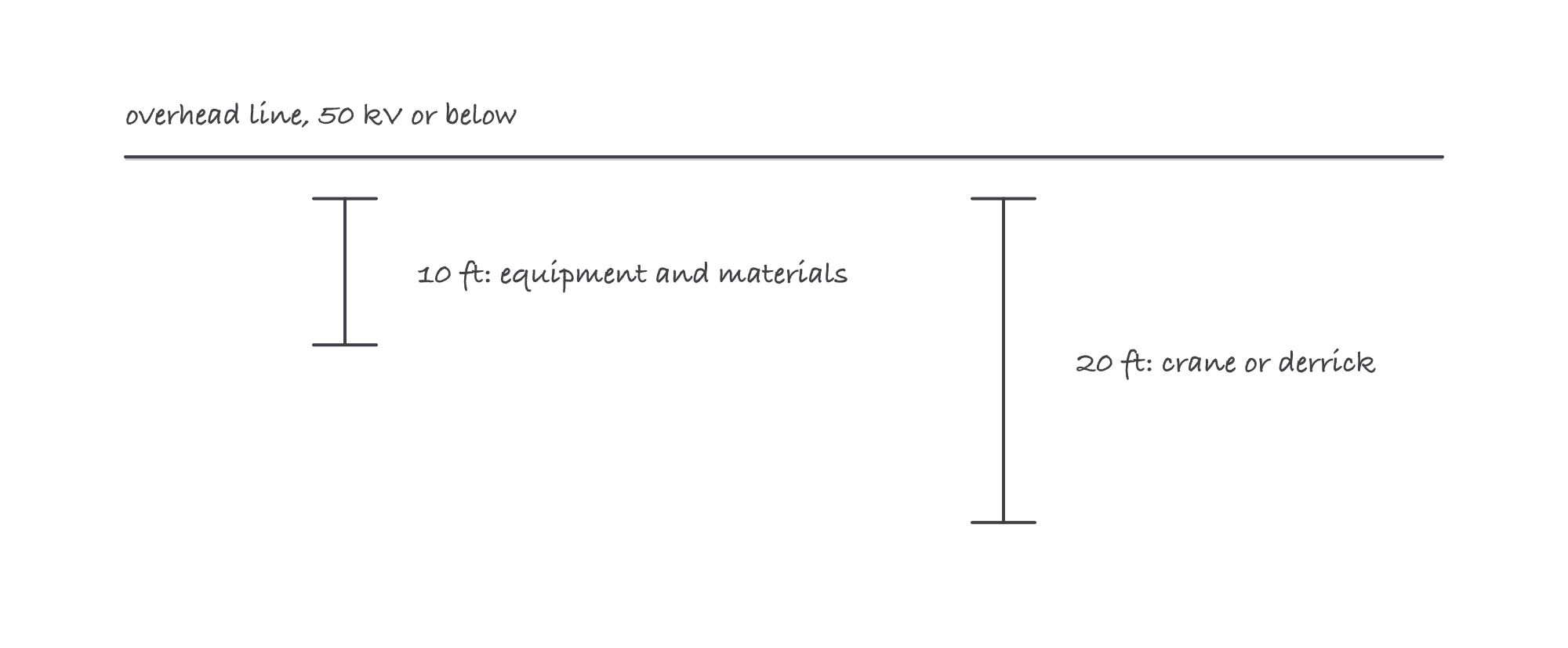
Two rules, one hazard: 10 ft for equipment and materials, 20 ft once a crane or derrick is involved
Where it bites
- Overhead line contact is a spotter problem. Operators cannot judge boom-to-wire distance from the seat. Marked no-go zones and a dedicated spotter near lines are the controls that work.
- A metal ladder is a conductor you carry. Repositioning one under a service drop is a classic fatal sequence. Fiberglass exists for this reason.
- Extension cords are temporary wiring, and they age fast under traffic, doors, and weather. Daily visual checks catch most of what kills.
- If a machine contacts a line, stay on it until the utility kills the line, and jump clear with both feet together only if fire forces you off. The ground around an energized machine carries voltage in rings; stepping normally can put a lethal difference between your feet.
Verified requirements
| Where | Expires | Renewal | Continuing education |
|---|---|---|---|
| United States (federal) | Confirm with issuer | Confirm with issuer | Confirm with issuer |
| United States (federal) | Confirm with issuer | Confirm with issuer | Confirm with issuer |
Information comes from issuing-authority sources. Confirm current rules, fees and eligibility with the authority before acting.