Learn · Construction Safety
Fall Hazards
Part of From the Tools to Safety Professional · step 3 of 24 · next: Struck-By Hazards
In learning paths: From the Tools to Safety Professional
Falls kill more construction workers than any other hazard, year after year. Not exotic falls: ordinary ones, from roof edges, ladders, floor openings, and unfinished stairwells, usually from heights a crew has stopped noticing by the second week on site.
*Learn the Trades is a free study resource. We are not a licensing body, an authorized training provider, or an exam administrator. Reading this page does not award any card, license, or certification. Always verify requirements with the issuing authority linked in the sources.*Why it matters on the job
A fall does its damage in under a second, which means the only decisions that count are the ones made before it starts. Every unprotected edge, uncovered hole, and unanchored ladder is a decision already made, and the ground does not negotiate. Fall protection is not about clumsy workers. It is about the fact that everyone trips, and height turns a trip into a fatality.
The 6-foot trigger
OSHA’s construction standards set the general trigger at 6 feet: when you work with an unprotected side or edge 6 feet or more above a lower level, some form of fall protection is required. That covers roof edges, floor perimeters, wall openings, and holes you could step or fall through.
Treat 6 feet as the general construction number, not a universal one. Scaffolds carry their own trigger of 10 feet, and steel erection runs on different rules again. The habit to build is asking two questions at every height: how far is the drop, and which rule set does this work fall under.
Prevent the fall or catch the faller
Fall protection splits into two families, and the order matters.
Prevention keeps the fall from ever starting: guardrail systems along edges, covers secured over holes, and positioning work so nobody needs to approach the edge at all. A guardrail protects everyone behind it all day with no user decisions.
Arrest catches a fall already in progress: a personal fall arrest system, meaning an anchor, a full-body harness, and a connector such as a shock-absorbing lanyard or self-retracting lifeline. Arrest works only if every one of those three parts is right, and only if there is enough clear space below to complete the catch.
Prevention beats arrest whenever you have the choice, because a prevented fall has no forces, no rescue, and no margin for user error.
Worked example: how much clearance a lanyard really needs
You tie off with a 6 ft shock-absorbing lanyard, anchored at your feet on a walking surface. Add up the fall:
- Free fall before the lanyard comes tight: 6 ft of lanyard plus roughly 5 ft from your D-ring down to your feet, so about 11 ft.
- Shock absorber deployment: up to 3.5 ft.
- Safety margin below your feet at full stretch: 3 ft.
Total clearance needed: 11 + 3.5 + 3 = 17.5 ft below the anchor. On a 12 ft high deck, that system lets you hit the ground before it finishes catching you. The fix is anchoring overhead, using a shorter connector, or using a self-retracting lifeline that limits free fall to inches.
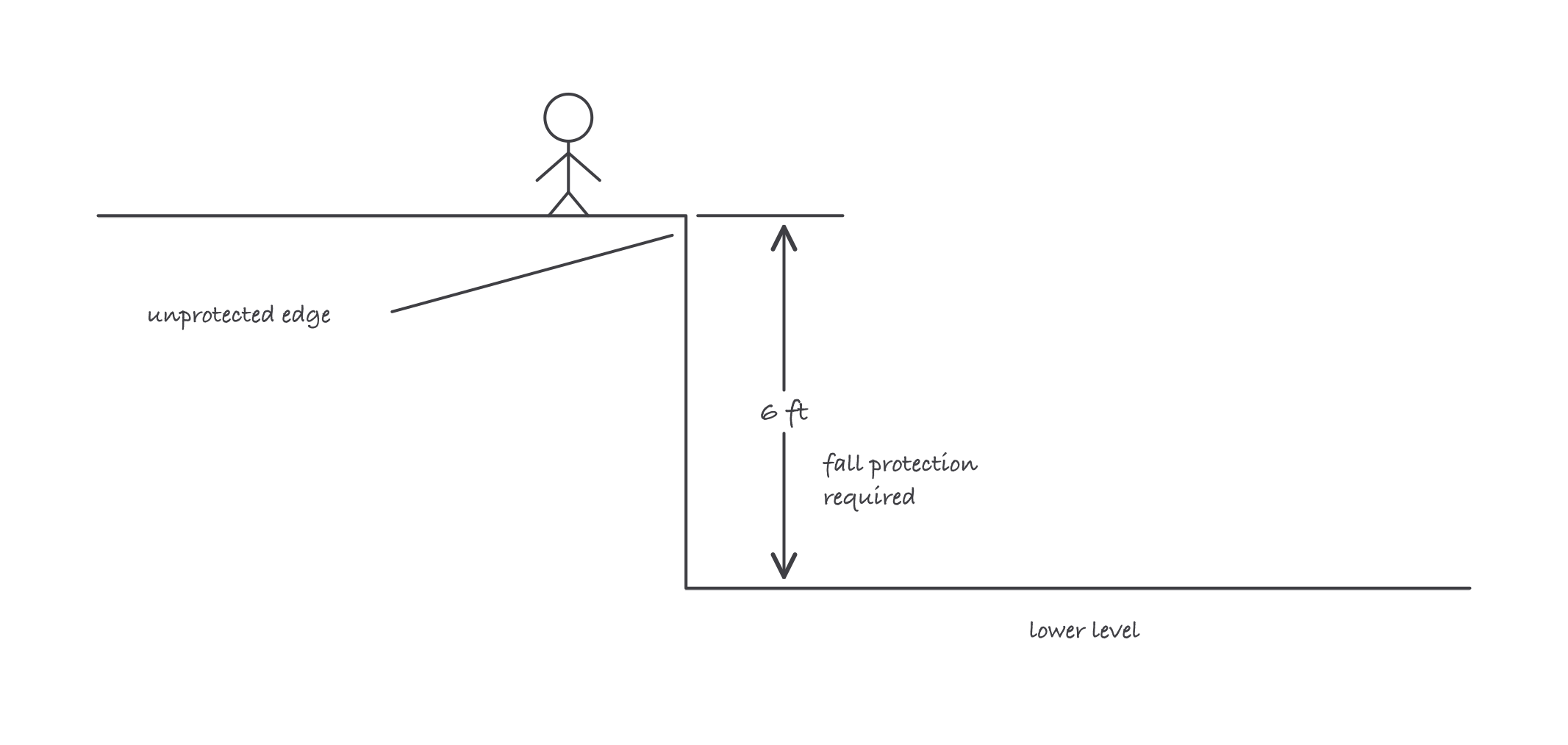
The general construction trigger: at 6 ft above a lower level, fall protection is required
Where it bites
- The trigger is not one number. 6 ft general, 10 ft on scaffolds, different rules in steel erection. Working to the wrong rule set is a common and expensive mistake.
- Anchoring at foot level maximizes free fall. The worked example above is the math behind why low tie-off points quietly defeat good equipment.
- A hole cover that is not secured and marked is a trap, not protection. People move unmarked covers.
- A harness without a rescue plan is half a system. Hanging in a harness after an arrested fall restricts circulation within minutes. Someone on site must know how you come down.
- Ladders produce falls below every trigger height. Most ladder incidents come from overreaching, bad angles, and carrying loads up by hand, none of which any threshold number fixes.
Verified requirements
| Where | Expires | Renewal | Continuing education |
|---|---|---|---|
| United States (federal) | Confirm with issuer | Confirm with issuer | Confirm with issuer |
| United States (federal) | Confirm with issuer | Confirm with issuer | Confirm with issuer |
Information comes from issuing-authority sources. Confirm current rules, fees and eligibility with the authority before acting.