Learn · Construction Safety
Employer Duties Under the OSH Act
Part of From the Tools to Safety Professional · step 17 of 24 · next: Injury Recordkeeping (300 Logs)
In learning paths: From the Tools to Safety Professional
Assumes you know: How OSHA Works: Standards, Citations, Inspections
The Occupational Safety and Health Act places the duty squarely on the employer: comply with the standards, and furnish a workplace free from recognized hazards that are causing or likely to cause death or serious harm. Workers have obligations too, but citations, penalties, and abatement orders run to employers. Understanding that assignment of duty explains most of how safety actually operates on a site.
*Learn the Trades is a free study resource. We are not a licensing body, an authorized training provider, or an exam administrator. Reading this page does not award any card, license, or certification. Always verify requirements with the issuing authority linked in the sources.*Why it matters on the job
When you know what your employer owes you, you can tell the difference between a favor and an obligation. Training in a language you understand is not a perk. PPE you did not pay for is not generosity. A workplace where raising a hazard does not cost you your job is not a culture bonus. These are duties, and knowing them changes what you accept quietly.
The specific duties
The standards and the Act spell out a core set:
- Comply with every applicable standard. The trigger heights, inspections, and protections in Part 1926 are employer obligations, not suggestions to crews.
- Provide required training, in a language and vocabulary workers actually understand. Training a Spanish-speaking crew in English satisfies nothing.
- Provide most required PPE at no cost to workers. OSHA’s rules carve out narrow exceptions, ordinary safety-toe footwear and prescription eyewear among them, but the default is employer-paid.
- Designate competent persons where the standards demand them, with real authority attached.
- Keep records and report severe incidents, post the official poster, and give workers access to their own exposure and medical records.
- Not retaliate against workers who raise hazards, file complaints, or talk to inspectors.
The General Duty Clause: covering the gaps
No rulebook can name every hazard. The Act’s answer is the General Duty Clause, the catch-all obligation to keep the workplace free of recognized serious hazards even where no specific standard exists. It is a concept worth understanding precisely, because it is narrower than its reputation.
To sustain a General Duty Clause citation, OSHA must show four elements together:
- A hazard existed to which employees were exposed.
- The hazard was recognized, by the employer directly, or by the employer’s industry through guidance, consensus standards, or plain common knowledge.
- It was causing or likely to cause death or serious physical harm.
- A feasible means of abatement existed to correct it.
All four, or the citation fails. The clause is not a blank check for inspectors, and it is not a loophole for employers either: silence in the standards never means permission.
One site, many employers
Construction complicates the duty because a single site stacks employers. Enforcement policy sorts them by role: the employer who creates a hazard, the one whose workers are exposed to it, the one responsible for correcting it, and the controlling employer running the site. More than one can hold a duty for the same hazard at the same time, which is why a general contractor can be cited for a subcontractor’s trench and the subcontractor cited alongside them.
Worked example: a heat wave and the four elements
A slab crew works a 98 °F week. There is no specific federal heat standard to point to on this site, yet the employer’s duty does not evaporate. Run the four elements:
- Hazard: strenuous work in high heat with no shade, water station, or rest cycle. Workers are exposed all shift.
- Recognized: heat illness is textbook-recognized across the industry, and the employer’s own toolbox-talk materials mention it.
- Serious harm: heat stroke kills construction workers every summer; the severity element is easily met.
- Feasible abatement: water, shade, scheduled rest cycles, and acclimatization for new workers are cheap, known, and widely used.
All four elements stand, so the General Duty Clause reaches the situation despite the missing standard. An employer who waits for a clause number before providing water has misread the Act from the first sentence.
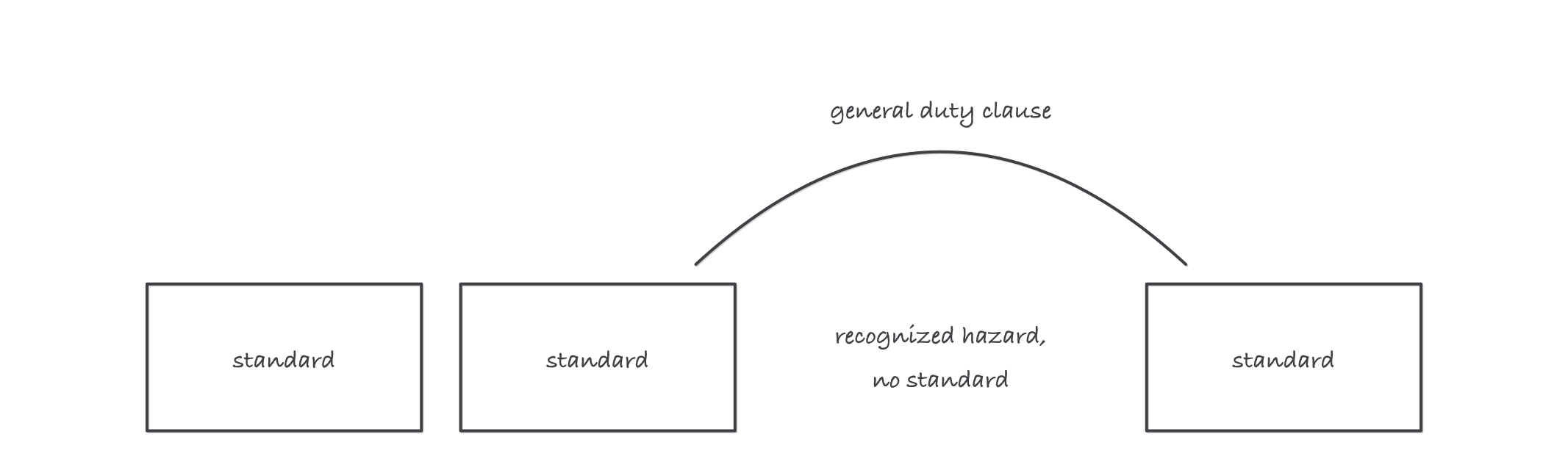
Specific standards cover named hazards; the General Duty Clause spans the gaps between them
Where it bites
- No standard is not no duty. The gap between clauses is exactly where the General Duty Clause lives. Recognized plus serious plus fixable equals obligated.
- The four elements cut both ways. Workers sometimes expect the clause to cover any discomfort; it reaches only recognized, serious, feasibly correctable hazards.
- Employer-paid PPE has narrow exceptions, not loopholes. Everyday footwear is one thing; charging workers for harnesses or respirators is another entirely.
- Multi-employer sites blur nothing. Controlling and creating employers carry duties for hazards their own workers never touch. Pointing at the sub is not a defense.
- The misconduct defense is narrower than foremen think. Blaming a trained worker’s choice only holds where rules existed, were enforced, and the violation was truly unforeseeable. A rule nobody enforced is no rule at all.
Verified requirements
| Where | Expires | Renewal | Continuing education |
|---|---|---|---|
| United States (federal) | Confirm with issuer | Confirm with issuer | Confirm with issuer |
| United States (federal) | Confirm with issuer | 5 years | Confirm with issuer |
Information comes from issuing-authority sources. Confirm current rules, fees and eligibility with the authority before acting.