Learn · Construction Safety
Scaffolding Safety
Part of From the Tools to Safety Professional · step 8 of 24 · next: Silica and Dust Exposure
In learning paths: From the Tools to Safety Professional
Assumes you know: Fall Hazards
A scaffold is a temporary structure you trust with your life before lunch on day one. Scaffold incidents come from three failures: the platform or its support gives way, someone falls from it, or something falls off it onto the people below. All three are prevented by the same discipline: build it to the numbers, inspect it every shift, and never improvise on it.
*Learn the Trades is a free study resource. We are not a licensing body, an authorized training provider, or an exam administrator. Reading this page does not award any card, license, or certification. Always verify requirements with the issuing authority linked in the sources.*Why it matters on the job
Unlike a permanent structure, a scaffold is designed, erected, loaded, modified, and dismantled in weeks, by busy people, on ground that was not prepared for it. Every one of those steps is a chance to quietly remove margin. The rules below exist to keep the margin in place even when the schedule is screaming.
Built for four times the load
The core structural rule: OSHA’s construction standards require each scaffold and every component in it to support its own weight plus at least 4 times the maximum intended load. That factor of 4 is the margin that absorbs everything the design math did not see: a dynamic jolt as material lands on the platform, a leg on soft ground, a slightly bent brace, rust.
The number that drives everything is the maximum intended load: every worker, tool, and stack of material that will be on the scaffold at the worst moment, decided before erection, not discovered after. Loading a scaffold beyond its intended load is not using up spare capacity. It is spending the margin that was protecting you from everything else.
Worked example: sizing the margin
A masonry crew plans a work platform:
- Two workers at about 250 lb each with tools: 500 lb.
- Staged block and mortar: 700 lb.
- Maximum intended load: 500 + 700 = 1,200 lb.
- The scaffold and its components must therefore support their own weight plus 4 × 1,200 = 4,800 lb.
If the crew later stages an extra pallet “just for an hour,” the intended-load figure the whole structure was sized around is fiction.
Falls, planks, and the stuff underneath
The fall trigger on scaffolds is 10 feet, not the general construction 6: above 10 feet, workers on a scaffold need guardrails or personal fall arrest. Platforms are fully planked, with planking and decking rated for the job, no makeshift lumber.
Access is built, not climbed. You reach the platform by ladder, stair tower, or built-in access. Cross-braces are structure, not rungs.
People below are part of the design. Toeboards, screens, or barricaded zones handle everything that rolls or gets kicked off the platform edge.
A competent person inspects the scaffold before each shift and after anything that could affect it: wind, impact, modification. Erecting, moving, or altering a scaffold happens only under that supervision. The five-minute morning inspection is where sunken legs, missing pins, and borrowed planks get caught.
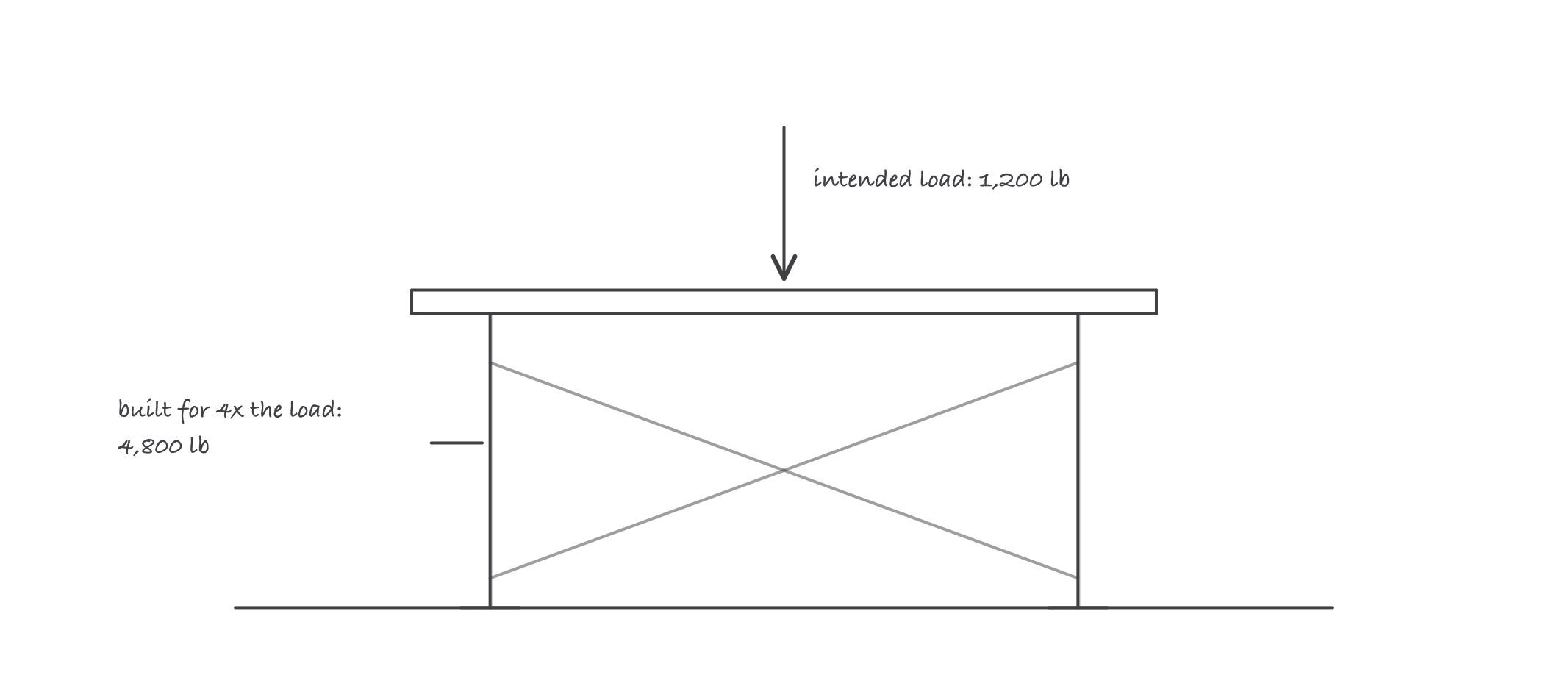
The 4x rule: the structure is sized for four times the worst load you plan to put on it
Where it bites
- Guardrails removed “temporarily” to land material are the classic scaffold fall. If a rail must come out, fall arrest goes on first, and the rail goes back before the task ends.
- Mixing components from different manufacturers can defeat the ratings of both systems. Frames, pins, and braces are engineered as a family.
- Mudsills matter more than anything above them. A perfectly built scaffold on soft or frozen ground settles unevenly, and every load path above follows.
- Rolling scaffolds move with people on them only under strict conditions. Wheels unlocked at the wrong moment turn a work platform into a vehicle with no driver.
Verified requirements
| Where | Expires | Renewal | Continuing education |
|---|---|---|---|
| United States (federal) | Confirm with issuer | Confirm with issuer | Confirm with issuer |
| United States (federal) | Confirm with issuer | 5 years | Confirm with issuer |
Information comes from issuing-authority sources. Confirm current rules, fees and eligibility with the authority before acting.