Learn · Construction Safety
Ladder Safety
Part of From the Tools to Safety Professional · step 12 of 24 · next: Lockout/Tagout on Construction Sites
In learning paths: From the Tools to Safety Professional
Assumes you know: Fall Hazards
A ladder is the most familiar tool on any site, and familiarity is the hazard. Ladder falls happen below every regulatory trigger height, in the ordinary two-second gaps where someone overreaches, skips the angle check, or climbs with full hands. Ladder safety is a handful of physical rules applied every single time, not just when the height looks serious.
*Learn the Trades is a free study resource. We are not a licensing body, an authorized training provider, or an exam administrator. Reading this page does not award any card, license, or certification. Always verify requirements with the issuing authority linked in the sources.*Why it matters on the job
A fall from 8 ft can end a career as surely as a fall from 30 ft, and 8 ft is where most ladder work lives. Nobody rigs a fall arrest system to change a light fixture, which means the ladder itself, its angle, its footing, and how you climb it, is the entire protection system. Set it up wrong and you are freeclimbing a lever that wants to kick out or tip sideways.
The 4-to-1 setup rule
For an extension or straight ladder, the base sits 1 ft away from the wall for every 4 ft of height to the point of support. That angle balances two failure modes: too steep and the ladder tips backward with you on it; too shallow and the base kicks out from under you.
You do not need a tape measure. Stand with your toes at the ladder’s feet and extend your arms straight out: your palms should land on the rung at shoulder height. That stance is the 4-to-1 angle within a degree or two.
Three more setup rules travel with the angle:
- Extend 3 ft above the landing when climbing onto a roof or platform, so you have rails to hold through the step-over.
- Secure it: tie off the top, or have it footed while you do.
- Footing: firm, level, and clear. A ladder base on frozen mud, a scrap of plywood, or a slope is a countdown.
The 3-point climb
Keep three of your four limbs on the ladder at all times: two hands and a foot, or two feet and a hand. That single habit rules out the classic causes of ladder falls:
- Carrying tools by hand. Tools ride in a belt or go up on a hand line. If a load needs a hand, it does not go up a ladder with you.
- Overreaching. Keep your belt buckle between the side rails. Reaching past the rail shifts your weight off the ladder’s base; the ladder stays put and you rotate around it. Climb down and move it.
- Standing on the top step or cap. Stepladders are labeled for a reason: above the marked highest standing level there is nothing left to hold.
Pick the ladder before you climb it: a duty rating that covers you plus your tools, and fiberglass, never aluminum, anywhere near energized lines or equipment.
Worked example: setting up to reach a 16 ft eave
You need to get onto a roof whose eave is 16 ft up.
- Base distance: height to support point divided by 4. 16 ft ÷ 4 = 4 ft out from the wall.
- Rail height: the rails must extend 3 ft above the landing, so the ladder reaches to 16 + 3 = 19 ft up the wall.
- Ladder length: a leaning ladder covers slightly less vertical height than its working length, and extension sections must overlap. A 20 ft ladder is already borderline; you select a 24 ft extension ladder and extend it to suit.
- Check: toes at the feet, arms out, palms on the rung at shoulder height. Tie off the top at the eave before the first full-load climb.
Thirty seconds of arithmetic and stance-checking, and the ladder is now the boring part of the day, which is the goal.
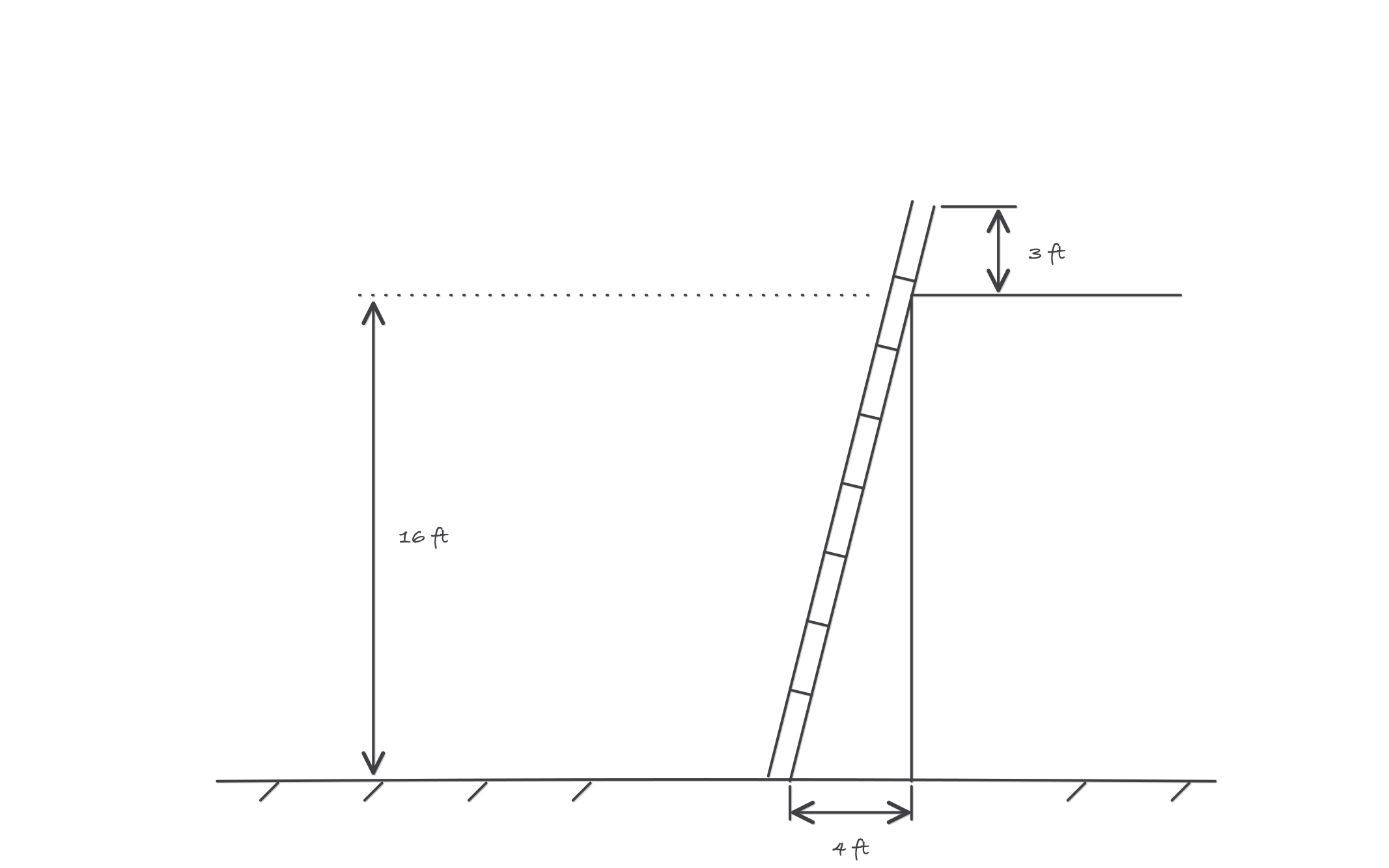
The 4-to-1 rule: 16 ft up means 4 ft out, with 3 ft of rail above the landing
Where it bites
- The angle drifts on repeat setups. The first placement gets the stance check; the fifth gets eyeballed. Kick-out failures come from the lazy afternoon setups.
- The missing 3 ft bites on the way down. Stepping off a roof onto a ladder that ends at the eave means groping for rails that are not there, with your back to the drop.
- The top step is not a step. The label says so, and so does every stepladder tip-over report.
- Aluminum near power is electrocution, not a fall hazard. The focus four overlap: the ladder becomes the conductor.
- Damaged rails and feet disqualify the ladder. A cracked rail or a missing foot pad is a tag-out, not a workaround.
Verified requirements
| Where | Expires | Renewal | Continuing education |
|---|---|---|---|
| United States (federal) | Confirm with issuer | Confirm with issuer | Confirm with issuer |
| United States (federal) | Confirm with issuer | Confirm with issuer | Confirm with issuer |
Information comes from issuing-authority sources. Confirm current rules, fees and eligibility with the authority before acting.