Learn · Construction Safety
Silica and Dust Exposure
Part of From the Tools to Safety Professional · step 9 of 24 · next: Fall Protection Systems
In learning paths: From the Tools to Safety Professional
Every time a blade, bit, or grinder touches concrete, brick, block, stone, or mortar, it releases respirable crystalline silica: dust particles small enough to ride past your nose and throat and lodge deep in the lungs. Silica does its damage over years, not seconds, which makes it the hazard on this list that is easiest to ignore and impossible to undo.
*Learn the Trades is a free study resource. We are not a licensing body, an authorized training provider, or an exam administrator. Reading this page does not award any card, license, or certification. Always verify requirements with the issuing authority linked in the sources.*Why it matters on the job
Silica particles that reach the deep lung do not leave. The lung tissue scars around them, and enough scarring becomes silicosis: progressive, incurable, and still killing tradespeople. Silica exposure also drives lung cancer and COPD. The cruelty of the hazard is its time delay: the cut you make dry today feels like nothing, and the bill arrives in your 50s. Everything about silica safety is about the day the dust was made, because that is the only day you can do anything about it.
The dust you cannot see
The respirable fraction, the particles that matter, is largely invisible. A visible dust cloud means exposure is high, but the absence of a visible cloud does not mean the air is clean. That is why silica is managed by controls and numbers rather than eyeballs. OSHA’s silica standard for construction sets the permissible exposure limit at 50 micrograms of respirable crystalline silica per cubic meter of air, averaged over an 8-hour shift. For scale, that is a few millionths of a gram, spread through a cube of air a meter on each side.
Controls, in order
Silica control follows a strict order, and the respirator is deliberately last:
- Wet methods first. Water delivered at the point of dust generation, the blade, the bit, the grinding wheel, keeps dust from ever becoming airborne. A saw with integrated water feed is the standard example.
- Vacuum capture second. Where water will not work, a shroud around the tool connected to a HEPA-filtered dust extractor collects dust as it is made.
- Respirators last. When engineering controls cannot get exposure under the limit on their own, respiratory protection is added on top of them, never instead of them.
OSHA’s silica rule also lists common construction tasks with pre-approved control setups: run the task exactly as specified, water flow, vacuum airflow, respirator where called for, and the employer does not have to run its own exposure measurements. Housekeeping follows the same logic: wet sweeping or HEPA vacuums, never dry sweeping or compressed air, which just relaunch settled dust.
Worked example: how the 8-hour average works
The exposure limit is a time-weighted average, and the arithmetic shows why “just a quick dry cut” adds up.
- You spend 4 hours on a task exposing you to 100 µg/m³, twice the limit.
- The other 4 hours you are in clean air at 0 µg/m³.
- Average over 8 hours: (4 × 100 + 4 × 0) ÷ 8 = 50 µg/m³, exactly at the limit.
Half a day of doubled exposure eats the entire day’s allowance. A full shift of dry cutting can run at many times these numbers, which is why the wet saw is not optional equipment.
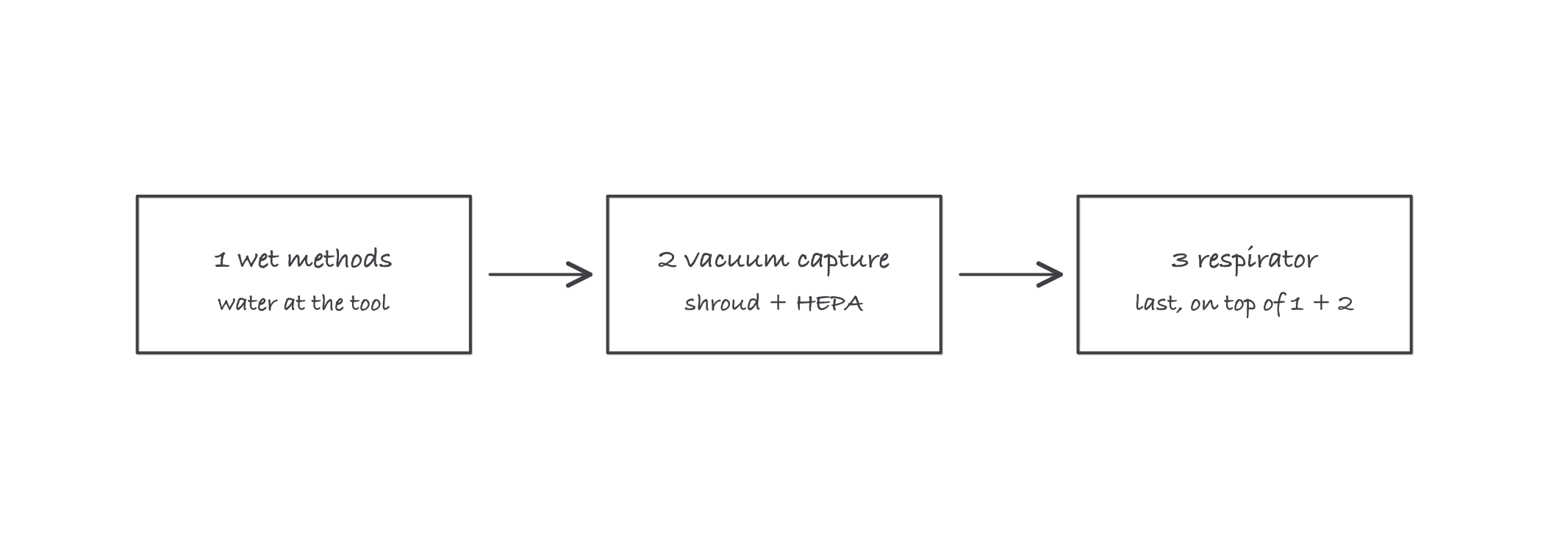
The escalation that protects your lungs: water at the tool, then vacuum capture, and a respirator only on top of those
Where it bites
- Dry cutting because the water setup is a hassle is the classic trade. Two minutes of convenience against lung tissue that never heals.
- The bystander gets dosed too. The laborer sweeping behind a dry-cutting saw crew may breathe more silica than the sawyer. Controls protect the area, not just the operator.
- A respirator on a stubbled face is decoration. Tight-fitting respirators seal against skin, which is why fit testing and shaving requirements exist.
- Not all dust is silica, but plenty is. Concrete, block, brick, mortar, tile, granite: if the tool is eating masonry, assume silica until you know otherwise.
Verified requirements
| Where | Expires | Renewal | Continuing education |
|---|---|---|---|
| United States (federal) | Confirm with issuer | Confirm with issuer | Confirm with issuer |
| United States (federal) | Confirm with issuer | 5 years | Confirm with issuer |
Information comes from issuing-authority sources. Confirm current rules, fees and eligibility with the authority before acting.