Learn · Construction Safety
Fall Protection Systems
Part of From the Tools to Safety Professional · step 10 of 24 · next: HazCom and GHS
In learning paths: From the Tools to Safety Professional
Assumes you know: Fall Hazards
Every fall protection system is an answer to one question: what happens at the moment someone reaches the edge. The best systems make that moment impossible. The rest catch what they failed to prevent. You already know the trigger heights from the fall hazards lesson; this one is about choosing and assembling the system itself.
*Learn the Trades is a free study resource. We are not a licensing body, an authorized training provider, or an exam administrator. Reading this page does not award any card, license, or certification. Always verify requirements with the issuing authority linked in the sources.*Why it matters on the job
Most fall protection failures are not equipment failures. They are system design failures: the right harness clipped to the wrong anchor, a lanyard too long for the drop, an anchor so far to the side that the fall becomes a pendulum into a column. The gear does exactly what it was built to do. The system fails because nobody did the math.
The hierarchy: eliminate, guard, restrain, arrest
Work through the options in order, and stop at the first one that fits the task.
Eliminate the exposure: build the assembly on the ground and crane it up, or sequence the work so nobody goes near the edge.
Guard the edge: guardrail systems, secured and marked hole covers, safety nets. These are passive, they protect everyone behind them with no decisions required.
Restrain the worker: a travel restraint system, an anchor and a fixed-length connector sized so you physically cannot reach the edge. The fall never starts.
Arrest the fall: a personal fall arrest system that catches you mid-drop. This is the last resort because it only works if every component, every dimension, and the rescue plan are all right.
Each step down the list shifts the burden from the system to the worker. That is why the order is not a preference, it is the design method.
The ABC of fall arrest
A personal fall arrest system has three parts, and it is only as good as its weakest one.
Anchorage: the tie-off point. It must be capable of supporting the loads OSHA’s construction standards set for arrest anchors, or be designed by a qualified person as part of an engineered system. A guess is not an anchor. Rebar, a guardrail, or a conduit run are not anchors.
Body harness: full-body only, with the D-ring centered between the shoulder blades so an arrested body hangs upright. Body belts are not allowed for arrest.
Connector: the link between the two, a shock-absorbing lanyard or a self-retracting lifeline. The connector sets your free-fall distance, which sets your clearance requirement.
Swing fall and clearance
Two dimensions kill arrest systems on paper before anyone falls.
Clearance is the vertical space the catch consumes: free fall, plus shock absorber deployment, plus your body below the D-ring, plus a safety margin. The fall hazards lesson worked this math: a 6 ft lanyard anchored at foot level needs about 17.5 ft below the anchor. If the drop is shorter than the catch, the system is decoration.
Swing fall is what happens when you work to the side of your anchor. Fall, and you pendulum back under the anchor point, striking whatever is in the arc at nearly the speed of a straight drop from the same height. Keep the anchor overhead, or limit how far you can drift from it.
Worked example: restraint that makes the fall impossible
You are inspecting equipment mounted on a flat roof, 15 ft in from the edge, no guardrails. Choose restraint, not arrest.
- Anchor point: 20 ft back from the edge.
- Restraint lanyard: fixed 12 ft, non-shock-absorbing.
- Your maximum reach from the anchor: 12 ft of lanyard plus roughly 3 ft of body and arm reach, about 15 ft.
Maximum reach 15 ft, edge at 20 ft: you stop 5 ft short of the edge no matter what you trip over. No clearance math, no swing fall, no rescue plan needed, because the fall cannot start. That is the hierarchy doing its job.
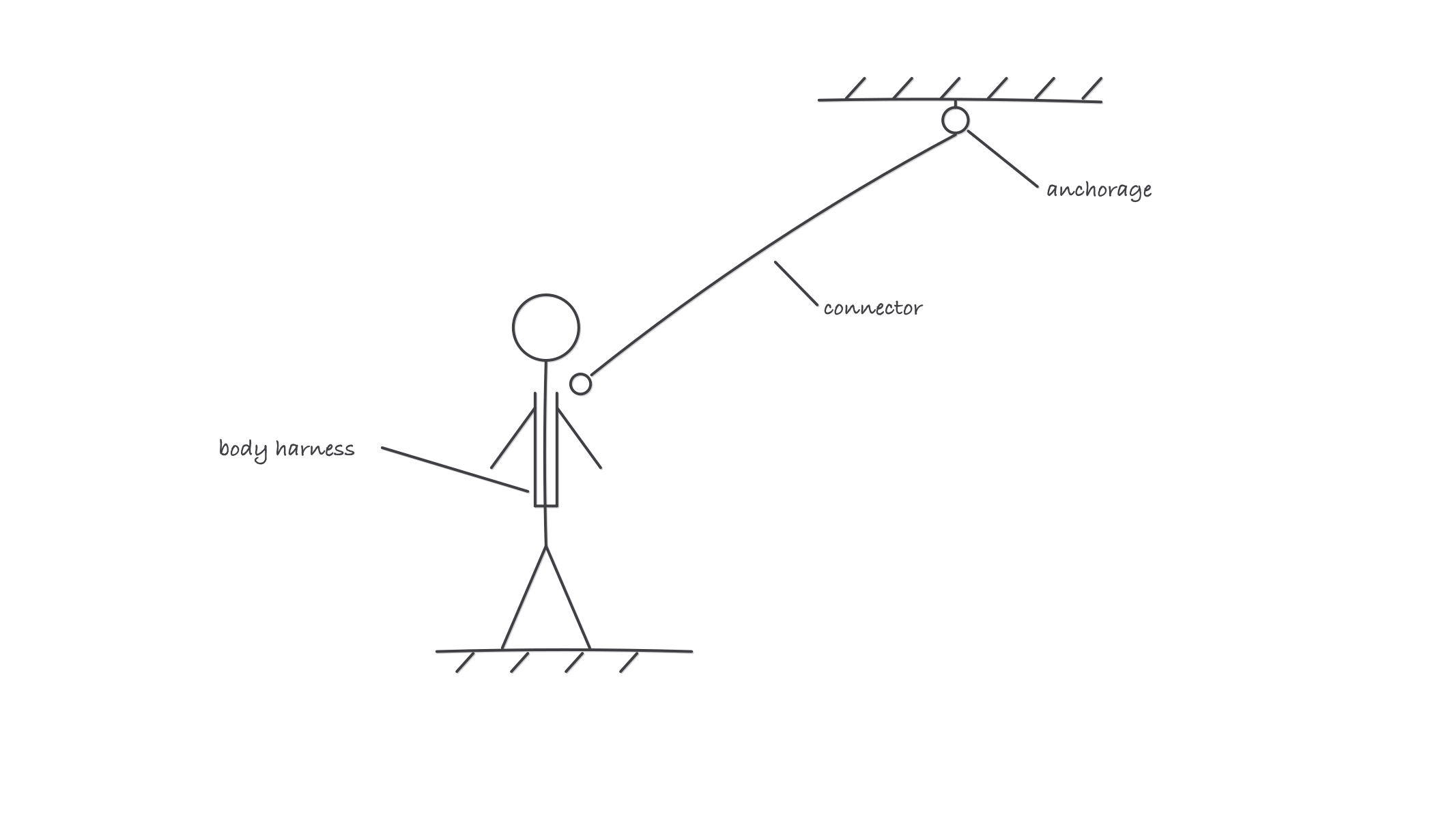
The ABC of fall arrest: anchorage, body harness, connector, each one load-bearing
Where it bites
- Swing fall is the forgotten dimension. Crews check the drop below and never the arc to the side. The pendulum hits scaffolding, steel, and parked equipment.
- Anchors get guessed. A connector rated for thousands of pounds clipped to a bar joist nobody evaluated is a system rated at whatever the joist felt like that day.
- Restraint gear drifts into arrest service. A non-shock-absorbing restraint lanyard used at an edge becomes an arrest system with no energy absorber. Label and separate the gear.
- Self-retracting lifelines near edges have their own rules. A fall over a leading edge loads the line across the edge itself; that calls for equipment rated for it.
- Arrest without rescue is half a plan. Suspension in a harness turns dangerous in minutes. Before anyone ties off, someone must be able to say how a hanging worker comes down.
Verified requirements
| Where | Expires | Renewal | Continuing education |
|---|---|---|---|
| United States (federal) | Confirm with issuer | Confirm with issuer | Confirm with issuer |
| United States (federal) | Confirm with issuer | 5 years | Confirm with issuer |
Information comes from issuing-authority sources. Confirm current rules, fees and eligibility with the authority before acting.