Learn · Construction Safety
The Competent Person Requirement
Part of From the Tools to Safety Professional · step 16 of 24 · next: Employer Duties Under the OSH Act
In learning paths: From the Tools to Safety Professional
Assumes you know: How OSHA Works: Standards, Citations, Inspections
A competent person, in OSHA’s construction standards, is defined by two things held at once: the capability to identify existing and predictable hazards in the work, and the authorization to take prompt corrective measures to eliminate them. Both halves are load-bearing. Knowledge without authority is a bystander; authority without knowledge is a rubber stamp. The definition only functions when one person carries both.
*Learn the Trades is a free study resource. We are not a licensing body, an authorized training provider, or an exam administrator. Reading this page does not award any card, license, or certification. Always verify requirements with the issuing authority linked in the sources.*Why it matters on the job
The competent person is the standards’ answer to a hard problem: rules on paper cannot inspect a trench after last night’s rain or judge whether today’s scaffold modification changed the load path. So the standards delegate. At the moments where conditions change faster than any rulebook, they require a designated human on site with the judgment to spot trouble and the power to stop it. If you work construction long enough, you will either rely on a competent person daily or be designated as one.
The two-part definition, slowly
Part one: capable of identifying hazards. Not just hazards present now, but predictable ones, the trench wall that will slough when the sun hits it, the scaffold tie that tomorrow’s masonry lift will need. Capability comes from training plus experience with the specific work. No card or course automatically confers it; the definition is about what the person can actually do.
Part two: authorized to correct them promptly. The person must have standing, given by the employer, to stop work, order people out, and commit resources to a fix without phoning three layers up for permission. This is the half organizations fumble. A safety-minded foreman who must ask the project manager before pulling a crew from a trench fails the definition at the exact moment it matters.
Designated. The employer names the competent person for a given activity. It is a role assigned for specific work, not a rank, and a site typically has different competent persons for different subjects: one for excavations, one for scaffolds, one for fall protection.
Where the standards demand one
The phrase appears throughout Part 1926, and each appearance attaches duties to it. The pattern to remember: wherever conditions evolve and judgment calls are required, a competent person owns the call. The classic examples:
- Excavations: daily inspections, and again after rain or anything else that changes soil conditions.
- Scaffolds: oversight of erection, alteration, and inspection before each shift.
- Fall protection: key roles in inspecting systems and, where plans substitute for conventional protection, administering them.
The neighboring term qualified person is different: someone who, by degree, certificate, or extensive experience, can solve problems relating to the work, the one who designs and calculates. The competent person watches and corrects; the qualified person engineers. One individual can be both, but the roles answer different questions.
Worked example: the rainstorm that tested both halves
A crew is laying pipe in a 7 ft trench with a trench box. Overnight, a storm drops an inch of rain. The designated competent person arrives before the crew.
- Capability at work: she inspects and finds water pooled at the base and new tension cracks in the spoil-side wall, a predictable sign the wall may move against the box or above it.
- Authority at work: she holds the crew out of the trench, orders the water pumped down, and calls for the box to be reset deeper before entry. The schedule slips half a day. She does not ask permission, because her designation means she does not have to.
- The counterfactual: same person, same findings, but a superintendent who overrules her and sends the crew in. At that moment the employer has no competent person on that excavation, whatever the paperwork says, because part two of the definition failed.
The definition is a test you can apply to any site: who here can spot it, and can that same person stop it.
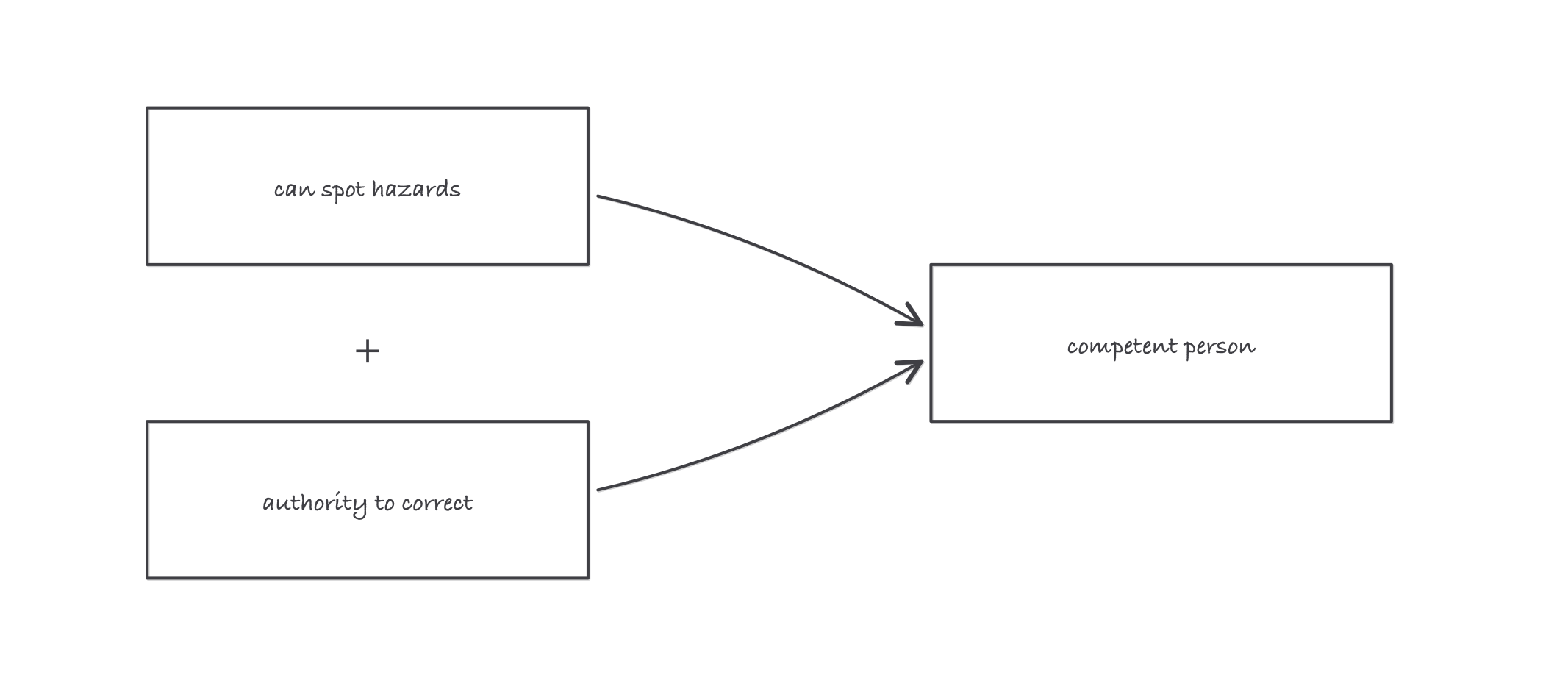
Both halves or neither: capability and authority meet in one designated person
Where it bites
- The paper designation. A name written on the site plan whose stop-work calls get overruled is not a competent person, and inspectors probe for exactly this by asking who can halt work and when they last did.
- Card confusion. A 30 hour awareness card, or any course, does not by itself make anyone competent for a specific activity. Capability is demonstrated against the actual work.
- One title, many subjects. Competent for scaffolds does not mean competent for excavations. The designation attaches to the activity.
- Competent versus qualified. Mixing these up on a design question puts judgment where engineering belongs, and vice versa.
- Prompt means prompt. Corrective measures that wait for the Monday meeting fail the definition. The authority exists so the fix can happen now.
Verified requirements
| Where | Expires | Renewal | Continuing education |
|---|---|---|---|
| United States (federal) | Confirm with issuer | Confirm with issuer | Confirm with issuer |
| United States (federal) | Confirm with issuer | 5 years | Confirm with issuer |
Information comes from issuing-authority sources. Confirm current rules, fees and eligibility with the authority before acting.