Learn · Construction Safety
Lockout/Tagout on Construction Sites
Part of From the Tools to Safety Professional · step 13 of 24 · next: PPE Selection
In learning paths: From the Tools to Safety Professional
Assumes you know: Electrocution Hazards on Site
Lockout/tagout is the discipline of making a machine or circuit not just off, but incapable of coming back on while someone is inside it. The lock is not a formality: it is a personal claim, hung by the one person whose hands are in the equipment, removable by that person alone. On a construction site, with multiple trades sharing equipment and power, that personal claim is the whole system.
*Learn the Trades is a free study resource. We are not a licensing body, an authorized training provider, or an exam administrator. Reading this page does not award any card, license, or certification. Always verify requirements with the issuing authority linked in the sources.*Why it matters on the job
The workers hurt by unexpected energization are almost never the ones who flipped the switch. They are the ones downstream: the electrician in the panel when a helper resets the breaker, the mechanic in the fan housing when someone restores power to test something else. Construction multiplies the danger because crews change daily, several employers share the same disconnects, and temporary power gets rearranged constantly. The fix is procedural, and it is personal: one exposed worker, one lock, one key.
Who locks, whose lock
Three rules carry the entire program:
- Every exposed worker hangs their own lock. Not the foreman’s lock on behalf of the crew, not one lock for three people. If your body is in the danger zone, your lock is on the isolation point.
- Only the person who hung a lock removes it. Nobody removes another worker’s lock as a favor, at shift end, or because the schedule slipped. Employers have a formal exception process for a worker who left site; it is deliberately slow and documented.
- One energy source can carry many locks. A multi-lock hasp lets six workers lock a single disconnect. On larger jobs a group lockbox holds the isolation keys, and each worker locks the box.
A tag without a lock is a request. Tags alone are a last resort where a device physically cannot accept a lock, and they demand extra measures precisely because paper stops nobody.
The sequence: isolate, lock and tag, verify dead
- Identify every energy source. Electrical is the obvious one; stored energy is the sneaky one: capacitors, charged hydraulic lines, compressed springs, suspended loads, pressurized pipe.
- Notify and shut down. Tell affected crews, then shut the equipment down by its normal controls.
- Isolate. Open the disconnect, close the valve, block the cylinder. Isolation happens at the energy source, not at a control button.
- Lock and tag. Your lock on the isolation device, your name on the tag.
- Release stored energy. Bleed pressure, discharge capacitors, block anything gravity wants to move.
- Verify dead. Try the start button with everyone clear. For electrical work, test the conductors with a meter you proved on a known live source before and after: live, dead, live. A meter with a dead battery reads zero volts on everything.
Verification is the step that separates lockout from hope. The lock proves who is exposed; the test proves the isolation actually worked, because breakers get mislabeled and disconnects feed the wrong thing more often than anyone admits.
Worked example: two trades, one fan motor
An electrician and an HVAC tech replace a roof exhaust fan motor fed from a disconnect 40 ft away.
- Both walk to the disconnect and open it.
- Electrician hangs a hasp, then her lock and tag. The HVAC tech adds his own lock to the same hasp. Two exposed workers, two locks.
- At the fan, they press the local start control: nothing.
- The electrician tests her meter on a known live circuit, tests the motor leads dead, then re-proves the meter live. Live, dead, live.
- Work proceeds. The HVAC tech finishes his rigging first and removes his lock, and only his. The electrician’s lock holds the disconnect open until her hands are out and her lock comes off.
Nobody had to trust anybody’s memory, radio call, or good intentions. The hardware enforced it.
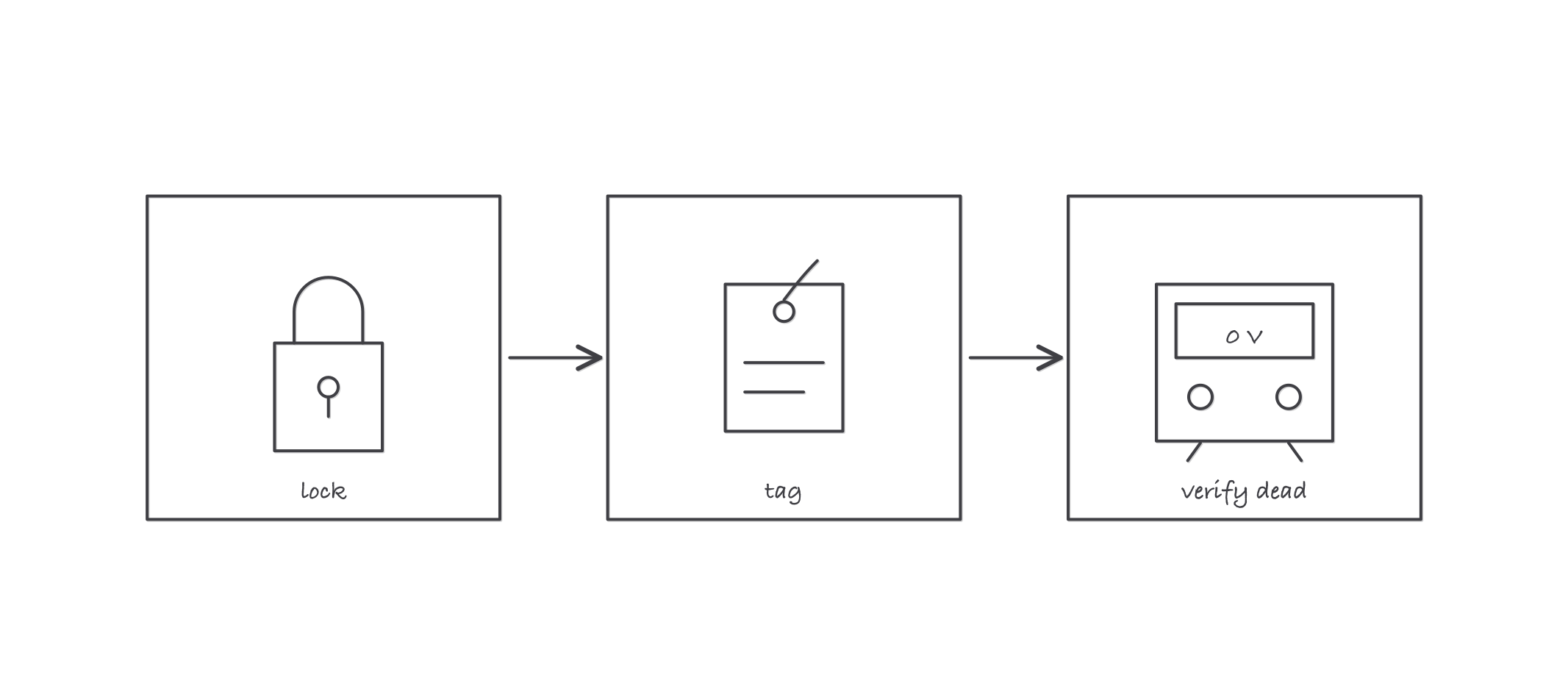
The sequence that counts: lock it, tag it, then prove it dead before hands go in
Where it bites
- The borrowed lock. One lock covering a crew means the last person out is protected by nothing when the first person out takes the lock. One worker, one lock.
- Stored energy after electrical isolation. The disconnect is open and the spring-loaded damper still takes off a finger. Walk every energy type, not just the wire.
- Verification skipped on the label’s word. Panel schedules lie. The live-dead-live test exists because zero on a meter must itself be proven.
- Shift change is the classic gap. Continuity procedures, an overlapping handoff of locks, exist because equipment sitting quietly unlocked between shifts invites a reset.
- Off is not isolated. A stop button, a pendant, or a software interlock can be overridden from places you cannot see. Isolation happens at the source.
Verified requirements
| Where | Expires | Renewal | Continuing education |
|---|---|---|---|
| United States (federal) | Confirm with issuer | Confirm with issuer | Confirm with issuer |
| United States (federal) | Confirm with issuer | 5 years | Confirm with issuer |
Information comes from issuing-authority sources. Confirm current rules, fees and eligibility with the authority before acting.