Learn · Water and Wastewater
Water Treatment: Source to Tap
Part of Water Operator, Certified · step 1 of 23 · next: Coagulation and Flocculation
In learning paths: Water Operator, Certified
Water treatment is a chain of barriers. Raw water from a river, lake, or well passes through a series of stages, and each stage removes something the next stage cannot handle. By the time the water reaches the tap it has been coagulated, settled, filtered, and disinfected, and no single stage did the whole job.
Why it matters on the job
As an operator you will spend your career adjusting one stage at a time, but every adjustment ripples downstream. A poor coagulant dose shows up hours later as a filter that clogs early. A filter problem shows up as a disinfection problem, because particles shield microorganisms from chlorine. Learn the train as one connected system first, and every later lesson in this group slots into place.
The treatment train
Source and intake. Surface water (rivers, lakes, reservoirs) arrives carrying silt, algae, organic matter, and microorganisms, and its quality changes with the weather. Groundwater from wells is usually clearer and more stable, so many groundwater plants can skip stages that surface water plants cannot. The intake screens out fish, sticks, and trash before the water enters the plant.
Coagulation and flocculation. The fine particles that make water cloudy are too small and too light to settle on their own. A coagulant chemical destabilizes them, and gentle mixing gathers them into larger clumps called floc that are heavy enough to remove. This is the chemistry stage, and the next lesson covers it in depth.
Sedimentation. The water flows slowly through a large basin called a clarifier, and the floc sinks to the bottom as sludge. Most of the particle load leaves the water here, not at the filters.
Filtration. The clarified water passes down through beds of granular media, typically sand and anthracite coal, which trap the particles that escaped settling. Filtration is the last physical barrier for particles.
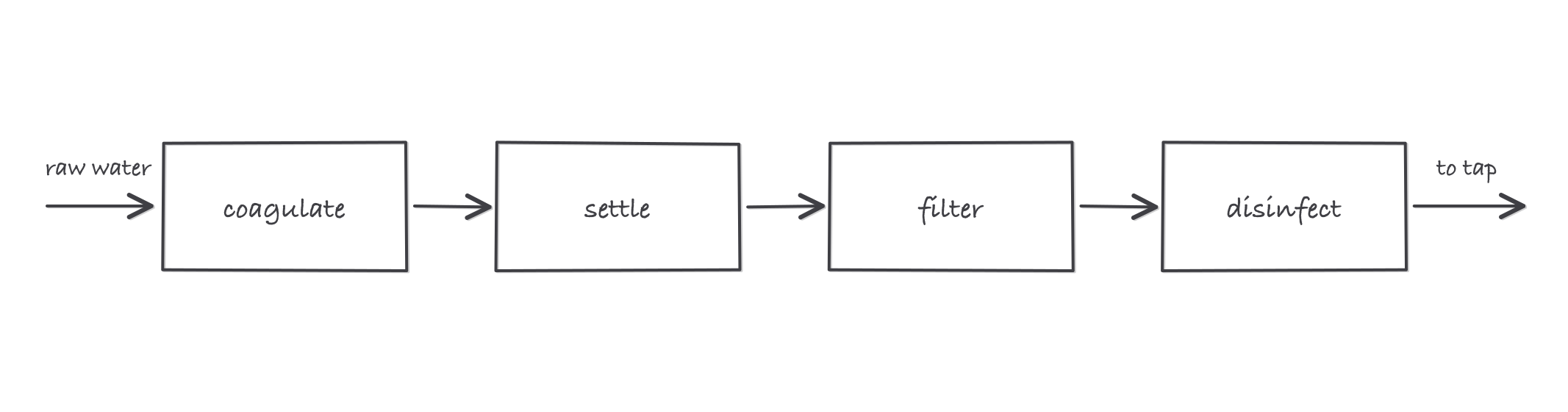
Each stage removes what the next one cannot: chemistry, then gravity, then media, then chlorine
Disinfection. Chlorine or an alternative disinfectant inactivates the microorganisms that made it this far, and a chlorine residual rides out into the distribution system to protect the water on its way to the customer.
Storage and distribution. Treated water is held in clearwells and tanks, then pumped through the distribution system. Treatment and distribution are typically certified as separate operator tracks, so know which side of that line your job sits on.
Worked example: follow the water
Trace one gallon through a conventional surface water plant.
- River water enters the intake carrying fine clay that will not settle by itself.
- In the rapid mix basin, a coagulant dose neutralizes the particles in seconds. In the flocculation basin, slow paddles spend tens of minutes building floc.
- In the clarifier, the floc settles out over several hours of detention time and is drawn off as sludge.
- The filters catch the remaining particles, dropping turbidity to a small fraction of what arrived.
- Chlorine contact inactivates pathogens, and the gallon leaves the clearwell with a free chlorine residual still protecting it in the pipes.
Gravity, chemistry, and contact time did the work. Pumps only moved the water between stages.
Where it bites
- Every stage protects the one after it. Operators who chase a filter problem at the filter often find the real cause upstream at the coagulant feed. Diagnose the train, not the stage.
- Groundwater is not “already clean.” It skips some barriers only when the source assessment says it can, and some wells need treatment for dissolved contaminants that surface plants rarely see.
- Water treatment and wastewater treatment are different tracks. Federal employment statistics group both under one job title, but the certifications, exams, and chemistry are separate ladders. This group of lessons is the drinking water side.