Qualifications · Water and Wastewater
Operator Certification: The Mandatory Ladder
Part of Water Operator, Certified · step 15 of 23 · next: Grade Exams: What Each Level Tests
In learning paths: Water Operator, Certified
Operator certification is the water industry’s career ladder: a sequence of state-issued certificates, each earned by exam plus documented experience, that decides what size and kind of system you are allowed to be responsible for. Every US state runs a program. On the drinking water side that is not a coincidence: federal law forces it.
*Learn the Trades is a free study resource. We are not a licensing body, an authorized training provider, or an exam administrator. Reading this page does not award any card, license, or certification. Always verify requirements with the issuing authority linked in the sources.*Why it matters on the job
Your grade is your job description. It sets which systems can put you in responsible charge, which shifts you can run without someone above you, and what you are worth at hiring time. Moving up the ladder is how pay rises in this trade, and the ladder is the same shape everywhere even though the labels change state to state.
Where the mandate comes from
The 1996 Amendments to the Safe Drinking Water Act added Section 1419, which required EPA to set minimum standards for certifying the operators of community and nontransient noncommunity water systems. EPA published its final guidelines in 1999, and the enforcement lever is financial: a state without a compliant program forfeits 20 percent of its Drinking Water State Revolving Fund grant. No state leaves that money on the table, so all of them certify.
Wastewater certification has no SDWA equivalent: states require it under their own laws. From the operator’s chair the programs look the same: a graded ladder with exams, experience requirements, and renewal.
How the ladder works
The pattern repeats in every state:
- Systems are classified by size and complexity, from a small well-and-tank system up to a large surface water plant.
- Certificates come in grades that mirror the system classes. The higher the grade, the larger and more complex the system you may be responsible for.
- Each rung takes an exam and experience. You qualify for the next exam with time in the field (and often education), pass it, then serve at that level while the clock runs toward the rung above.
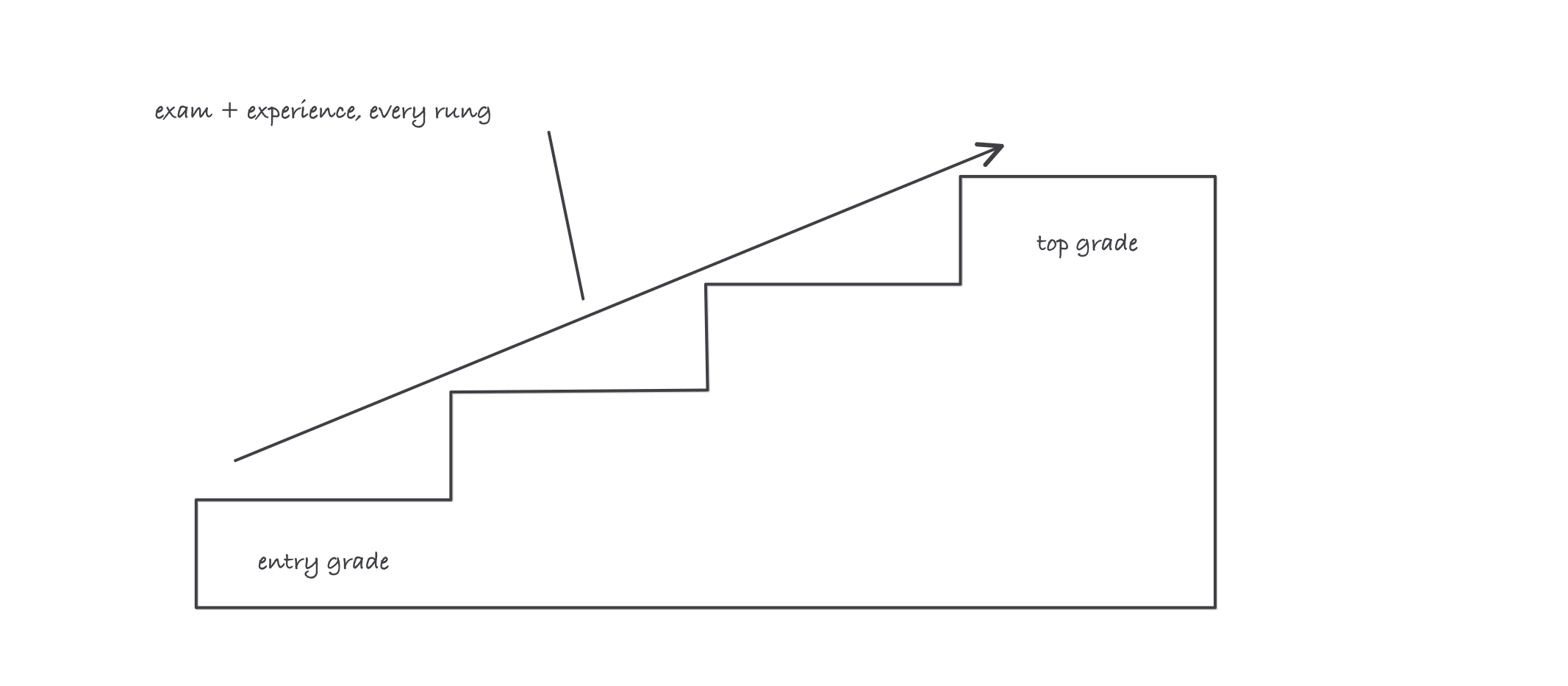
The pattern every state follows: each rung is an exam plus experience, and higher rungs unlock bigger systems
One more split matters from day one: treatment and distribution are usually separate ladders on the drinking water side, and treatment and collection are separate on the wastewater side. A treatment certificate does not make you the responsible operator for the pipes, or the reverse.
The labels change at the state line
WPI (formerly ABC), the organization behind most states’ standardized exams, numbers its exam classes I through IV. California grades T1 to T5 and D1 to D5. Texas runs Class D up to Class A, with A on top. New York uses different vocabularies for water and wastewater. The ladder concept is national; the names are not, and the lesson on state grade patterns maps them.
Where it bites
- “Certification” reads as optional. It is not. The state certificate is legally required to operate; voluntary industry credentials like WPI’s Professional Operator designation sit on top of it, never in place of it.
- “Water operator” is ambiguous. Ask which ladder: treatment or distribution, water or wastewater. A T3 treatment operator cannot legally cover a distribution post that needs a D3.
- Operator-in-Training is not a national rung. Some states define OIT grades with real requirements; in others it is only a job title. Check your own program before you put it on a resume.
- Moving states means requalifying. Reciprocity is a state-by-state decision, never automatic. The certification-by-state lesson covers what actually transfers.
Exam relevance
Every rung of this ladder is gated by an exam, and the rest of this subject group exists to get you through them: what each grade’s exam tests, who writes the questions, and how your state runs the process.
Verified requirements
| Where | Expires | Renewal | Continuing education |
|---|---|---|---|
| California | Yes | Confirm with issuer | Continuing education required for renewal; approved-provider list and acceptable technical and safety topics published by DWOCP |
| California | Yes | Confirm with issuer | Confirm with issuer |
| Texas | Yes | 3 years | 30 hours of continuing education per 3-year term, including at least 2 hours of approved resiliency training (required for all water operators since April 1, 2024, under Senate Bill 3 after Winter Storm Uri). Class A and B operators may not count the Basic Water course for renewal credit. |
| New York | Yes | 5 years | Renewal training contact hours per 5-year cycle scale with grade: Grade 1/1A 20 hours, Grade 2/2A 40 hours, Grade 3/3A 60 hours, Grade 4/4A 80 hours |
| New York | Yes | Confirm with issuer | Confirm with issuer |
Information comes from issuing-authority sources. Confirm current rules, fees and eligibility with the authority before acting.