Learn · Water and Wastewater
Coagulation and Flocculation
Part of Water Operator, Certified · step 2 of 23 · next: Sedimentation and Filtration
In learning paths: Water Operator, Certified
Assumes you know: Water Treatment: Source to Tap
Coagulation is chemical destabilization: a coagulant cancels the electrical charge that keeps fine particles apart. Flocculation is the gathering that follows: gentle mixing bumps the destabilized particles into each other until they grow into floc heavy enough to settle. Two steps, one goal: turn particles that would float in the water for days into clumps that sink in hours.
Why it matters on the job
Nothing downstream can rescue bad coagulation. If the dose or the mixing is wrong, the clarifier passes cloudy water, the filters clog early, and turbidity climbs at the very point you are trying to drive it down. Operators adjust the coagulant feed daily, sometimes hourly, because raw water quality changes with every storm.
Why the particles will not settle on their own
The clay, silt, and organic particles that make water turbid are colloidal: so small that gravity barely acts on them. Worse, they carry a negative surface charge, so they repel each other and never combine into anything bigger. Left alone, they stay suspended more or less forever.
A coagulant (most commonly an aluminum or iron salt such as alum or ferric chloride) carries strong positive charge. Dosed into the water, it neutralizes the particles’ negative charge, and the repulsion that kept them apart disappears.
Two kinds of mixing, in the right order
Rapid mix comes first and lasts seconds. The coagulant must reach every particle almost instantly, because the coagulation reactions happen fast. A rapid mix basin or an in-line mixer blasts the chemical through the full flow with high energy.
Flocculation comes second and takes tens of minutes. Slow-turning paddles roll the water over so destabilized particles collide and stick, building floc from pinpoint specks into visible, fluffy clumps. The mixing energy here is deliberately low: stir too hard at this stage and you shear apart the floc you spent all that time building.
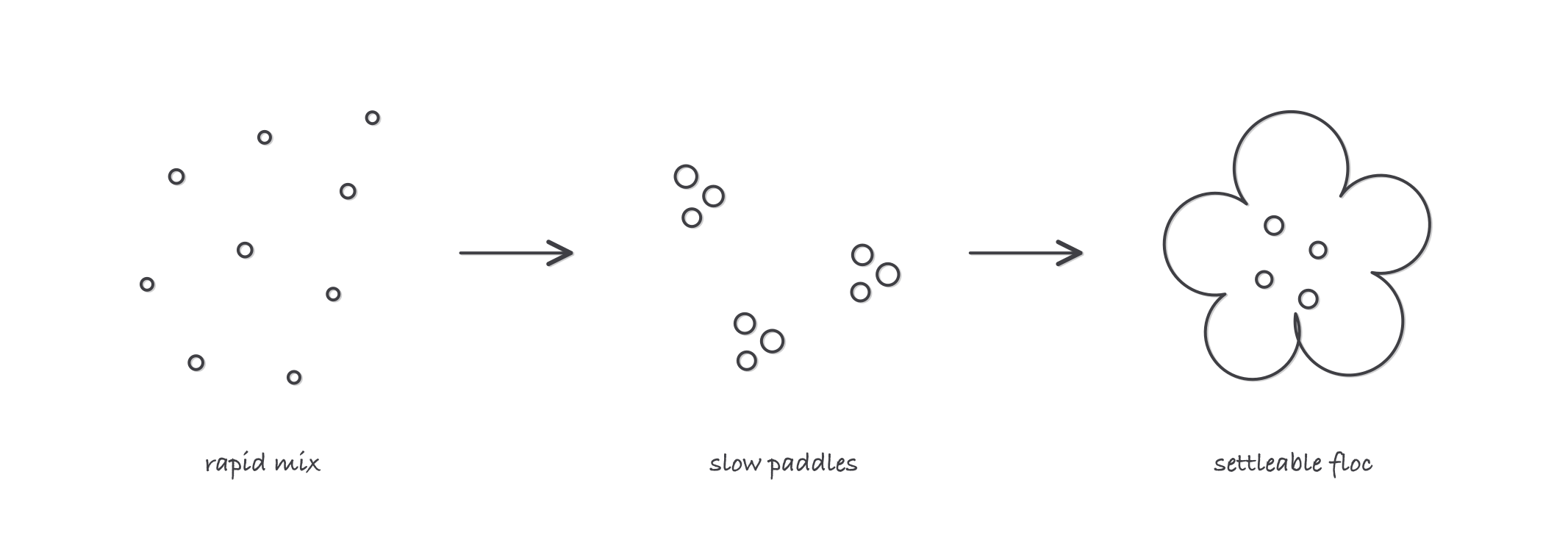
Hard mixing spreads the chemical in seconds; soft mixing grows the floc over tens of minutes
Energy goes down as size goes up. That inverse relationship is the whole design of the two basins.
Worked example: from jar test to feed rate
The dose is not calculated from theory. It is found by a jar test: several jars of today’s raw water are stirred with a range of coagulant doses, and the jar that produces the best-settling floc with the lowest dose wins.
Suppose the jar test picks 20 mg/L of alum, and the plant is treating 3 MGD (million gallons per day). The chemical feed in pounds per day uses the pound formula:
lbs/day = flow (MGD) × dose (mg/L) × 8.34
lbs/day = 3 × 20 × 8.34 = 500.4 lbs of alum per day
The 8.34 is the weight of a gallon of water in pounds. The Operator Math lesson drills this formula; here the point is that a bench test on a quart of water sets a feed rate measured in hundreds of pounds.
Where it bites
- More coagulant is not better. Overdosing recharges the particles positively and restabilizes them, and the water goes cloudy again with the chemical bill still rising. The jar test finds the optimum, not the maximum.
- Mixing order is fixed. High energy at the floc stage shears floc; low energy at the dosing stage leaves pockets of water untreated. Fast then slow, always.
- Cold water coagulates sluggishly. The same dose that worked in September can underperform in January, and pH shifts change coagulant behavior too. When raw water changes, jar test again rather than trusting last month’s number.
- Pinpoint floc that will not grow usually means the dose is wrong or the rapid mix is not dispersing it, not that the flocculators need more speed.