Qualifications · Water and Wastewater
Very Small Water Systems Certification
Part of Water Operator, Certified · step 23 of 23
In learning paths: Water Operator, Certified
Assumes you know: Operator Certification: The Mandatory Ladder
A well, a pump, a tank, and a few dozen service connections is still a public water system, and federal rules pull it under certified operation exactly as they do a city plant. Very small water system certification is the entry-scale path built for exactly this case: the mobile home park, the rural district, the school on its own well.
*Learn the Trades is a free study resource. We are not a licensing body, an authorized training provider, or an exam administrator. Reading this page does not award any card, license, or certification. Always verify requirements with the issuing authority linked in the sources.*Why it matters on the job
Small systems vastly outnumber big plants, and they are where many operators start: often part time, often alongside another job like maintenance or grounds. If you run one, or want the certificate that lets someone put you in charge of one, this is the rung built for you.
Why tiny systems still need certified operators
EPA’s operator certification guidelines, the federal floor every state program stands on, apply to community water systems and nontransient noncommunity systems regardless of size. A campground with its own well serving the same staff and students every day is inside the rule. The logic is blunt: the people drinking from a 50-connection system deserve the same safe water as a city.
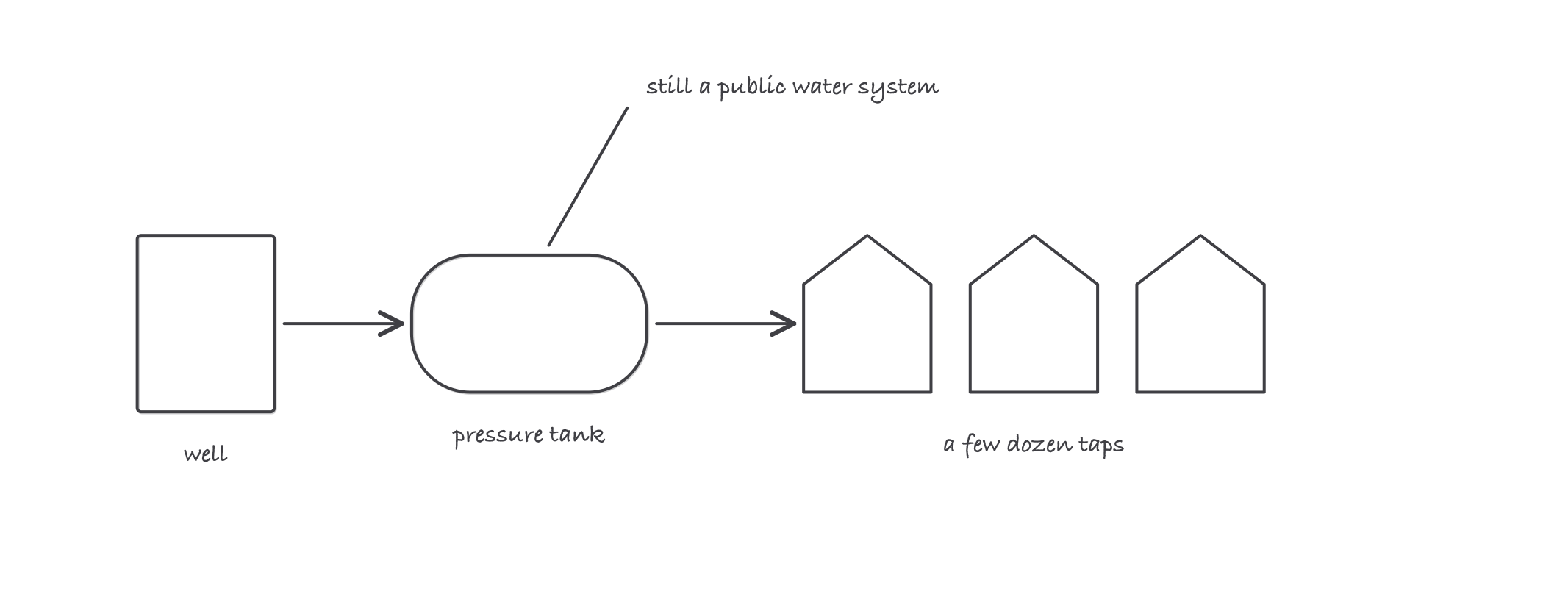
No clarifiers, no filter gallery, no control room: this is the whole system, and the law still wants a certified operator running it
The VSWS exam
WPI’s ABC Testing catalog includes a Very Small Water System exam alongside its four main series. It covers the operating knowledge this scale of system actually demands: source and well operation, disinfection, pressure tanks, sampling, and the recordkeeping that keeps a small system compliant, without the large-plant process depth of the treatment series.
Whether that exam is your path depends, as always, on your state. Some states administer the VSWS exam as their small-system entry grade; others fold small systems into the bottom rung of their regular ladder or run their own small-system tier. Your state program’s page tells you which certificate a given small system requires, and how its operator qualifies.
The rung above
A VSWS-level certificate is scoped to very small systems. The moment your career points at larger systems, treatment plants, or distribution networks, you are back on the main ladder from the operator certification lesson: higher grades, the four main exam series, and experience requirements that your small-system time may partly satisfy. Ask your state program how small-system experience counts before assuming it does.
Where it bites
- Scope is the trap. The small-system certificate qualifies you for small systems, not for the next size up. Check your state’s system classifications before accepting responsibility for a system that grew past your grade.
- “Very small” is your state’s definition. Population and connection cutoffs for system classes are set by each state program. Never assume another state’s threshold, and never guess: look the system’s classification up.
- Part-time does not mean optional. A system too small to employ a full-time operator still must have a certified operator in responsible charge. That is often exactly the contract role a new VSWS certificate holder fills.
Exam relevance
The VSWS exam sits in the same WPI machinery as the main series: standardized, criteria-based, administered by your state. Study the fundamentals lessons in this trade (disinfection, operator math, sampling) at entry depth, and get the exam logistics from your state’s candidate materials.
Verified requirements
| Where | Expires | Renewal | Continuing education |
|---|---|---|---|
| California | Yes | Confirm with issuer | Continuing education required for renewal; approved-provider list and acceptable technical and safety topics published by DWOCP |
| Texas | Yes | 3 years | 30 hours of continuing education per 3-year term, including at least 2 hours of approved resiliency training (required for all water operators since April 1, 2024, under Senate Bill 3 after Winter Storm Uri). Class A and B operators may not count the Basic Water course for renewal credit. |
| New York | Yes | Confirm with issuer | Confirm with issuer |
Information comes from issuing-authority sources. Confirm current rules, fees and eligibility with the authority before acting.