Learn · Water and Wastewater
Distribution and Collection Systems
Part of Water Operator, Certified · step 13 of 23 · next: Confined Space Entry
In learning paths: Water Operator, Certified
Assumes you know: Pumps and Hydraulics
Half of this trade is buried. Distribution is the pressurized network that carries finished drinking water from the plant to every tap; collection is the mostly-gravity network that brings wastewater back. The plant lessons taught you what happens at each end. This one is about the pipes in between, and the two different physics they run on.
Why it matters on the job
System operator jobs are their own certification track (distribution on the water side, collection on the wastewater side), and at small utilities one crew runs both. Main breaks, low-pressure complaints, sewer backups, and lift station alarms are the daily work, and every one of them is solved with the hydraulics you learned in the pumps lesson, applied underground.
The water side: pressure everywhere, always
A distribution system has one non-negotiable job: keep every point in the network pressurized, all the time. Pressure is what pushes water to the tap, and it is also the system’s immune defense: water leaking out of a pressurized pipe is a nuisance, but groundwater leaking into a depressurized pipe is a contamination event.
Elevated tanks and standpipes do most of the work. The height of the water surface sets the pressure below it: every 2.31 feet of elevation is 1 psi. Pumps fill the tanks; the tanks float on the system, supplying pressure through peaks and power cuts. That is why water towers exist: they are pressure, stored.
The rest of the water-side craft follows from stagnation and friction. Mains are looped where possible, so water keeps moving and reaches users from two directions. Dead-end mains collect stale water and sediment, so they get flushed through hydrants on a schedule. Valves are exercised so they will actually close the day a main breaks.
Worked example: reading pressure off the tank
A standpipe’s water surface sits 231 ft above a customer’s meter. Static pressure at the meter:
231 ft ÷ 2.31 ft/psi = 100 psi
A second customer on a hill has a meter 60 ft higher, so the water column above them is 231 − 60 = 171 ft:
171 ft ÷ 2.31 ft/psi = 74.0 psi
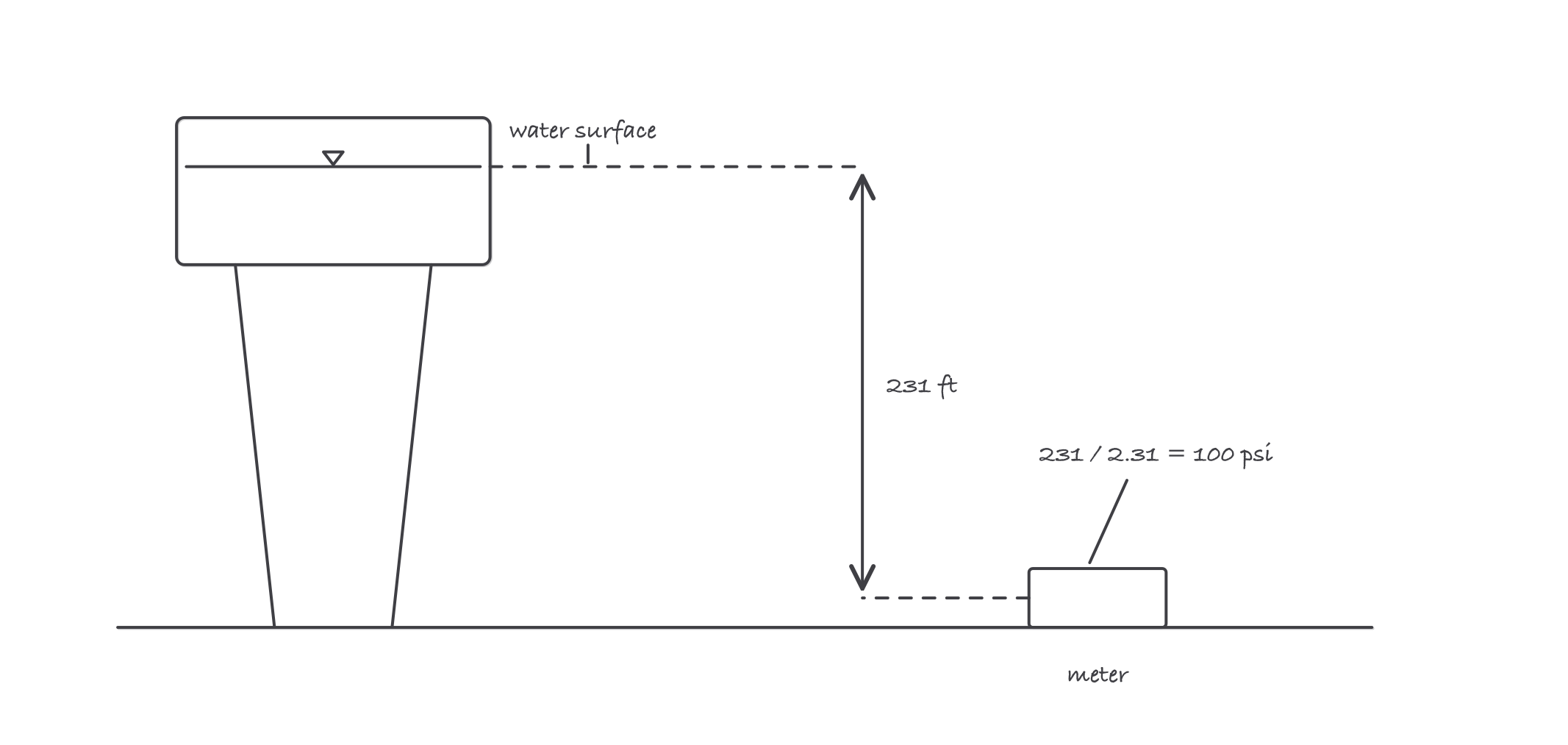
The tank’s water surface sets the pressure: divide the height difference in feet by 2.31 and you have psi
Both numbers are static, meaning no flow. Open a big demand (a hydrant, a main break) and friction loss subtracts from them, which is why pressure complaints spike when flow does.
The sewer side: gravity, with help
Collection systems run the opposite physics. Sewers are laid on a continuous downhill slope so wastewater flows by gravity, partly full, with air above the flow, from every building lateral into progressively larger mains. Manholes give access at junctions and changes of grade.
Gravity eventually runs out: the pipe gets too deep, or the ground rises. There a lift station takes over: a wet well collects the flow, pumps lift it through a pressurized force main to a higher point, and gravity resumes. Lift stations are where collection systems fail loudest, so level controls, alarms, and standby pumps get obsessive attention.
The quiet enemy is clean water. Infiltration (groundwater seeping through joints and cracks) and inflow (stormwater entering through illegal connections and leaky manhole covers), together called I&I, can multiply the flow reaching the plant in wet weather, stealing capacity the treatment process needs.
Where it bites
- Static and residual pressure are different numbers. A gauge on a dead system tells you elevation math; a gauge under flow tells you elevation math minus friction. Diagnose complaints with both.
- A force main is not a gravity main. Between a lift station and its discharge point the sewer is under pump pressure. Cutting into one like a gravity line is a serious injury risk. Know which kind of pipe you are opening.
- Manholes and wet wells are confined spaces. Sewer atmospheres kill operators, and OSHA treats these entries as permit work. The confined space entry lesson is the survival half of this one.
- Backups are not always blockages. Wet-weather surcharging from I&I can push flow up laterals with nothing stuck anywhere. Check the weather before you rod the line.
Exam relevance
Distribution and collection have their own exam series, and their math is exactly this lesson’s kind: elevation-to-pressure conversions with 2.31 ft/psi, flow and velocity in mains, and wet well pumping rates. Expect the concepts too: looping, flushing, I&I, and why force mains and gravity mains are treated differently.