Learn · Water and Wastewater
Wastewater Treatment Overview
Part of Water Operator, Certified · step 6 of 23 · next: Preliminary and Primary Treatment
In learning paths: Water Operator, Certified
A wastewater plant does on purpose, in hours, what a river would do on its own in weeks: it lets biology consume the waste, then separates the biology from the water. Everything in the plant either feeds that central act or cleans up after it, and the flow splits into two trains you must track separately: the water moving through, and the solids pulled out of it.
Why it matters on the job
Every downstream lesson in this group is one stage of this train in close-up. Operators who hold the whole map can trace any symptom (a smell, a cloudy effluent, a rising blanket in a clarifier) to the stage that caused it, which is usually not the stage where it showed up.
The liquid train
Collection. Sewers and lift stations deliver raw wastewater to the plant. What arrives is mostly water carrying organics, solids, grit, and whatever else the community put down the drain.
Preliminary treatment. Bar screens catch rags and debris; a grit channel drops out sand and gravel. Nothing is treated yet; the plant is protecting its own pumps and tanks.
Primary treatment. A primary clarifier slows the flow so settleable solids sink and floatables rise to be skimmed. This is physics only, but it removes a large share of the incoming solids and a meaningful part of the organic load.
Secondary treatment. The biological heart. Microorganisms in an aerated basin eat the dissolved and suspended organics, then a secondary clarifier settles the microorganisms out so clear water leaves without them. Activated sludge, the most common version, gets its own lesson.
Disinfection and discharge. The treated effluent is disinfected, commonly with chlorine (then often dechlorinated) or UV, and released through an outfall under the plant’s discharge permit.
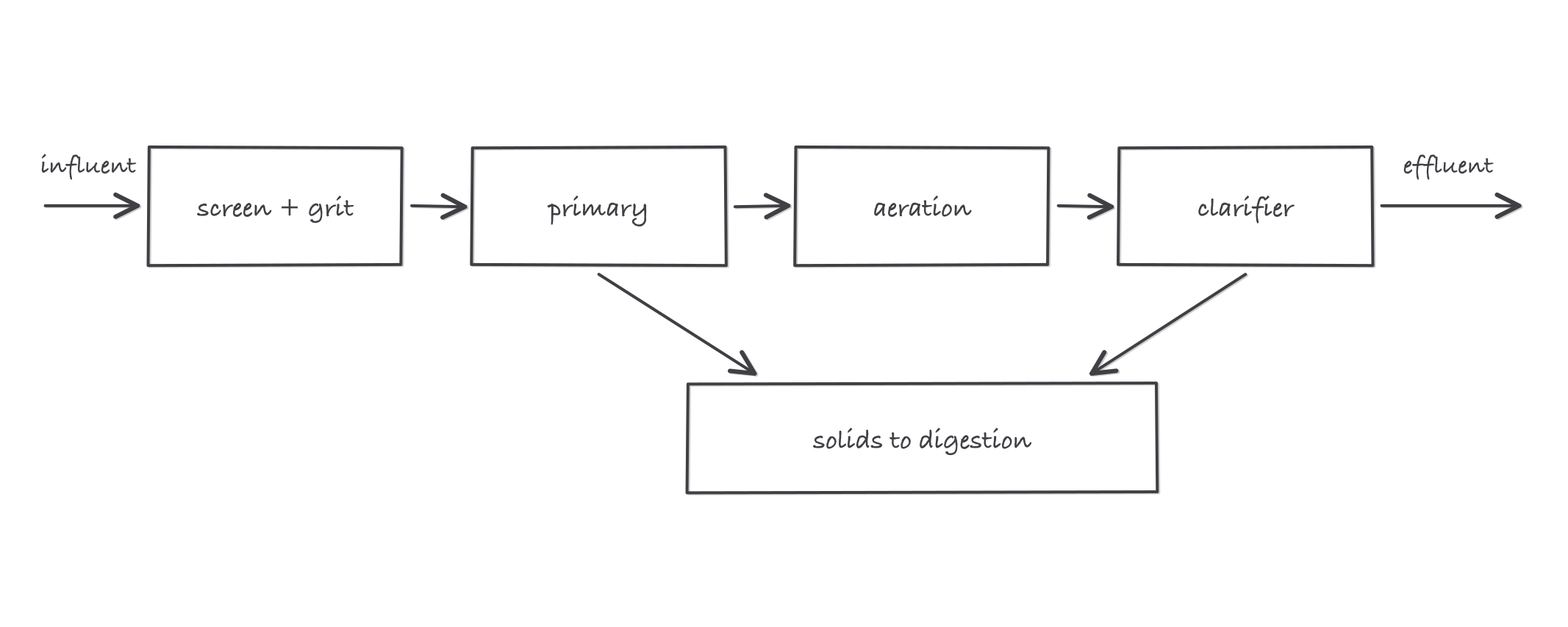
One train flows through the plant; the other drops out of it: water moves left to right, solids fall to digestion
The solids train
Primary sludge from the primary clarifiers and waste sludge from the biological process leave the liquid train and enter their own: thickening, digestion, and dewatering, covered in the solids handling lesson. Roughly speaking, the liquid train’s job is to move contamination out of the water and into the solids train; the solids train’s job is to stabilize it and shrink it until it can leave the plant as biosolids.
The number the plant lives by: BOD
BOD (biochemical oxygen demand) measures the organic strength of wastewater: how much oxygen microorganisms consume while eating what is in it. Strong waste has high BOD; clean water has almost none. The standard test runs five days in the lab and is written BOD5. Treatment performance is judged by how much BOD and TSS (suspended solids) the plant removes.
Worked example: percent removal
Influent BOD5 arrives at 200 mg/L. The final effluent leaves at 20 mg/L.
Percent removal = (in − out) ÷ in × 100
Percent removal = (200 − 20) ÷ 200 × 100 = 180 ÷ 200 × 100 = 90%
The same formula scores TSS removal, individual stages, and the plant as a whole. Discharge permits commonly set both a concentration limit and a percent-removal requirement, so this calculation appears on operator exams and monthly reports alike.
Where it bites
- Sanitary, storm, and combined sewers are different systems. A sanitary sewer carries wastewater only; a storm sewer carries runoff only; a combined sewer carries both and can overflow in wet weather. Which kind feeds your plant decides how hard rain hits your process.
- Treatment does not sterilize. Effluent is treated and disinfected, not drinkable. The permit defines “clean enough,” and the receiving water is part of that definition.
- The two trains are coupled. Solids problems become liquid problems: a failing digester sends its liquid back to the head of the plant, and a clarifier holding sludge too long sends it over the weir. When the effluent goes bad, check the solids side too.
- Wastewater and drinking water are separate certification tracks. Same employer sometimes, different exams, different chemistry. This group is the wastewater side.