Learn · Water and Wastewater
Solids Handling and Digestion
Part of Water Operator, Certified · step 9 of 23 · next: Effluent Limits and NPDES Permits
In learning paths: Water Operator, Certified
Assumes you know: Activated Sludge
Solids handling is a shrinking operation. The sludge a plant pulls from its clarifiers is almost entirely water: a stream of 1 percent solids is 99 percent water you are paying to pump, store, and haul. Thickening, digestion, and dewatering exist to take water out and biology down, until what began as tank-loads of liquid leaves the plant as truck-loads of stabilized biosolids.
Why it matters on the job
Every gallon of water you fail to remove early rides through every downstream step at full cost. Solids handling is also where the plant’s most serious hazards live (digester gas is flammable; enclosed solids buildings concentrate toxic gases), and where a senior operator’s process sense shows: digesters reward patient, steady operation and punish shock.
Thickening: the cheap water removal
Thickening concentrates sludge by gravity or flotation before anything else happens to it. A gravity thickener is a small, deep clarifier where sludge settles and compacts; dissolved air flotation floats it instead, using fine bubbles. Either way the goal is the same: cut the volume before the expensive processes.
Worked example: what concentration does to volume
The solids mass does not change when you thicken; only the water leaves. So concentration times volume stays constant:
V1 × C1 = V2 × C2
A plant wastes 10,000 gallons per day of sludge at 1% solids, and the thickener brings it to 4%:
V2 = (10,000 × 1) ÷ 4 = 2,500 gallons per day
Later, dewatering takes the digested sludge to a 20% cake:
V2 = (2,500 × 4) ÷ 20 = 500 gallons-equivalent per day
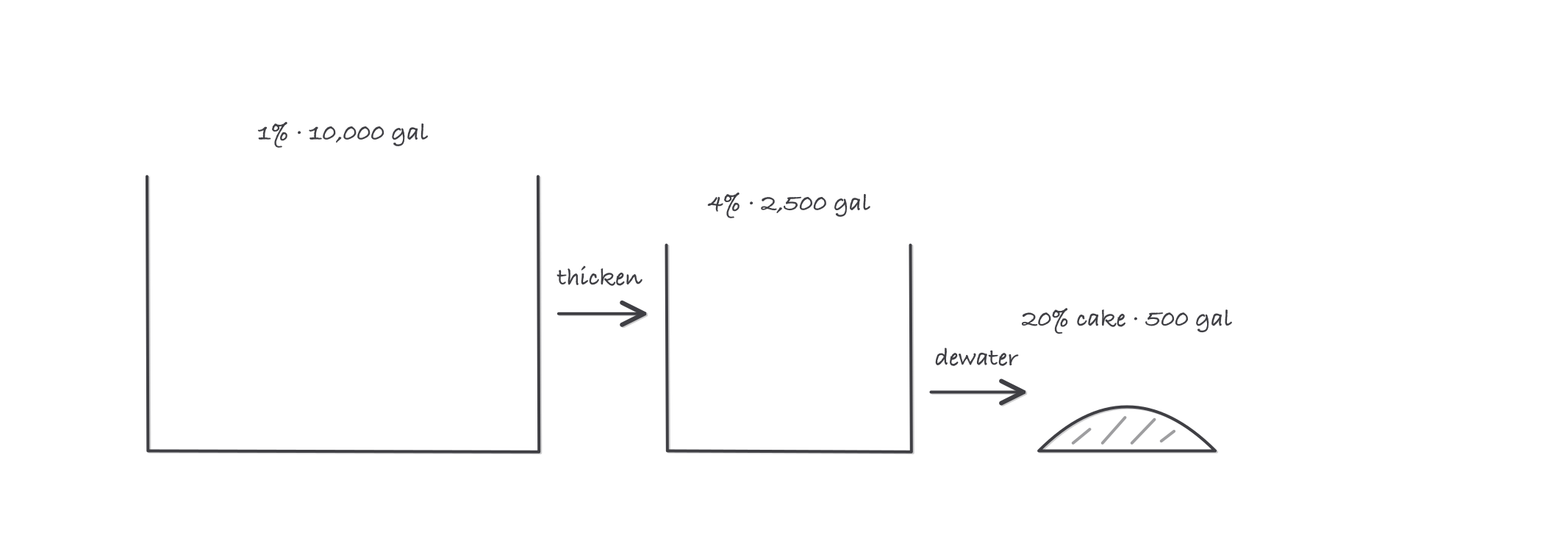
The solids never change; the water leaves: every jump in percent is a matching cut in volume
From 10,000 gallons to the equivalent of 500: a 20-fold reduction, and the same pounds of solids are in both. This one relationship (double the concentration, halve the volume) runs the whole solids train, and it is a fixture of certification math.
Digestion: stabilizing the solids
Raw sludge is biologically active: it rots, stinks, and carries pathogens. Digestion lets controlled biology consume the volatile (organic) fraction so what remains is stable.
Anaerobic digestion, the classic at larger plants, works without oxygen in closed, heated tanks. Over weeks, bacteria break down volatile solids and produce digester gas, roughly two-thirds methane, which many plants burn for heat or power. The process runs as a partnership between acid-forming bacteria and methane-forming bacteria, and the methane formers are the delicate ones: they dislike temperature swings, pH drops, and slug loads. Feed a digester steadily and watch its temperature, pH, and gas production; sudden changes in any of them are the process asking for help.
Aerobic digestion, common at smaller plants, blows air into open tanks and lets the organisms consume themselves once the food runs out. It is easier to operate, produces no usable gas, and pays for that simplicity in blower power.
Dewatering and where the solids go
Digested sludge is still a liquid. Dewatering (belt presses, centrifuges, screw presses, or drying beds at small plants) turns it into a damp cake that handles like wet soil. Polymer conditioning makes the water release, and the right polymer dose comes from bench testing on your sludge, not from the drum label.
What leaves the plant is biosolids, and federal rule 40 CFR Part 503 sets two quality classes. Class A biosolids are treated to reduce pathogens to below detection and can be used with few restrictions, including bagged products the public buys. Class B biosolids still contain reduced but detectable pathogens and are land-applied under site restrictions and waiting periods. The class is earned by the treatment process and proven by testing.
Where it bites
- Class A and Class B biosolids have nothing to do with operator license classes. A Class C operator can produce Class B biosolids; the vocabularies are unrelated. Exams and job postings both trip people on this.
- Digester gas is a serious hazard. Methane is explosive in the right mix with air, and hydrogen sulfide in solids areas is toxic at low concentrations. Solids buildings and digester galleries are where gas monitors earn their keep.
- The digester eats on a schedule, not on yours. Slug feeds, cold feed sludge, or aggressive withdrawals sour anaerobic digesters, and recovery takes weeks, not hours.
- Sidestreams come back. The water removed by thickening and dewatering returns to the head of the plant carrying concentrated ammonia and solids. A poorly timed pressing run can hit the liquid train like an extra customer.
- Grit that reached the digester stays there, displacing capacity year after year. The cure is upstream, at the grit channel, which is why preliminary treatment is a solids-handling topic in disguise.